
WSJ (“Trump orders leak probe after venting about media coverage of munitions stockpile“):
President Trump has ordered new investigations into the disclosures of the Pentagon’s munitions stockpile, administration officials said, an escalation of his effort to battle damaging revelations about the Iran war.
Trump made the demand after weeks of media headlines describing depleted munitions levels associated with the war, according to administration officials, despite administration assurances that the U.S. has what it needs to fight Tehran and world powers such as Russia and China. The president’s frustration with the war has grown, advisers say, as he sees few good options to force Iran into dismantling its nuclear program or more broadly bringing an end to the conflict.
The White House has maintained that the U.S. had enough munitions for any operation, but at the same time threatened anyone leaking information on the issue.
“The United States has the most powerful military in the history of the world, with more than enough firepower to carry out any operation the President orders at any time and place,” said Karoline Leavitt, the White House press secretary. “Anyone entrusted with access to classified military information who leaks it to the media is betraying that trust and breaking federal law, and should be prosecuted to the fullest extent of the law. President Trump is committed to enforcing that law without exception.”
When asked Thursday about munitions levels at the White House, Trump told reporters that some munitions were more available than others, adding “we always want more.” The U.S. was “in very good shape,” he said. “We have literally massive amounts of ammunition.”
If someone is giving reporters specific numbers of weapons remaining in the stockpile, information classified at the SECRET level in most cases, they should absolutely face the consequences. But the fact that certain systems are “exquisite”—meaning very expensive and hard to replace—is not classified. We’ve known for quite a long time that we have a problem and have been very slow to rebuild our capacity. And the Russia-Ukraine war and our current operation in Iran have highlighted a related problem: shooting down $40,000 drones that can be mass manufactured with $4 million interceptors that can’t is a losing game.
The first mention here of the problem, at least in relation to this (then-potential) conflict,* was my February 24 post, “Joint Chiefs Chairman Cautious About Iran Fight.” It quotes a WaPo report (“Trump’s top general foresees acute risks in an attack on Iran“) which begins,
As the Trump administration weighs an attack on Iran, the Pentagon’s top general has cautioned President Donald Trump and other officials that shortfalls in critical munitions and a lack of support from allies will add significant risk to the operation and to U.S. personnel, according to people familiar with internal discussions.
Gen. Dan Caine, chairman of the Joint Chiefs of Staff, expressed his concerns at a White House meeting last week with Trump and his top aides, these people said, cautioning that any major operation against Iran will face challenges because the U.S. munitions stockpile has been significantly depleted by Washington’s ongoing defense of Israel and support for Ukraine. Caine’s remarks at the White House meeting have not been previously reported. [emphases added]
Once the war kicked off, in my March 1 post “The Ayatollah Is Dead. Now What?” I quote Elliot Cohen: “One may hope (but should not expect) that there are enough precision missiles and interceptors in Israeli and U.S. arsenals to let this war roll on for weeks or longer, and that there are plans for refilling empty bins after some intense fighting.”
The next day, I drill down further in a post titled, “The Logistics of Massive Air Defense.” In it, I quote a WSJ report with the headline “U.S. Races to Accomplish Iran Mission Before Munitions Run Out,” which details concerns about, well, running out of munitions—particularly Patriot and THAAD air defense missiles and Tomahawk cruise missiles. Additionally, I point to an X thread by Kelly Grieco detailing the comparative costs of those systems and Shahed drones and a WSJ editorial by Christian Brose published four days before the war started titled “America Needs a Lot More Weapons.”
Suffice it to say, it’s not the least bit surprising that, five months later, we’re running into issues. And, of course, the president was warned.
Back to today’s WSJ report:
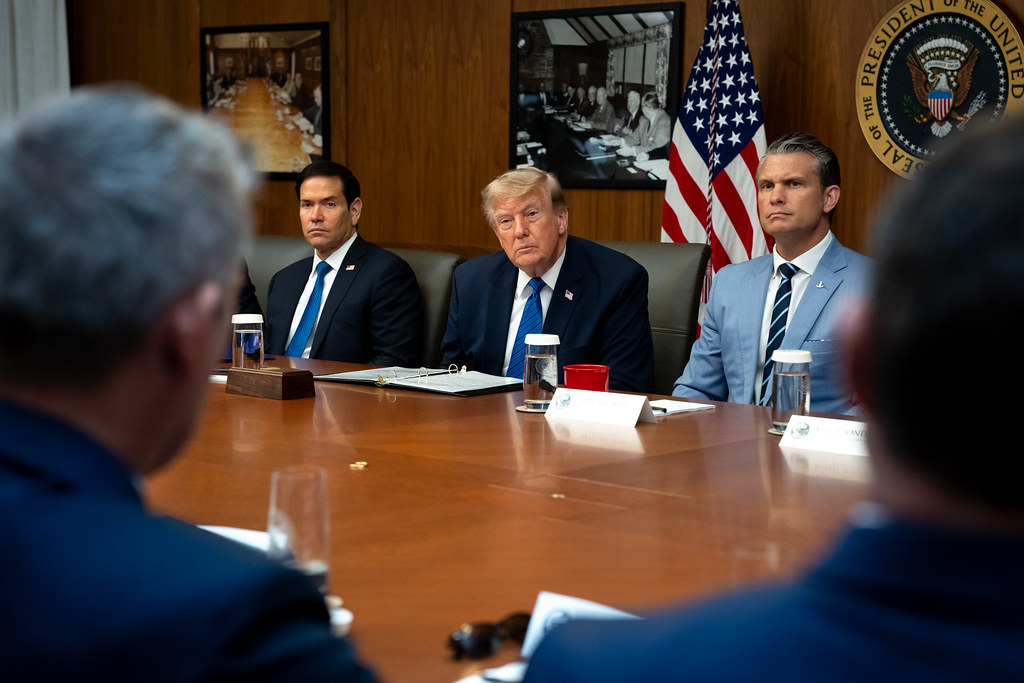
The frustrations have roiled Trump for several weeks, senior administration officials said, with one saying the negative headlines drove him “crazy.” The Washington Post late Wednesday reported that Trump expressed frustration with Hegseth at a cabinet meeting at Camp David last week, which the White House denies. The Post says it stands by its reporting.
While presidents naturally wish to control the information cycle, they are often stymied by realities on the ground. In an ideal world, they avoid creating their own bad situations.
Munitions were on Trump’s mind shortly after a cabinet meeting last week at Camp David, said U.S. officials. He called Deputy Defense Secretary Stephen Feinberg, who has led a yearlong effort to increase munitions production, to discuss the Pentagon’s munitions levels, according to people familiar with the call. Hegseth was also on the line, one person said.
Other senior defense officials were scrambled for a last-minute meeting that night to brainstorm ways to quickly increase production of critical munitions, the people said. NBC News reported earlier on Feinberg’s discussion with colleagues.
Feinberg has tried dangling incentives before the weapons industry to speed up production. But while the Pentagon reached agreements with companies to boost production of key munitions, such as Patriot and Thaad missiles, over the next seven years, many of the deals still require Congress to approve funding.
Trump has previously pressed senior Pentagon officials and top military contractors to produce more munitions quickly, summoning acquisition officials and industry executives to the White House for a contentious meeting in June, the Journal previously reported. The defense industry can do little to address the shortfall, however, without completing the contracts, according to experts and people familiar with the discussions.
Given that the Pentagon has been under orders for a decade now to prepare to deter—and, if it comes to it, fight—a war with China, which is a peer competitor with a massive arsenal, we can’t fix this problem fast enough. But, certainly, starting a war with Iran has exacerbated it in the short run.
Meanwhile, Ukraine is finding out what happens when you run out of air defense missiles.
*The earliest mention of air defense missile interceptors seems to have been a June 2006 post titled, “If Necessary, Strike and Destroy.” We weren’t worried about running out of them then.









