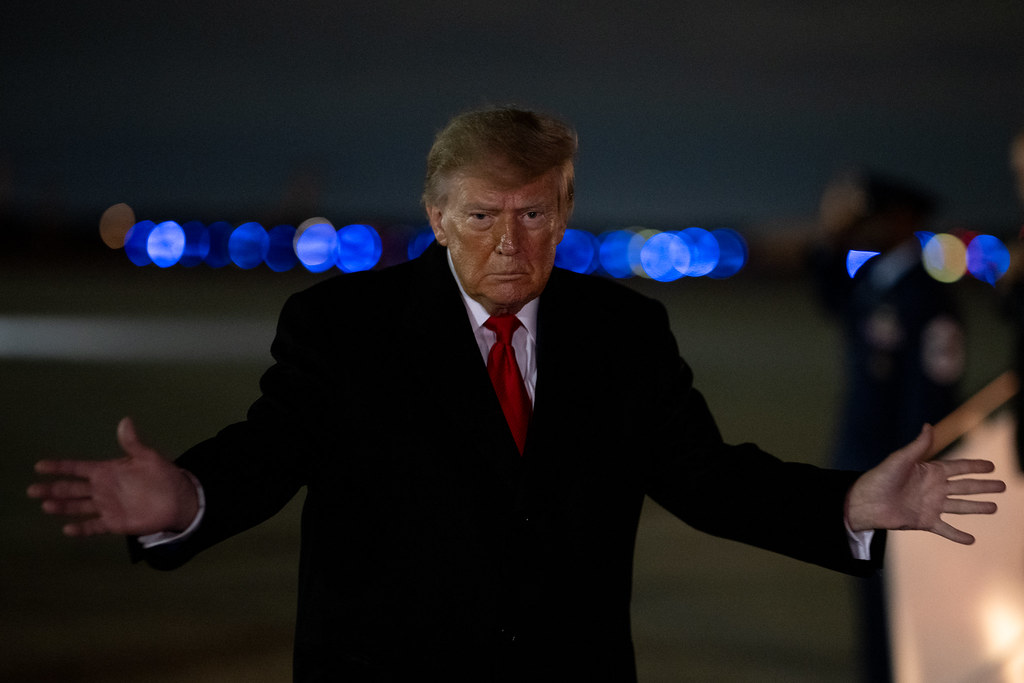
The dominant view of yesterday’s election is expressed by The New York Times:

WaPo put it this way:

Even the WSJ piles on:

The 45th and 47th President of the United States retorts:

Of course, he spent months imploring Americans to pretend that he was on the ballot. But it may just be that we don’t have much imagination.
Still, from the perspective of the Republican Party, the results were somewhat less than ideal. That became obvious early, as South Carolina rejected the late Lindsey Graham’s ignoramus sister in favor of a Democratic pediatrician by almost five points. The GOP was blown out across the board in Texas, sweeping the Senate, Governorship, and Lieutenant Governorship. And things could get worse, as the count is not yet final in Alaska and Mississippi, two traditional Republican strongholds that are too close to call.
WaPo (“Voters punish Trump with historic swing to Democrats“):
The American voter dealt President Donald Trump a historic rebuke on a scale not seen since 1974, propelling Democrats into control of both houses of Congress with commanding wins in places they hadn’t carried in decades.
Democrats won both the Senate and governor’s races in Texas — their first statewide victories there since 1994. They took a U.S. Senate seat in South Carolina and the Georgia governorship for the first time since 1998. Kansas sent a Democrat to the Senate for the first time since 1932.
Among their early House victories were a Kentucky district that voted for Trump by 15 points and two Florida seats that Republicans redrew to shift right. The head of the House GOP’s campaign arm trailed in his own race with 99 percent of the vote counted. As of 12:01 a.m. Wednesday, Democrats led in every competitive House contest.
The leftward swing extended across demographics and geographies. Compared with 2024, the exit poll conducted for the Associated Press and the major television networks showed double-digit swings toward the Democrats among Latinos, Catholic voters and voters younger than 30.
Republicans also suffered from a collapse in turnout, as fewer of their supporters showed up on Election Day than four years ago, according to preliminary turnout data. Sixty percent of voters said they disapproved of Trump, and 81 percent of them voted for Democrats, according to preliminary results from the NORC Civic Health & Elections Project survey, which was sponsored by The Washington Post and other organizations.
Voters named the economy, health care and the war with Iran as their top issues, the survey showed. Just 12 percent said their family was getting ahead, while 29 percent said they were falling behind. Democrats had a 12-point advantage with voters who named the economy and jobs as their top concern, who made up a majority of the electorate. Two years ago, such voters favored Trump by 20 points.
Voters without college degrees, who favored Trump by more than a dozen points in 2024, went for Democrats this year by about 49 percent to 47 percent. Democrats also narrowly won with men, who voted for Trump by 55 percent to 43 percent in 2024.
Lisa Lerer, NYT (“How a Blue Wave Became a Red Wipeout“):
In the end, it wasn’t just a wave. It was a wipeout.
A Democrat won a Senate seat in Kansas for the first time since the Herbert Hoover administration. The party picked up Senate seats in Texas, North Carolina and South Carolina. Republicans even fell short in House districts in the South where they had tried to give themselves an edge by drawing new, gerrymandered maps.
The sweeping Democratic victories on Tuesday night offered a decisive rebuke to President Trump and his aggressive, often chaotic second-term agenda.
The party seized control of both houses of Congress. Voters rejected Republicans in conservative states that supported Mr. Trump by double-digit margins just two years ago, in places that had not seen competitive elections for major seats in decades.
Even some Democrats were stunned by the extent of their wins, which included defeating Greg Abbott, the three-term Republican governor of Texas; and Susan Collins, the five-term Republican senator from Maine.
“It’s a blood bath,” said Dan Sena, who was the executive director of the Democratic Congressional Campaign Committee during the last Democratic wave, in 2018. “Democrats are going to be in power in places they haven’t been in power in decades.”
And so the era of one-party rule in Washington ended with a crash, as voters pushed back on high gas prices, an unpopular war in Iran and stubbornly high inflation. As Wednesday dawned, there were signs that the country was entering a new and uncertain political time, in which both parties would be forced to consider how to navigate a post-Trump political era.
Natalie Allison, WaPo (“Trump told voters, ‘Pretend I’m on the ballot.’ They did.“):
President Donald Trump spent two months urging Americans to pretend he was on the ballot. On Tuesday, they did just that.
Voters delivered a stunning rebuke to Trump’s party that rivaled anything Republicans had suffered in 50 years, defeats on ruby-red turf that Trump won handily just two years ago, where he has dominated politics for nearly a decade and against candidates he had in some cases handpicked.
Not only did Democrats flip Senate and governor seats in red states, but at times by eye-popping margins.
“The message is very clear and very simple here. It was a complete repudiation of the party as defined by Donald Trump,” said Mike Murphy, a Los Angeles-based Republican consultant who worked for candidates in the pre-Trump GOP, including Jeb Bush and John McCain.
“We have a little saying in show business, ‘box office poison,’ and that’s what Donald Trump has become.”
More than 41 times in recent weeks, The Washington Post found, Trump told voters to act this November as if the midterms were a referendum on him — a bold dare for a president whose approval ratings had reached historic lows as a growing number of Americans reported opposing his policies and his behavior in office.
In just two years since Trump’s remarkable presidential victory campaign, in which he vowed to lower consumer prices, he has generated deep resentment of his policies. Voters blamed his decision to go to war against Iran and his tariff policies for raising prices, instead.
Trump left himself no hedge against being held responsible for voter unhappiness because he had molded the GOP into his image over the last decade. He demanded complete loyalty from Republicans and sought to cast out those who opposed him. Then he made himself the face of the party’s midterm messaging, not only calling for his advisers to feature him in midterm television advertisements but demanding that the GOP host a first-of-its-kind midterm convention to tout his policies.
Trump “brought a Chernobyl-level disaster to the Republican Party,” Murphy said, “the worst beating the party has taken since ’74, after Watergate.”
That year, Democrats gained 49 seats in the House and four in the Senate, on the heels of newly installed President Gerald Ford’s pardon of Richard M. Nixon and amid a spike in gas prices and overall inflation.
So far this year, with some races left to be called, Democrats have flipped seven Senate seats and at least 25 in a House with far fewer competitive seats. They also flipped several governorships and state legislative chambers.
In yesterday’s episode of The Daily (“A Guide to Election Night 2026“), NYT chief pollster Nate Cohn offered four scenarios as to how the results might play out. They were quite similar to Steven Taylor’s disastrous-to-sublime outcomes.
The fourth scenario is the tsunami. […] Let me describe what the extent of the damage for Republicans could look like in this scenario. In the House, the Democrats could win the popular vote by double digits and claim 250 seats maybe.
In the Senate, the Republicans wouldn’t merely lose in some close battles in a few critical states. The Democrats might win the Senate with room to spare in a place like Michigan, where the Democrats have a candidate in Dr. El-Sayed that maybe could have lost in a different election, but maybe he cruises to that big double-digit win that our poll showed this weekend.
Maybe Democrats win Texas. And they don’t just win Texas by a little bit, but they win it big. James Talarico wins by five points or more, with Hispanic voters surging 40-plus points toward the left. Maybe the Democrats win Kansas, a Senate state that hasn’t voted Democratic since 1932. Again, not just by a little bit, but by five points or more.
And maybe a whole extra tier of state that we haven’t really considered top-tier battleground, like South Carolina, which I’ve alluded to a few times, but also add to that Florida or Mississippi maybe. The Democrats are spending money there, and maybe those are the states that wind up being the closest on election night, states that we haven’t even really considered to be top-tier contests.
Stepping back, this is a generational victory. This is the largest victory for either party in decades. The Democrats would win more Senate seats in heavily Republican territory in this scenario than both 2008 and 2006 combined and then more. I think you’d have to go back maybe to 1974, the election right after Watergate, to come up with something that felt this big.
It took some prodding from host Michael Barbaro to get him to admit,
I will find it hard to ever say scenario four is likely in this polarized era and when all Republicans need to do to avert scenario four is show up and vote Republican. But I do have to be honest with you, and that’s that the polls, if anything, say that scenario four is the single likeliest outcome here. Maybe scenario 3.7 is the likeliest outcome based in the polls. And the polls don’t show Republicans losing in South Carolina, for instance, to take a case that I had in scenario four.
But they do show Democrats winning all of these critical Senate states, as I mentioned at the beginning of the episode. They also show them winning in these red states with room to spare sometimes, like Texas. The final polls show James Talarico ahead by a comfortable margin, not just our polls, but other polls.
Same story in Kansas. And I want to note that it’s not just the polls that say this. It’s the behavior of both parties. We’ve already talked about how Democrats are spending in places like Mississippi and South Carolina. The Republicans have spent hundreds of millions of dollars in Texas this cycle. It’s not because they think it’s the state it’s been in the past. Donald Trump has been to South Carolina three times in the last few weeks.
The reason for his hesitation is simple: the hardest part of political polling is turning the raw numbers into a “likely voter” forecast. Pollsters weight the raw numbers to reflect who they think is most likely to vote. And that’s more art than science.
In the Trump era, Republican voters have been much less likely to respond to polls. It’s why he overperformed the polls all three times he was on the ballot.
So essentially, every pollster is going much farther to try and adjust their samples to properly represent Trump supporters than they did in 2020 or 2016. They, in particular, simply just give more weight to the Trump supporters who take their polls.
So let’s take an evenly divided state like Pennsylvania. If I take a poll of Pennsylvania and Trump voters are 40 percent of the sample and we know they were 50 percent of the vote, the typical pollster will make them 50 percent of the vote right now.
[…]
It’s a heavy-handed approach. I will also note that if the turnout is very blue for Democrats, you can at least talk yourself into a scenario where that’s an overcorrection, potentially. So it’s not a panacea, but it is a reason to think that the risks could be lower than before. Though I should caution that just because pollsters are doing more than before doesn’t mean that the underlying problems facing pollsters didn’t get worse.
It appears that pollsters did indeed over-correct, if only slightly.
In terms of the results, I’m particularly gratified that voters punished the Republican Party for nominating an ignoramus in South Carolina and a despicable human being in Texas. And that Michiganders ignored the racist attacks and voted for the all-American Rhodes Scholar with two doctoral degrees despite being a Muslim with an Arabic name. And, given how big the wave is otherwise, I would not be all that displeased if Peltola’s attempts to mislead Alaska voters cost her the seat.
What’s even more remarkable about the results—which dwarf even the 1994, 2006, and 2010 waves—is that it happened despite all the institutional barriers. As Steven and I have been hammering on lately, because the parties have sorted so much on the issues, it’s incredibly hard for a Republican to vote for a Democrat.
Even if you love Talarico and hate Paxton or think Darline Graham is just too goddamn stupid to be a United States Senator, voting Blue is a vote not just for Talarico or Annie Andrews but for Majority Leader Chuck Schumer, Banking Committee Chair Elizabeth Warren, Health-Education-Labor Chair Bernie Sanders, Finance Chair Ron Wyden, and Judiciary Chair Sheldon Whitehouse. Goodbye Trump Supreme Court nominations. And you have to live with that for six years, quite possibly through a whole term of a Democratic President.
That a significant number of people did that, anyway—and many more simply sat the election out rather than vote for a Republican—amplifies the magnitude of the backlash.
Thank you for your attention to this matter.