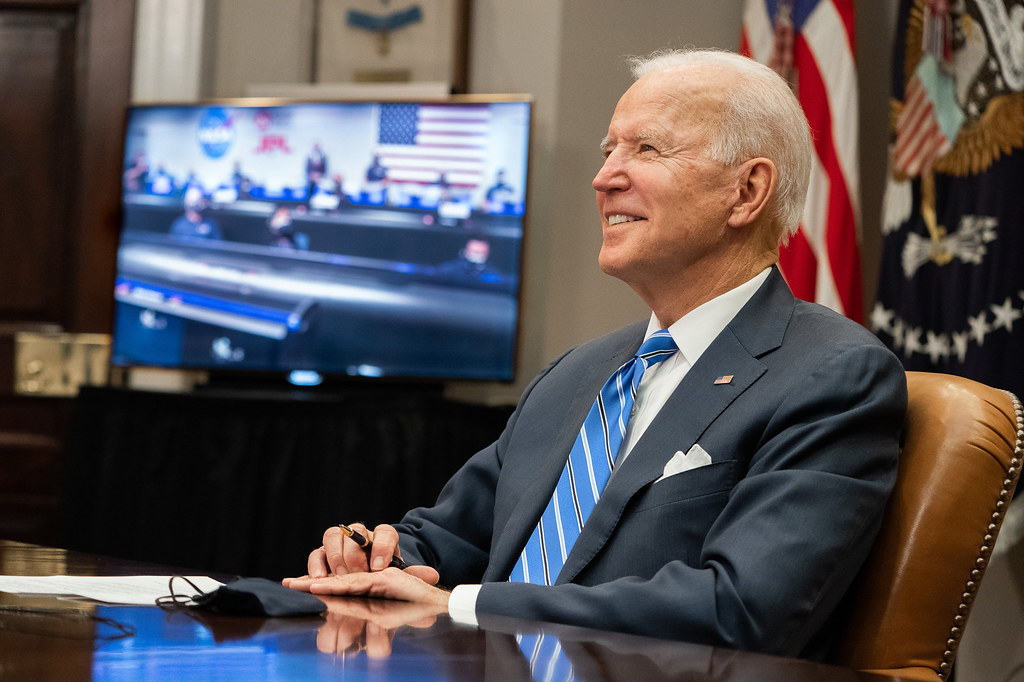

Wednesday will make one hundred days in office for President Joe Biden and he’ll mark the occasion with a speech to a joint session of Congress.
NPR’s Domenico Montanaro assesses “How Biden Has Fared So Far On His Promises.”
Before being elected president, Joe Biden promised he could accomplish a lot of things in his first 100 days in office.
We gathered a number of those priorities here, two days after he was declared the winner of the 2020 election.
As we approach the 100-day mark of his presidency, and ahead of his first address to a joint session of Congress on Wednesday, Biden has made a lot of progress on COVID-19, and Americans largely approve of the job he’s doing handling the coronavirus pandemic and the economy.
It’s a different story, however, when it comes to immigration, which polls show is the president’s biggest vulnerability at this point. H has also made efforts on racial justice, the environment and switching back to a more multilateral approach to foreign policy. But so far he has not been able to get everything done that he set out to do.
Here’s where Biden stands on much of what he promised (jump down to the details on each topic from the graphic):
The version on their page is interactive, with each of the major topics linking to its own breakout page. For the sake of posterity, here’s a static version:

Granting that most of the DONE agenda was low-hanging fruit or merely required starting the ball rolling, not bad for 100 days, especially given that the impeachment of his predecessor sucked up several days’ bandwidth and contributed to the delays in getting his team in place. Conversely, many of the IT’S COMPLICATED tasks are so big that it’s silly to expect much progress in 100 days; indeed, some will require more than a single presidential term.
CNN White House reporter Stephen Collinson is somewhat uncharitable in his assessment, “How Biden anchored his first 100 days on two simple principles.”
The increasingly radical presidency of Joe Biden was built on a straightforward foundation: putting Covid-19 shots in arms and stimulus checks in the bank.”When I took office, I decided that — it was a fairly basic, simple proposition, and that is I got elected to solve problems,” Biden said at his first official news conference in March. “
And the most urgent problem facing the American people, I stated from the outset, was Covid-19 and the economic dislocation for millions and millions of Americans.”Had Biden stumbled on these key tasks, his emerging, and staggering, multi-trillion dollar aspirations to remake the US economy and much of the social safety net would have appeared not just ambitious but politically inconceivable.
But the President can report at the end of his first 100 days in office to a joint session of Congress on Wednesday night that he has successfully embarked on a mission he defined on Inauguration Day to “repair,” “restore,” “heal” and “build.”
He promised 100 million vaccines administered in his first 100 days, and delivered 200 million. With a Democratic-controlled Congress, he sent out the $1,400 emergency checks that never arrived under ex-President Donald Trump and a Republican Senate.
As Collinson rightly notes, this is mostly a matter of under-promising and over-delivering.
When Biden took office, the US was averaging around 195,000 new cases of Covid-19 a day and 3,000 deaths. Now there are signs the pandemic is easing, with an average around 57,000 fresh infections and nearly 700 deaths per day. Those numbers are still dangerously high, but Biden’s claims reflect a strategy that under-promised and over delivered on vaccinations, while his administration benefited from taking power at a dark moment in the pandemic that his predecessor had largely neglected. The President also had the good fortune to inherit an effective vaccine development program from Trump, though his team argues that the previous administration had few plans to distribute it.
We may well have turned the corner and, while he’ll get too much credit, he deserves a lot of it. We would have easily achieved 100 million vaccines at this stage of the Trump administration—but quite likely not the 200 million that came about with aggressive acquisition and promotion.
Thus far, the public seems to be pleased:
Polling as the end of Biden’s first symbolic 100 days approaches suggests public satisfaction with how the new President seized control of the pandemic. An average of the six most recently conducted surveys shows 55% of Americans approve of the way he is handling his job while 41% disapprove.
In an NBC News poll released Sunday, 69% back his handling of the pandemic and 52% view his economic management positively. ABC News/Washington Post survey data on the same questions puts Biden at 64% and 52%.
Given the polarization of America in the wake of Trump’s presidency, it’s possible that these numbers represent a high point in his popularity. Once the President begins to work on the more partisan elements of his program, impressing some Republican voters may be tougher.
Considering that Trump spent all but the first week of his presidency underwater—and spent his last months in office working to undermine Biden’s legitimacy—these numbers are remarkably high. Compare:


Trump literally spent every day of his presidency more unpopular than Biden has been his worst day. Given that Trump’s high water mark was 47 percent positive and low water mark was 58 percent negative, it seems reasonable to suggest that 42 percent are next to unpersuadable, die-hard Trumpers. So, 58 is probably as high as Biden could possible go and he’s already sitting at 53 percent. And, while his negatives have indeed climbed as he rolls out massively expensive bills, they’ve stayed under that 42 percent mark all but a few days.