University of Virginia Law professor Amanda Frost argues that, now that the legal argument for birthright citizenship has been won (for now at least), proponents should start making the argument on policy grounds.
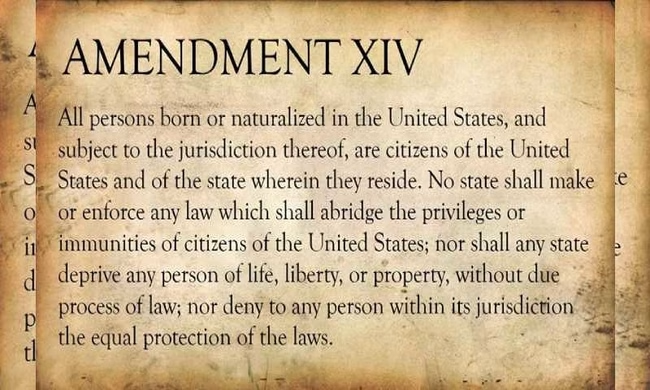
[Justice John Roberts’ majority] opinion is a meticulous rendition of U.S. history up to the 1868 ratification of the Fourteenth Amendment, drawing on abundant evidence that the citizenship clause was intended to apply to nearly everyone born in the United States. The decision was a major defeat for one of President Trump’s signature policy initiatives. Notably absent from Roberts’s opinion, however, was any discussion of whether birthright citizenship is a good idea in 21st-century America.
And that’s a pity, because birthright citizenship brings many practical benefits to the United States today—arguments that the nation needs to hear, given the campaign being mounted against it.
I would contend that policy argument is not what the Supreme Court is there to do. Then again,
By contrast, the three dissenting justices did not hold back, devoting many pages to claims that birthright citizenship is destructive and even dangerous in our modern, mobile world—assertions that are almost entirely unsupported and yet that went unrefuted.
Roberts, presumably, would counter that the policy implications are irrelevant. The 14th Amendment says what it says. (Of course, Roberts and company frequently go to extreme contortions to find ways to justify rulings that satisfy their policy preferences.)
Defenders of birthright citizenship have made strong legal arguments in its favor; they need to start making the policy case for it as well.
Given how vociferously opponents are making their case, I would agree. Alas, despite her training and expertise, Frost’s initial salvo is something of a sleight-of-hand:
It’s an easy case to make. The children of immigrants are about 10 percent of the total U.S. population. They power the U.S. economy and serve in significant numbers in the government and the military. Nearly half of Fortune 500 companies were founded by immigrants and their children, more than 10 percent of the current members of Congress are children of immigrants, and six out of 45 U.S. presidents, including Trump, had at least one immigrant parent. They are so well integrated into the fabric of the nation that most of us have no idea which of our neighbors and colleagues were born to immigrant parents unless they choose to tell us.
That immigration has been good for the country is not a case for granting citizenship automatically to the children of illegal immigrants and tourists, the cases excluded by the Trump executive order and lambasted by the minority Justices. But, yes, the fact that the children of legal immigrants are born American citizens is doubtless a boon.
If Trump’s executive order had gone into effect, it would have denied citizenship to about 255,000 newborn children a year going forward—a result that would have been not only a nightmare for them and their families but also bad news for the nation’s economy. Economists have found that citizenship status brings with it higher earnings. Even green-card holders who have the right to work and live in the United States indefinitely earn more after they naturalize. If all of these children remained in the U.S. without citizenship, they would contribute less to the tax base and to our already-strapped Social Security system. Worse, if they were deported (or if they self-deported), their absence would accelerate the demographic decline that is transforming us into an aging society with too few workers to support the retiring Baby Boomers.
Again, this is an argument for more legal immigration, not birthright citizenship.
In addition to these economic challenges, denying birthright citizenship undermines America’s founding principle that governments derive “their just powers from the consent of the governed.” The United States cannot claim to be a democracy and simultaneously deny the right to vote and hold office to a significant percentage of its inhabitants and their offspring in perpetuity, excluding them based on their “blood” and without regard to the fact that they are here. This is the essential truth that the framers of the citizenship clause recognized back in 1868, which is why they established birthright citizenship to protect not only the newly freed slaves but also the children of immigrants arriving from around the world. It remains just as true today.
Here, she backhandedly gets at what I consider the key case for birthright citizenship. Like the minority Justices, I would have no problem (absent the Constitution and federal law saying otherwise) deporting the children of illegal immigrants and those here on a tourist visa and denying them citizenship so long as we did it in close proximity to their arrival in the country/expiration of their visa. The problem is that, if we don’t do so, we create a nightmare for those who remain. Administratively, it’s simply easier to give everyone born here a birth certificate and citizenship than to ascertain their immigration status.
Here, she makes a decent point directly:
In dissent, Justices Clarence Thomas, Neil Gorsuch, and Samuel Alito collectively devoted thousands of words to describing what Alito called the “grotesque result” of granting citizenship to the children of undocumented immigrants and birth tourists.
Let’s start with “birth tourism”—the assertion that foreign women are coming to the United States on tourist visas to give birth to U.S.-citizen babies and then leave, which has become the focus of much of the conservative outrage over birthright citizenship. At the oral argument, Sauer stated that birth tourists from China and Russia number in the millions. But when the chief justice asked him directly whether he knew “how common that is or how significant a problem that is,” the solicitor general was forced to admit, “No one knows for sure.”
In fact, the U.S. government makes no effort to track birth tourism, which alone suggests that it is not a major crisis. The Center for Immigration Studies, a group that advocates for restricting immigration, makes a rough guess of 26,000 birth-tourist babies a year—fewer than 1 percent of the 3.6 million total births recorded in the United States annually.
But, of course, opponents could make the exact same argument to counter Frost. To the extent we’re granting birthright citizenship to accrue the benefits of assimilating immigrants, surely doing so for 26,000 fewer births out of 3.6 million would have a negligible impact.
If birth tourism seems troubling despite its small numbers, I have good news: It is already illegal. Under a federal regulation in place since 2020, the United States can deny a tourist visa to a woman whose primary purpose in coming to the U.S. is to give birth. That prohibition can be enforced by Customs and Border Protection officials at U.S. airports and at the country’s borders. Following its Supreme Court loss, the Trump administration announced plans to start prosecuting violators of that law; why it didn’t do so earlier is unclear. (I submitted a Freedom of Information Act request to the government more than a year ago asking for records regarding this policy’s implementation but have yet to receive a response.) In short, there is no need to take a hammer to birthright citizenship when we can use a scalpel to target birth tourism specifically.
Fair enough. Although, unless we’re going to simply start denying visas and/or entry to the country to women who appear to be pregnant, I don’t see how this addresses the problem. Indeed, that seems worse than denying the children citizenship.
True, airplanes didn’t exist in 1868 (though steamships did, and millions of foreigners traveled to the United States in the 19th century). Also true, however, is that today, international travel requires a passport and often a visa—neither of which was needed in 1868. Back then, there were few immigration restrictions and no federal immigration officials. Today, the nation spends billions to screen entrants using cutting-edge biometric tools, and thousands of Customs and Border Protection officers are stationed at every international airport and port of entry in the country. Most of the world’s 8 billion people cannot even board a plane to the United States or a nearby country because they lack the requisite documents, even assuming they can afford the price of a plane ticket.
So, this is a solid rebuttal. Thomas and company, presumably, would argue that the country wanted vast numbers of immigrants in 1868 and want more controlled immigration now. I agree with Roberts that changing circumstances don’t change the plain text of the Constitution. But Frost is seeking to make a case on policy grounds, not legal ones.
The issue of granting birthright citizenship to the children of undocumented immigrants also concerned the dissenters. Even Justice Brett Kavanaugh, who concurred in the result, described illegal immigration as a “new circumstance” that the “Framers of the Fourteenth Amendment could not have fully anticipated,” then concluded that “presumably” they would not have wanted to grant the “birthright citizenship benefit” to the children of these lawbreakers. Justice Alito argued that birthright citizenship provides a “powerful incentive to enter or remain in this country illegally.” These justices are correct that the United States, like the rest of the developed world, is wrestling with the relatively recent problem of large-scale illegal immigration. Where they go wrong is assuming that birthright citizenship has anything to do with it.
By design, U.S. law makes it extremely difficult, often impossible, for undocumented parents in the United States to gain legal status based on a child’s citizenship. And studies have shown that the primary incentive for irregular migration is jobs for the parents, not birthright citizenship for their children. That is why the rate of such migration drops precipitously during U.S. recessions. Moreover, European countries do not have birthright citizenship, yet they also struggle with waves of immigrants fleeing violence and poverty for a better life.
Again, I’m in agreement. I think very few illegal Latino immigrants are here to drop “anchor babies.” Almost all of them are economic migrants seeking a better life for themselves and their families. And, yes, rich, stable countries without birthright citizenship still draw immigrants doing the same.
None of that, however, is an argument for why giving their children American citizenship.
At the end of the day, the assimilation argument is the strongest. But it’s not overly compelling for the edge cases at issue.