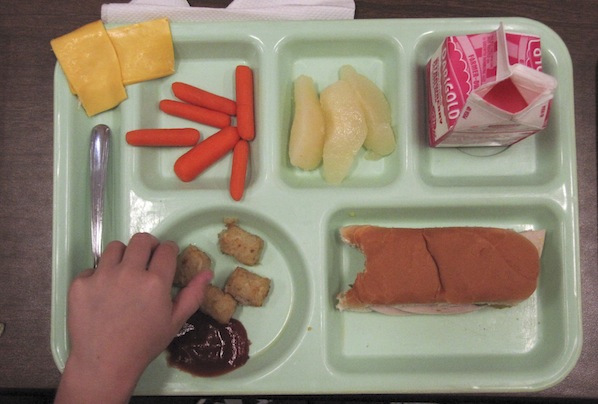

In one Chicago school, it’s the end of the lunchbox and the brown paper bag:
Fernando Dominguez cut the figure of a young revolutionary leader during a recent lunch period at his elementary school.
“Who thinks the lunch is not good enough?” the seventh-grader shouted to his lunch mates in Spanish and English.
Dozens of hands flew in the air and fellow students shouted along: “We should bring our own lunch! We should bring our own lunch! We should bring our own lunch!”
Fernando waved his hand over the crowd and asked a visiting reporter: “Do you see the situation?”
At his public school, Little Village Academy on Chicago’s West Side, students are not allowed to pack lunches from home. Unless they have a medical excuse, they must eat the food served in the cafeteria.
Principal Elsa Carmona said her intention is to protect students from their own unhealthful food choices.
“Nutrition wise, it is better for the children to eat at the school,” Carmona said. “It’s about the nutrition and the excellent quality food that they are able to serve (in the lunchroom). It’s milk versus a Coke. But with allergies and any medical issue, of course, we would make an exception.”
Carmona said she created the policy six years ago after watching students bring “bottles of soda and flaming hot chips” on field trips for their lunch. Although she would not name any other schools that employ such practices, she said it was fairly common.
A Chicago Public Schools spokeswoman said she could not say how many schools prohibit packed lunches and that decision is left to the judgment of the principals.
“While there is no formal policy, principals use common sense judgment based on their individual school environments,” Monique Bond wrote in an email. “In this case, this principal is encouraging the healthier choices and attempting to make an impact that extends beyond the classroom.”
Of course, there might be other reasons for this decision:
Any school that bans homemade lunches also puts more money in the pockets of the district’s food provider, Chartwells-Thompson. The federal government pays the district for each free or reduced-price lunch taken, and the caterer receives a set fee from the district per lunch.
At Little Village, most students must take the meals served in the cafeteria or go hungry or both. During a recent visit to the school, dozens of students took the lunch but threw most of it in the garbage uneaten. Though CPS has improved the nutritional quality of its meals this year, it also has seen a drop-off in meal participation among students, many of whom say the food tastes bad.
“Some of the kids don’t like the food they give at our school for lunch or breakfast,” said Little Village parent Erica Martinez. “So it would be a good idea if they could bring their lunch so they could at least eat something.”
“(My grandson) is really picky about what he eats,” said Anna Torrez, who was picking up the boy from school. “I think they should be able to bring their lunch. Other schools let them. But at this school, they don’t.”
Ms. Torrez, that’s because the bureaucrats at the school think they know what’s good for your grandson better than you do. After all, it takes someone who got a Bachelors Degree in Education to raise a child.
UPDATE (James Joyner): A YahooNews version of the story includes this nugget:
For parents whose kids do not qualify for free or reduced price school lunches, the $2.25 daily cafeteria price can also tally more than a homemade lunch. “We don’t spend anywhere close to that on my son’s daily intake of a sandwich (lovingly cut into the shape of a Star Wars ship), Goldfish crackers and milk,” Northwestern education policy professor Diane Whitmore Schanzenbach told the paper in an email. She told The Lookout parents at her child’s public school would be upset if they tried to ban homemade lunches.
So, in addition to the objections noted by Doug in the original, this will be a financial burden on some working class parents, especially those with multiple kids in school.
Amusingly, this photo accompanies that story:

My recollection of school lunches, which I occasionally bought, was that they were often built around a main course of hot dogs, sloppy Joes, pizza, and the like. The kid might as well bring in a bologna sandwich and some chips from home if that’s the healthy alternative provided by the school.