
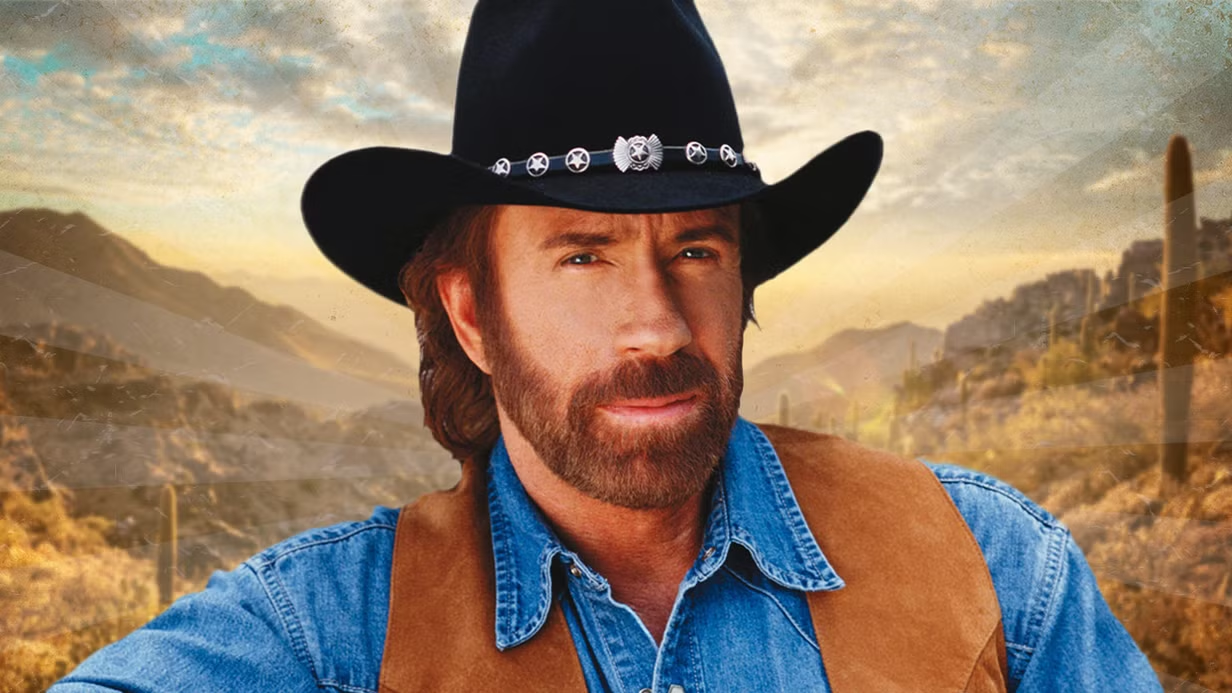
New York Times, “Chuck Norris, Crowd-Pleasing Star of Action Movies and TV, Dies at 86“
Chuck Norris, who channeled his skills as a martial arts black belt into a durable acting career that left film critics largely unimpressed but delighted millions of fans savoring his good-guy triumphs and fortune-cookie musings, died on Thursday. He was 86.
His death was announced by his family through his official Instagram account, but no further details were immediately available. He was hospitalized earlier that day in Hawaii after experiencing a medical emergency, the family said.
As an actor, Mr. Norris was well aware that no one was about to mistake him for a latter-day Henry Fonda or Laurence Olivier. In most of his films and in “Walker, Texas Ranger,” a television series that ran from 1993 to 2001, he played a warrior who comes to the rescue not with words or guns but, rather, with spinning back kicks and other techniques that had made him a leading martial arts practitioner.
“I play the man in the arena who’s pushed to the wall and forced to blast his way out,” he once told The San Francisco Chronicle. And blast out he did, in film after film.
His most fertile period onscreen stretched from the late 1970s to the early 2000s with movies that included “Good Guys Wear Black” (1978), “An Eye for an Eye” (1981), “Lone Wolf McQuade” (1983), “Code of Silence” (1985), “Invasion U.S.A.” (1985), “The Delta Force” (1986), “Delta Force 2: The Colombian Connection” (1990) and three “Missing in Action” offerings in the 1980s that gave him a chance to rescue Americans held captive in Vietnam.
On occasion, he showed a lighter side and a measure of vulnerability, as he did as a police detective in “Hero and the Terror,” a 1988 film that had him as a sensitive romantic who even faints watching a baby being born. But in the main, he was the solid fellow who didn’t look for trouble — until the bad guys left him no choice. His dialogue, while scant, could come laden with menace.
“I didn’t fight, I gave a motivational seminar,” he says after dispatching skinhead bullies in “Delta Force 2.” In “Code of Silence” he mutters, “If I want your opinion, I’ll beat it out of you.” And in “Braddock: Missing in Action III,” he says evenly, “I don’t step on toes. I step on necks.”
Film critics, to put it charitably, were generally unimpressed, though as the years passed they acknowledged that Mr. Norris had sharpened his acting skills. Not untypical was a 1977 New York Times assessment of him in “Breaker! Breaker!” as “about as emotional as a statue.” Time magazine once described him as “an expressionless blank” and as “the most successful really terrible actor since Audie Murphy.”
Nonetheless, audiences flocked to his films, some of which, along with episodes of “Walker, Texas Ranger,” were directed by his younger brother Aaron, a one-time stuntman. “Dodgeball: A True Underdog Story,” a 2004 movie in which he played himself, had worldwide grosses of $168 million.
Mr. Norris was an action hero in a class with Sylvester Stallone, Arnold Schwarzenegger and Charles Bronson, with the monosyllabic manner of early Clint Eastwood tossed in. He appealed to millions who liked seeing America win — for a change, some would add — whether by rescuing captive G.I.s in Vietnam, saving the country from terrorists in “Invasion U.S.A.” or defeating skyjackers and drug kingpins in the “Delta Force” series.
Associated Press, “Chuck Norris, martial arts master and actor whose toughness became internet lore, dies at 86“
Chuck Norris, the martial arts grandmaster and action star whose roles in “Walker, Texas Ranger” and other television shows and movies made him an iconic tough guy — sparking internet parodies and adoration from presidents — has died at 86.
[…]
Before he would become a star in movies and on TV, Norris was wildly successful in competitive martial arts. He was a six-time undefeated World Professional Middleweight Karate champion. He also founded his own Korean-based American hard style of karate, known sometimes as Chun Kuk Do, and the United Fighting Arts Federation, which has awarded more than 3,300 Chuck Norris System black belts worldwide. Black Belt magazine ultimately credited Norris in its hall of fame with holding a 10th degree black belt, the highest possible honor.
Born Carlos Ray Norris in Ryan, Oklahoma, on March 10, 1940, he grew up poor. At age 12, he moved with his family to Torrance, California, and joined the U.S. Air Force after high school, in 1958. It was during a deployment to Korea that he started training in martial arts, including judo and Tang Soo Do.
[…]
After he was honorably discharged in 1962, he worked as a file clerk for Northrop Aircraft and applied to be a police officer, but was put on a waitlist. Meanwhile, he opened a martial arts studio, which expanded to a chain, with students including such stars as Bob Barker, Priscilla Presley, Donny and Marie Osmond, and Steve McQueen, whom he later credited with encouraging him to get into acting.
Norris made his film debut as an uncredited bodyguard in the 1968 movie “The Wrecking Crew,” which included a fight with Dean Martin. He had also crossed paths with Bruce Lee in martial arts circles. Their friendship — sometimes, as sparring partners — led to an iconic faceoff in the 1972 movie “Return of the Dragon,” in which Lee fights and kills Norris’ character in Rome’s Colosseum.
He went on to act in more than 20 movies, such as “Missing in Action,” “The Delta Force” and “Sidekicks.”
“I wanted to project a certain image on the screen of a hero. I had seen a lot of anti-hero movies in which the lead was neither good nor bad. There was no one to root for,” Norris said in 1982.
In 1993, he took on his most famed role, as a crime-fighting lawman in TV’s “Walker, Texas Ranger.” The show ran for nine seasons, and in 2010, then-Gov. Rick Perry awarded him the title of honorary Texas Ranger. The Texas Senate later named him an honorary Texan.
“It’s not violence for violence’s sake, with no moral structure,” Norris told the AP in 1996, speaking about the show. “You try to portray the proper meaning of what it’s about — fighting injustice with justice, good vs. bad. … It’s entertaining for the whole family.”
The Hollywood Reporter, “Chuck Norris, Walloping Star of ‘Walker, Texas Ranger,’ Dies at 86“
Chuck Norris, the martial arts champion and karate school teacher who jumped fist- and feetfirst into stardom with 1980s action movies like Missing in Action and the long-running CBS drama Walker, Texas Ranger, has died. He was 86.
[…]
Unlike some other actors who boasted of their fighting prowess, Norris was the real deal, a holder of black belts in such disciplines as karate, Tang Soo Do and taekwondo and a guy who trained with Bruce Lee — and battled him in The Way of the Dragon (1972). Onscreen, he often portrayed loners, and like one of his heroes, John Wayne, he would only resort to violence when there was no other choice.
Encouraged by Steve McQueen to become an actor — he had given the Bullitt star private karate lessons for several years — Norris had his breakthrough with the Sergio Leone-inspired Lone Wolf McQuade (1983), playing a Texas Ranger who faces off against an arms merchant/martial arts master (David Carradine).
[…]
His father had a drinking problem and often left the family for long stretches, so Norris found his male role models in Wayne, Gene Autry and Roy Rogers at the movie theater.
“I determined that I would grow up one day to be like them,” he wrote. “Their behavior in their films was governed by the ‘Code of the West’ — loyalty, friendship and integrity. They were unselfish and did what was right even when the risk was great. Years later I would recall those Western heroes when I developed the kind of character I wanted to play as an actor.”
Variety, “Chuck Norris, Action Icon and ‘Walker Texas Ranger’ Star, Dies at 86“
Chuck Norris, the martial arts champion who became an iconic action star and led the hit series “Walker, Texas Ranger,” has died. He was 86.
[…]
As an action star, Norris had a degree of credibility that most others could not match.. Not only did he appear opposite the legendary Bruce Lee in 1972 film “The Way of the Dragon” (aka “Return of the Dragon”), but he was a genuine martial arts champion who was a black belt in judo, 3rd degree black belt in Brazilian Jiu-Jitsu, 5th degree black belt in Karate, 8th degree black belt in Taekwondo, 9th degree black belt in Tang Soo Do and 10th degree black belt in Chun Kuk Do.
[…]
While he scored high on credibility, Norris did not leaven his work with humor the way Arnold Schwarzenegger, Bruce Willis and Jackie Chan did. He was nevertheless the action star of choice for those seeking an all-American icon.
[…]
In 1984, Norris starred in “Missing in Action,” the first in a series of films centered around the rescue of American POWs purportedly still held after being captured during the Vietnam War. (Norris’ younger brother Wieland had been killed while serving in Vietnam, and the actor dedicated his “Missing in Action” films to his brother’s memory, but critics of Norris and producer Cannon Films maintained that the films borrowed too heavily from the central conceit of Stallone’s highly successful “Rambo” films.)
Norris was born three years before my parents and was making movies when I was six, so, from my perspective, he’s always been around. As the Variety obit notes, Stallone’s Rambo movies pioneered the Vietnam apologia genre and, in my view, were better than Norris’ entrees.
I was, though, a regular viewer of Walker: Texas Ranger, which was among the exemplars of the neo-Western cop genre that I’ve long enjoyed. I suppose Dennis Weaver pioneered it with McCloud, which I watched with my parents as a kid, but I don’t really remember much about it. It’s been done better in recent years, with Justified and Longmire likely the best of them, but, for better and worse, they lacked Walker‘s black-and-white characters.
At the time the show was running, it was often noted that Walker: Texas Ranger and Seinfeld, both wildly popular in the ratings, appealed to distinct audiences. I was in the small circle that watched both.
To younger generations, Norris was perhaps best known as a meme.
- Chuck Norris was once bitten by a king cobra; after ten excruciating minutes, the cobra died
- When Chuck Norris does push-ups, he doesn’t push himself up, he pushes the Earth down
- There was once a street named after Chuck Norris, but the name was changed as nobody crosses Chuck Norris and lives
- When the bogeyman goes to sleep every night, he checks his closet for Chuck Norris
- Chuck Norris can cut through a hot knife with butter









