
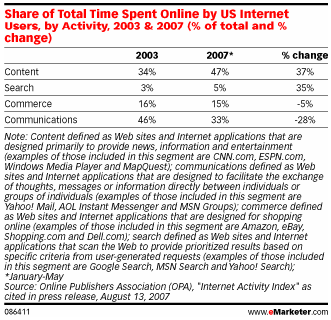
 It’s strange to me that content wouldn’t have always been the main role of the Internet. After all, the whole point of search (for me at least) has always been to locate content. Seemingly, though, as the chart at right indicates, that’s not the case.
Helen Leggatt explains, “Broadband penetration, online video and the increased effectiveness of search have all contributed to the shift in online behaviour, suggests the OPA.” The subheadline at eMarketer is even more bold: “Search improved, so users spend less time with it.” Then again, looking at the data, people are spending 35% more of their online time on search now than they were in 2003. Indeed, search has increased almost as much as content.
What has declined is time spent on Communications, by which they mean email, IM, and discussion boards. Presumably, much of that is now done through Web 2.0, whether through Twitter, Facebook, MySpace, or whathaveyou. Not to mention text messaging via cellular phone, which presumably would not count as an online activity.
Presumably, in addition to improvements of search technology people have grown accustomed to it and learned the basics of Boolean logic. There’s not much doubt that Google and its many competitors have gotten better in a variety of ways: They scour more of the Web and do it phenomenally quickly. Indeed, articles from OTB and other popular blogs are available via search within hours, if not minutes of posting.
On the other hand, that has rendered the results much more cluttered, making it harder to separate signal from noise. My wife was recently lamenting that the top several search results for most of her queries (usually, information technology related) are usually spam or e-commerce sites. The tendency of blogs and other highly cross-linked sites to have relatively high PageRank can hide very scholarly or otherwise authoritative sites.
Regardless, though, there’s a lot more content out there than ever before as part of the so-called Web 2.0. There’s blogs and various social media sites such as Facebook and MySpace, which not only give people something to read but also allow commenting, collaboration, and other forms of participation. There’s also tons of video out there, including YouTube and its rivals. If someone can find the video they want in 30 seconds, spend 4 minutes listening to it, and then find related videos conveniently linked, it’s no wonder that they’re spending more time engaging content than even four years ago.
While that’s great news for Web users, it’s not necessarily so good for content providers. Another study out today shows that User Generated Content sites such as blogs, video, and other Social Media have ad conversion rates a third lower than non-UGC sites. Presumably, this is flexible and sites such as MySpace are working on finding new ways to serve ads. Then again, it may just be that publishers need to find a way other than advertising to generate revenue.









