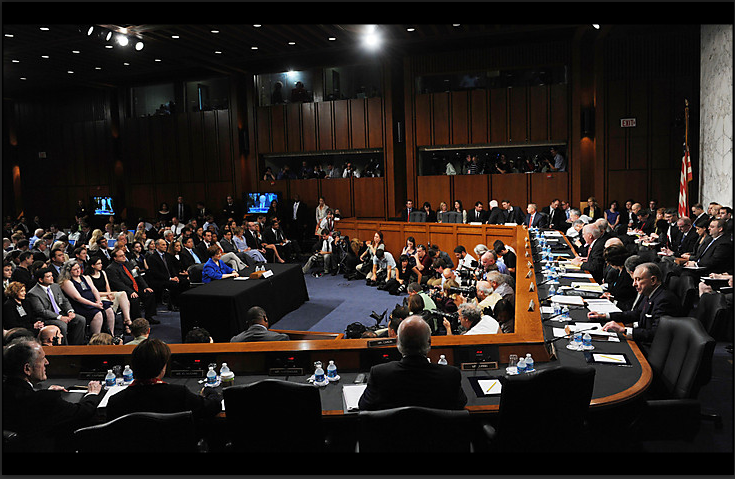

At times the pace of the first day of Elena Kagan’s confirmation hearings was so slow that it was putting Senators to sleep, which isn’t entirely suprising considering that there was a decided lack of substance:
WASHINGTON — Elena Kagan vowed Monday that if she was confirmed to the Supreme Court, her approach to judging would be “a modest one” that was “properly deferential” to Congress and the president — remarks intended to quell Republican criticism that she is a partisan who would use the court as an instrument to advance a Democratic agenda.
Addressing senators on the first day of her confirmation hearings, Ms. Kagan, the solicitor general and former dean of the Harvard Law School, was cautious and measured in her opening remarks. She pledged “even-handedness and impartiality” and promised “a fair shake” for Americans who come before the high court.
Her use of the term “modest” offered the first clue to Ms. Kagan’s judicial philosophy in her own words, and harks back to a term used by Chief Justice John G. Roberts Jr., who pledged “judicial modesty” during his confirmation hearings in 2005. The question of just what Ms. Kagan means by it — and just what, precisely, her judicial philosophy is — will be a core theme of the hearings when senators begin questioning her on Tuesday.
“We have less evidence about what sort of judge you will be than on any nominee in recent memory. Your judicial philosophy is almost invisible to us,” Senator Herb Kohl, Democrat of Wisconsin, told Ms. Kagan. He urged her to engage in “substantive and candid dialogue.”
Mr. Kohl’s challenge to Ms. Kagan was a rare exception to a day that unfolded as kind of a set piece, with Democrats and Republicans painting radically different pictures of Ms. Kagan. Republicans spotlighted her lack of judicial experience and sought to portray her as a legal neophyte and a Democratic operative, citing her work as a policy adviser to former President Bill Clinton.
“It’s not just that she has never been a judge,” said Senator Jeff Sessions, the ranking Republican on the panel. “She has barely practiced law, and not with the intensity and duration from which real understanding occurs.”
Democrats described her as a brilliant thinker with what Senator Charles E. Schumer of New York called “unprecedented practical experience.” Yet Mr. Schumer may have offered the most revealing assessment of the day when he mused that Supreme Court confirmation hearings have “the potential to be like eating spaghetti with a spoon — it’s a lot of work, and it’s hard to feel satisfied at the end.”
Both sides expect that, barring unforeseen circumstances, Ms. Kagan will be confirmed. Senator Orrin G. Hatch, Republican of Utah, seemed to say as much outright on Monday, when he remarked to Ms. Kagan, who had appeared before the panel when she was confirmed as solicitor general, that “something tells me this is likely to be your last confirmation hearing.”
Ms. Kagan began the day with a brief visit in the Oval Office to President Obama, who wished her well, aides said. She arrived at the hearings precisely at 12:30 p.m. to find an array of former students and family members — her brother Irving, a cousin, an aunt and a niece among them — seated behind her in the audience. She spent much of the day wearing a furrowed brow, pursed lips and a slightly uncomfortable expression, betraying little emotion as senators either picked apart her credentials or praised her.
One could imagine, though, the thoughts that were racing through her mind as she sat there for at least three hours listening to Senators pontificate, or as National Review’s Jim Geraghty put it on Twitter yesterday:
“Ms. Kagan, I have nothing significant to say, but the committee allotted me this time anyway, and so I will speak for the duration.”
And the statements from the Senators were entirely predictable, of course. Senate Democrats praised her while Senate Republicans voiced “concerns” about her lack of judicial experience and her ideology in a manner that essentially mirrored the talking points I discussed on theday Kagan had been nominated by the President.
It was all an absurd kabuki theater that was aimed more for the television cameras than the nominee.
Things are likely to get more interesting today as Senators begin questioning Kagan, but not by much. The questions, and the answers, will be tightly scripted and, unless someone at the White House made a mistake in preparing Kagan for these hearings (not likely), there’s unlikely to be any more actual news at the end of the day today than there was yesterday. It’s regrettable, these hearings should be more substantive and more important, but, thanks to the legacy of the Bork and Thomas hearings, they won’t be.