Congresswoman Mia Love, who recently lost her bid to win re-election to hear Utah Congressional seat in a closely fought race with the Democratic Mayor of Salt Lake City, issued a sharply worded rebuke to President Trump as she begins making her way out the door:
Days after losing her re-election bid in deep red Utah, Representative Mia Love, the only black Republican woman in Congress, condemned President Trump on Monday in a scathing concession speech, describing him as having “no real relationships, just convenient transactions.”
She used similar language to attack her own party, accusing Republicans of having a “transactional” relationship with minority and black voters.
Ms. Love, who was elected to Congress in 2014 and had been viewed as a rising Republican star, lost her election by less than a percentage point to Ben McAdams, the Democratic mayor of Salt Lake County. Her defeat — in a district that Mr. Trump carried in 2016 by seven percentage points — handed Democrats another seat in the House of Representatives, giving the party 38 additional seats in the midterm elections and helping them take control of the chamber.
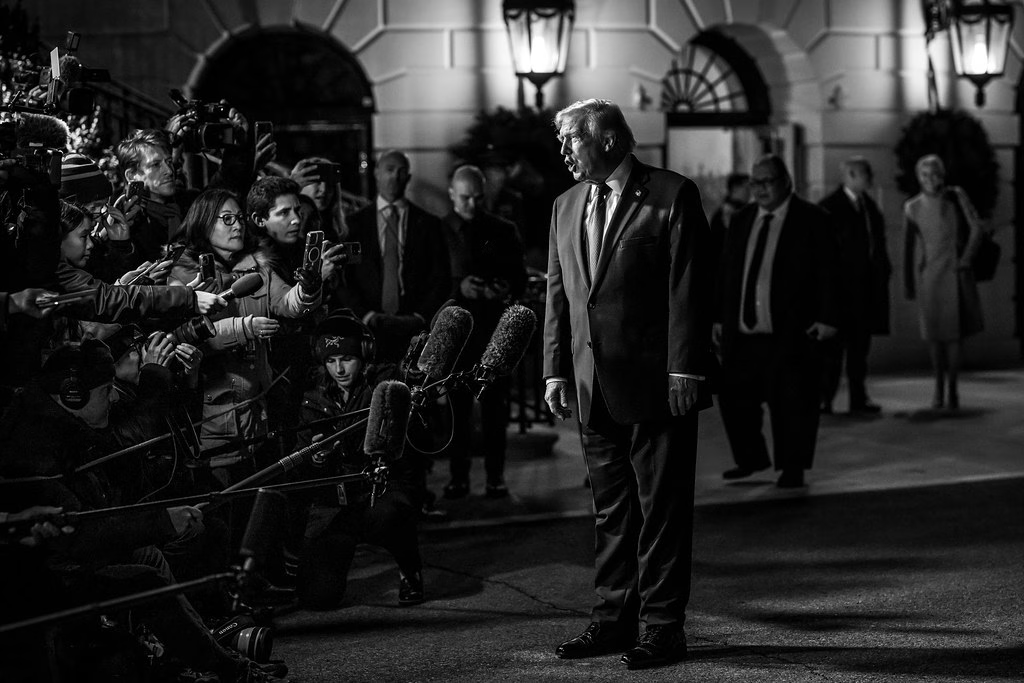
Ms. Love’s harsh words for Mr. Trump came in response to remarks the president made about her nearly three weeks ago: During a televised news conference the day after Election Day, Mr. Trump mocked the congresswoman for losing her race even as the votes were still being tallied.
“Mia Love gave me no love, and she lost,” Mr. Trump said. “Too bad. Sorry about that, Mia.”
Democrats had tried to portray Ms. Love as a Trump loyalist. But during her campaign, she had not enlisted the president’s help and had spoken out against him.
In her concession speech on Monday, Ms. Love said she was initially surprised by Mr. Trump’s “jab” at her.
“The president’s behavior toward me made me wonder, what did he have to gain by saying such a thing about a fellow Republican? It was not really about asking him to do more, was it? Or was it something else? Well, Mr. President, we’ll have to chat about that,” she said.
“However,” she added, “this gave me a clear vision of his world as it is: no real relationships, just convenient transactions.”
Ms. Love, the daughter of Haitian immigrants and the only Republican woman in the Congressional Black Caucus, also criticized Republicans for how they interact with minority voters.
“This election experience and these comments shines a spotlight on the problems Washington politicians have with minorities and black Americans — it’s transactional. It’s not personal,” she said. “We feel like politicians claim they know what’s best for us from a safe distance yet they’re never willing to take us home.”
“Because Republicans never take minority communities into their home and citizens into their homes and into their hearts, they stay with Democrats and bureaucrats in Washington because they do take them home, or at least make them feel like they have a home,” she added.
Writing at The Week, Ed Morrissey argues that Republicans and conservatives ought to take Love’s warnings seriously:
Love hits the nail on the head. She echoes what a number of minority voters told me when I started field research in key swing counties for the 2016 election while writing my book, Going Red. Republicans would open an office and hire someone to talk to the people in minority neighborhoods a few months before an election, then as soon as the voting ended, pack up and decamp.
The problem, as the thoughtful and concerned citizens of these communities told me, wasn’t so much that Republicans “never take minority communities into their home,” but that they don’t make minority communities their home in the first place. Former GOP Florida Rep. Shawn Harrison related how election consultants pushed him to ignore minority communities as hopelessly Democratic, and how that cost him a re-election bid in 2012. African-American conservatives in places like Wake County, North Carolina, said that while they often felt Democrats took them for granted, at least Democrats try to participate in their communities, whereas Republicans abandon them entirely.
The 2018 midterms show what happens when Democrats show up to vote: They outperform Republicans, even in red districts. Base-turnout strategies only take either party so far in general elections, but they take Democrats further, thanks to the party’s sustained registration advantages. Trump managed to win in 2016 without a campaign strategy to improve this failing on behalf of the GOP. However, he won those blue-wall states not because he significantly expanded the Republican voter footprint, but because Hillary Clinton failed to turn out Democratic voters, falling well below the turnout for Barack Obama four years earlier.
There are only two ways for Republicans to win general elections: The first relies on Democrats nominating incompetent candidates, which certainly could happen again — although it seems unlikely they will give Clinton another shot. The second requires Republicans to do the hard work of becoming part of new and broader communities to both build credibility and make their agenda relevant to those voters. Until Republicans demonstrate some love for these voters beyond sloganeering, Mia Love’s warning will prove all too prescient.
When it comes to Love herself, there are other factors at play that go a long way toward explaining her loss, but that does not diminish the fact that, as Morrissey says, her overall warning to the GOP is well-placed and ought to be taken to heart. Love first ran for the seat that she lost earlier this month in 2012 when it was represented by long-standing Democratic incumbent Jim Matheson. Almost as soon as she won the GOP nomination, Love became something of a national celebrity on the right. As a result, she found herself invited to a number of national conferences, included the Conservative Political Action Conference held that year, where I briefly met her and heard her speech to the crowd. For a candidate whose only previous political experience was as Mayor of a city in Utah, she came across as well-informed, well-spoken, and energetic, seemingly the perfect Republican candidate in a red state like Utah. Notwithstanding this, and notwithstanding the fact that she happened to be running in the same year that Mitt Romney was on the ballot, Love narrowly lost the race, and many observers on the ground commented that part of the reason for her loss was because she didn’t spend enough time in the district campaigning. Two years later, Love again won the GOP nomination and, this time didn’t make the mistakes she had in 2012 and managed to pull off a win. She was easily re-elected in 2016, but this year she faced a challenge from Ben McAdams, the equally popular Mayor of Salt Lake County, a jurisdiction with a population of roughly 1,000,000 people. McAdams was able to use that popularity to pull off a narrow win over Love that leaves open the possibility that she will try to make a comeback in 2020.
Like many Republicans in Utah, Love tended to keep her distance from President Trump due in no small part that, notwithstanding the fact that it is strongly Republican, Utah has never been Trump country due to the fact that most of the state’s Mormon population strongly disapprove of Trump’s personal behavior. As was the case with other prominent Utah Republicans such as Senator-Elect Mitt Romney, Love did not endorse Trump in 2016 and largely spent the first two years of his Administration keeping her distance from him as much as possible. One of the main reasons for this, of course, is the fact that the state’s Mormon population had significant doubts about Trump to the point where he failed to win a majority of the vote in the state and that conservative Independent Evan McMullin, won more than 21% of the vote.
In reality, it is unlikely that Republicans and conservatives will take Love’s words to heart even after a midterm election that was clearly a repudiation of Trump, his political style, and the policies that he has attempted to get enacted. Additionally, her points about the failure of Republicans to adequately address the concerns of minorities are so seemingly obvious that it barely needs to be argued. In this case, though, it seems clear that the GOP has hitched its star to the idea that it can continue to win elections by appealing almost exclusively to the white working-class voters that turned out for Trump in 2016. As has been noted before, though, this is a risky strategy both because this same voting group has voted Democratic in the past, most notably for Barack Obama in 2008 and 2012, and because it is a progressively smaller part of the overall population and the voting age population. These two factors make it clear that Republicans are essentially doomed unless they find ways to win outside of the white identity politics that they have embraced in the era of Trump. Whether they realize that or not is another question.