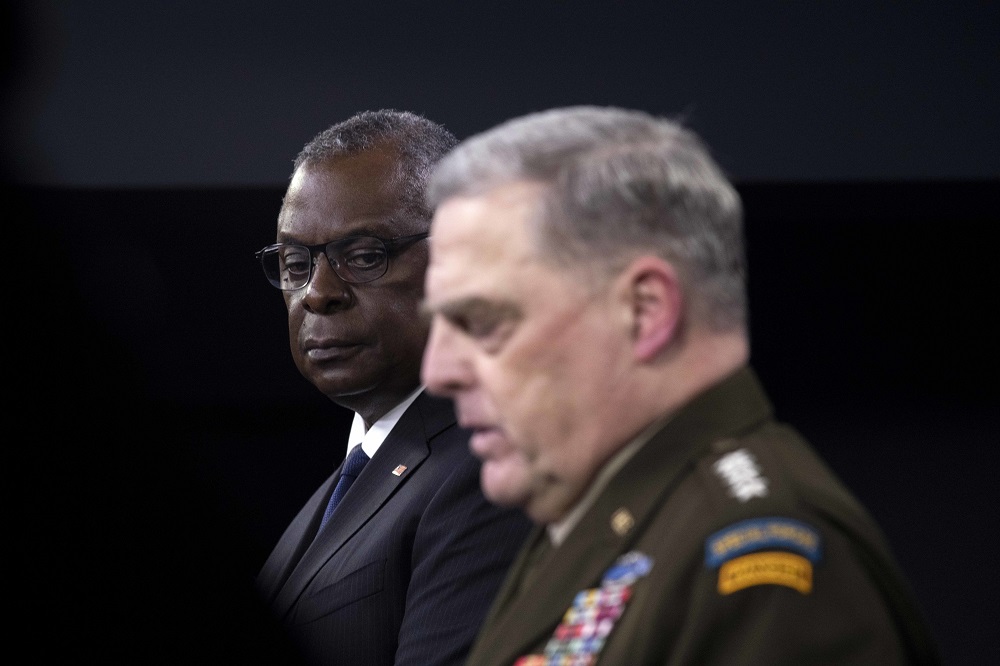

The Hill (“Defense secretary blames State Department for delay in Afghanistan evacuation“):
Defense Secretary Lloyd Austin on Wednesday blamed the State Department for the last-minute evacuation of allies from Afghanistan. “The call on how to do that and when to do it is really a State Department call,” Austin said in response to a question from Rep. Jim Langevin (D-R.I.).
The Biden administration has come under intense scrutiny for a chaotic withdrawal that left behind many Afghan allies, including those seeking a special immigrant visa (SIV) following their assistance to the U.S. military.
Austin said the State Department pumped the breaks on a quick exit following pushback from then-Afghan President Ashraf Ghani. “Their concerns rightfully were that, No. 1, they were being cautioned by the Ghani administration that if they withdrew American citizens and SIV applicants at a pace that was too fast, it would cause a collapse of the government that we were trying to prevent. And so, I think that went into the calculus,” Austin said.
He also said that slow SIV processing stalled the military operations. “A number of things kind of came together to cause what happened to happen. But again, we provided our input and we certainly would have liked to seen it go faster or sooner,” Austin said.
For his part, Langevin criticized the Biden administration for waiting well into the withdrawal to begin its rushed evacuation. “I wish the administration had been more thoughtful and not had rushed this. I’ve yet to hear the answer to the question, though, of why did we not start withdrawing American citizens and SIVs sooner. We knew we were going to be withdrawing,” he said.
Rep. John Garamendi (D-Calif.) said lawmakers had been given assurances from Ghani and other Afghan leaders they would be able to stabilize the country so long as there was not a massive exodus of Afghans. “They were very, very confident that they would be able to maintain their government through the reduction and the withdrawal of American troops. … they also said that they did not want to allow Afghans to leave. That’s what They specifically told us they did not want Afghans to leave — obviously Ghani decided that he would leave,” he said, referencing Ghani’s rushed departure from Afghanistan.
Axios (“Scoop: Milley’s blunt private blame for the State Department“):
In a classified briefing with senators on Tuesday, Joint Chiefs Chairman Mark Milley directly blamed the State Department for a botched evacuation from Afghanistan, saying officials “waited too long” to order the operation out of Kabul’s airport, two sources with direct knowledge of the briefing told Axios.
Why it matters: Those private remarks were far more blunt than Milley’s public testimony, in which the nation’s top general said the issue of whether the order should have been given earlier is an “open question that needs further exploration.”
The big picture: Two days of testimony from Milley, Defense Secretary Lloyd Austin and Gen. Frank McKenzie, the head of U.S. Central Command, underscore the finger-pointing and deep divisions between the State Department and the Pentagon.
[…]
During a closed session after Tuesday’s public testimony before the Senate Armed Services Committee, Sen. Tammy Duckworth (D-Ill.) directed a general question to Austin about lessons learned from the withdrawal. Milley jumped in to say that the evacuation of civilians — which Duckworth had not specifically asked about — needed to happen earlier.
The top U.S. general acknowledged that there’s often disagreement between the State Department and Pentagon in general, but that it was particularly pronounced in this instance. A third source, defending Milley, said the general “wasn’t blaming anybody per se, but was speaking from a purely military perspective. The quicker we moved out non-combatants, the safer they would be.”How it works: The State Department is responsible for triggering what’s called a noncombatant evacuation operation (NEO), which is carried out by the military. Austin testified publicly that he ordered CENTCOM to begin preparing for a potential NEO weeks after Biden’s announcement in April that the U.S. would withdraw from Afghanistan. But the State Department did not order the mission until Aug. 14 — one day before Kabul fell to the Taliban. A senior State Department official pointed to the fact that, as Milley himself repeatedly testified, nobody believed that the Afghan security forces would collapse in 11 days. It was only because the military had prepositioned forces in the region and run practice exercises, Austin testified, that thousands of troops were able to arrive in Kabul and secure the airport after 48 hours of chaos.
For the record: “Following the president’s decision to withdraw U.S. military forces from Afghanistan, CENTCOM updated contingency planning for a non-combatant evacuation operation, in coordination with the Department of State, including Embassy Kabul,” a senior administration official told Axios. “Senior leaders from the National Security Council, State, DoD, CENTCOM and the intelligence community discussed the planning during a table-top exercise on August 6.” “During that exercise, no DoD official, civilian or military, argued for triggering a NEO. If DoD had been pushing for an earlier NEO, we would have expected to have heard those calls during the discussion.”
Flashback: Blinken was the first senior Biden official to testify before Congress on Afghanistan. He faced sharp criticism and calls to resign from several Republicans but largely remained calm under pressure.
“We have to admit it was the State Department and the White House that caused this catastrophe, not the Defense Department,” Rep. Mike Rogers (R-Ala.), the House Armed Services Committee’s top Republican, said after hearing the generals’ testimony on Wednesday.
This deflection strikes me as semantic bullshit. It’s true that NEOs are authorized by State and carried out by DoD. But, as the “senior administration official” implies, had DoD pushed hard for one, State would almost certainly have acquiesced.
My strong sense, therefore, is that DoD leadership had an overly optimistic picture of how long they had to carry out operations before the Ghani government collapsed. From all accounts, nobody at the senior level of the US Government thought that it was going to collapse damn near instantaneously. If, however, State balked at ordering a NEO in the face of DoD demands, it was up to Austin, Milley, or the CENTCOM commander to go to the President and/or the NSC to press their case.
There is, therefore, no plausible scenario where State bears the bulk of the blame. Either all of the key players share equal blame for failing to anticipate the collapse of the Ghani government or President Biden himself overruled DoD in favor of State’s recommendation.