


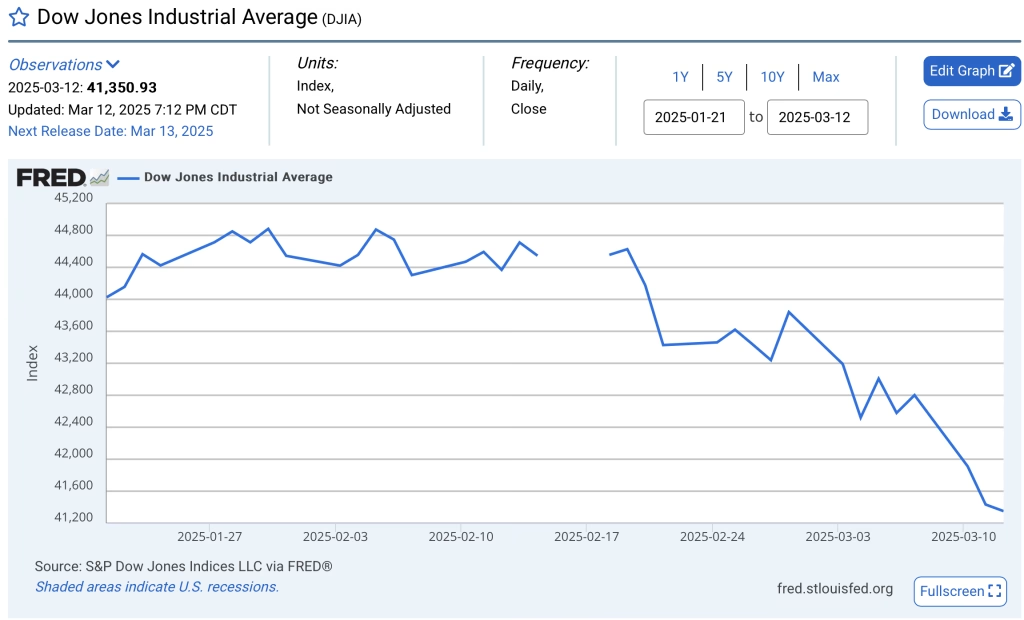
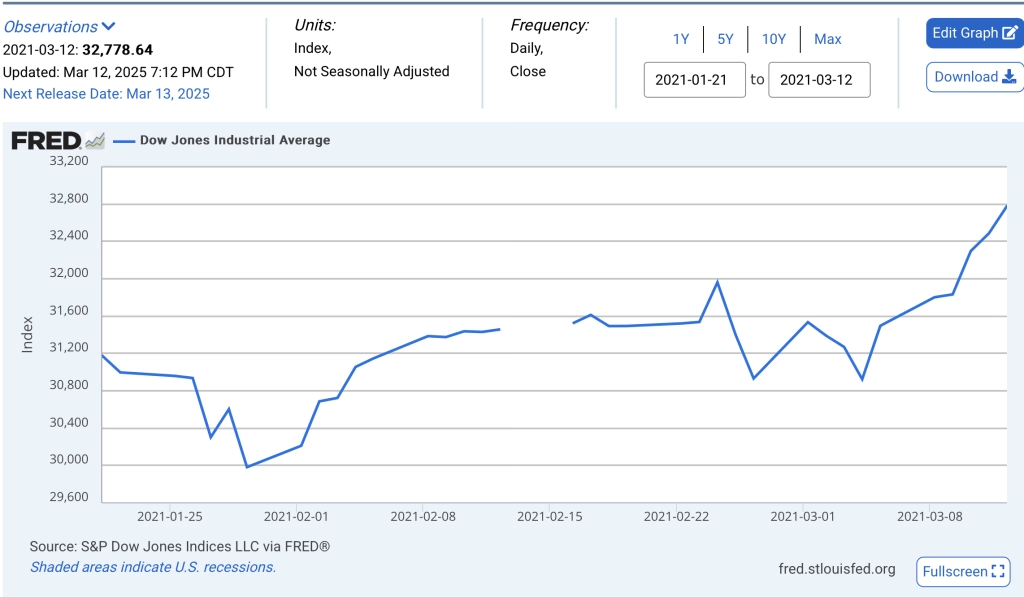
So, I made the mistake of commenting on a local news story on Facebook, as old retired fools tend to do. The story was about the economy, and I was replying to someone who was defending Trump’s policies by saying that these things take time. My retort was a graph of the DJIA over the last month, which noted what he had accomplished in the last month. The person then told me that “this always happens” with a new administration. Not surprisingly, my response was to provide the numbers for 2017 (first Trump term) and 2021 (Biden’s term), which clearly demonstrated that, no, in fact, a drop of this nature is not the norm.
The DJIA has dropped 2,674.25 points from Trump’s first full day in office (1/21/25) through yesterday (3/12/25).
For the same timeframe in 2021, the DJIA gained 1,602.63.
In 2017, the number was 1,103.07.
It is true that in 2009, the DJIA was down 779.11 points over that period of time, but that was during the Great Recession that had started the year prior.
(And yes, I know that a better comparison would be percentage changes, but I am only willing to take the work needed for this post so far. This is already more research and documentation than a FB comment deserves!).
I found this FRED tool this morning that provides easy graphs, which is why my FB rumble has expanded into a post.
Here’s Trump’s 2025 graph:
Here’s the same period for Biden.
And here’s Trump’s 2017 (I don’t have Obama’s for 2009 because the database doesn’t go back that far).

Look, I get all the standard caveats about the DJIA not being the real economy, as well as the fact that one seven week period does not necessarily mean anything in the long run.
But I think it is pretty clear that what we are witnessing is, in fact, unusual. But more to the point, it is a direct reaction to Trump’s tariff policies. He is actively creating uncertainty, and the markets don’t like it. This is a man-made economic mess that is not only unnecessary, but that makes no sense.
For all the flaws of the Dow and the shortcomings of market-watching, this is a signal that these policies are not being well-received by the business class.
Nonetheless, the propaganda and ignorance continue.
For example, via the Independent, Laura Ingraham urges Fox viewers to ‘ignore’ stock market meltdown: ‘Trump is good for business’.
“Just ignore the sky-is-falling reports and the regime press,”
The bizarre thing about that formulation is that the “regime” is controlled by Trump, and things like Fox News behave very much like “the regime press.”
I saw a clip of a Trump official (IIRC) saying something similar about ignoring the market, but I can’t find it.
Somehow, I think that if the DJIA was down somewhere in the vicinity of 7.5% in the first 7 weeks of the Harris administration that FNC and its friends would be telling us to ignore the Dow.
And, of course, there is this.
And to be clear: Yes, a tariff is a tax. And no, the costs are not all born by someone else. While it is possible that a company might absorb some of the cost, the majority of it will be passed on to consumers.
Note, too, if the goal is negotiations with other countries (often for things like fentanyl, that have nothing to do with jobs, the economy, etc.), Trump’s tariffs will not bring in revenue, because if they are negotiating tactics, they will be removed once Trump gets whatever it is he is allegedly after.
If the goal is forcing on-shoring of manufacturing (which is a dubious proposition), it will take time (years, if not a decade) and in the meantime, prices go up and Trump can’t use tariffs as negotiating tools because if they are to be tools of mercantalism, they have to stay in place.
On that last count, there is no guarantee that companies will decide that manufacturing in the US is the most economical option, even with tariffs, which could result in the opposite effect.
Meanwhile, it should be noted that if tariffs on imported items are put into place, this will lead to an increase in prices for domestically produced items as well. Consider that the basic logic of competition suggests that I should sell my products at as low as price as I can while still maximizing profits. If I have a competitor, part of my goal is to price my products competitively, hopefully at a level lower than my competitor. This drives prices downward. If my competitor is forced by tariffs to raise their price 25%, I can raise mine 20% or 24% and still undercut them, assuming that our pre-tariff prices were competitive.
So, remember a tariff regime not only raises the prices of imported goods, it incentivized price increases on domestically produced products as well.
This is all Economics 101.
In regards to a good discussion of tariffs, I recommend the recent episode of the Ezra Klein Show, Why Trump’s Tariffs Won’t Work.









