

WaPo (“Donald Trump removed from Maine primary ballot by secretary of state“):
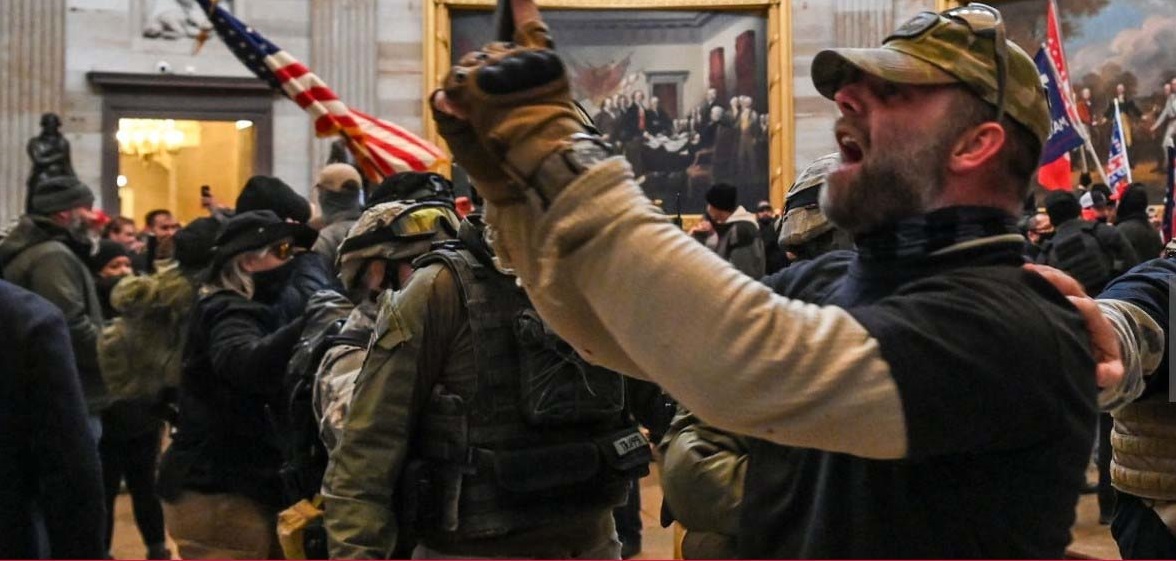
Maine barred Donald Trump from the primary ballot Thursday, becoming the second state to block the former president from running again because of his actions before and during the Jan. 6, 2021, attack on the U.S. Capitol.
The decision by Maine Secretary of State Shenna Bellows (D) is sure to be appealed. The Colorado Supreme Court last week found Trump could not appear on the ballot in that state under a part of the U.S. Constitution that prevents insurrectionists from holding office. The Colorado Republican Party has asked the U.S. Supreme Court to review the case, which could resolve for all states whether Trump can run again.
Both states have temporarily put their decisions on hold so Trump can pursue appeals.
In California, the nation’s most populous state, the secretary of state certified Trump’s name on Thursday, despite a request from the state’s lieutenant governor to consider excluding him on constitutional grounds. Gov. Gavin Newsom (D) had pushed back on the idea, saying Trump should be defeated at the ballot box.
[…]
“The events of January 6, 2021 were unprecedented and tragic,” Bellows wrote in Thursday’s decision. “They were an attack not only upon the Capitol and government officials, but also an attack on the rule of law. The evidence here demonstrates that they occurred at the behest of, and with the knowledge and support of, the outgoing President. The U.S. Constitution does not tolerate an assault on the foundations of our government, and [Maine law] requires me to act in response.”
Trump campaign spokesman Steven Cheung said Trump would quickly appeal the Maine decision.
“Democrats in blue states are recklessly and un-Constitutionally suspending the civil rights of the American voters by attempting to summarily remove President Trump’s name from the ballot,” Cheung said in a statement. “Make no mistake, these partisan election interference efforts are a hostile assault on American democracy.”
Colorado, Maine and more than a dozen other states hold their primaries on March 5, which is also known as Super Tuesday. Election officials need firm answers on who can appear on ballots weeks before then so they can print ballots and mail them to absentee voters, including ones who are overseas.
The challenges to Trump’s candidacy have focused on primaries because Republicans won’t choose their nominee until states hold their nominating contests and the party holds its national convention in July. If Trump’s ability to run has not been resolved by then, attention would shift to the general election.
Trump’s opponents have targeted their efforts to states where it is easiest to object to a candidate’s eligibility. In Maine, voters filed their challenges under a state law that allows them to lodge objections with the secretary of state. Bellows held an eight-hour-long, live-streamed hearing on those challenges on Dec. 15 under a provision of that law and determined Thursday that Trump’s name cannot appear on Maine’s primary ballot.
Bellows cited the Colorado decision in reaching her conclusion that the Jan. 6 attack “was violent enough, potent enough, and long enough to constitute an insurrection.” And Trump, she said, incited that insurrection by repeatedly and falsely claiming the election was stolen, summoning his supporters to Washington, telling them to “fight like hell” in a speech just as Congress was preparing to certify Joe Biden’s win, and criticizing Vice President Mike Pence on social media as the attack unfolded.
Trump, she wrote, “used a false narrative of election fraud to inflame his supporters and direct them to the Capitol to prevent certification of the 2020 election and the peaceful transfer of power.” Trump, she added, “was aware of the likelihood for violence and at least initially supported its use given he both encouraged it with incendiary rhetoric and took no timely action to stop it.”
Trump has five days to appeal the determination to Maine’s Superior Court. From there, the appeal could go to the state’s Supreme Judicial Court and the U.S. Supreme Court.
I’ve written about this matter numerous times, both when the idea of banning Trump under Section 3 was floated in theory and after the Colorado decision. I shan’t repeat myself here other than to say that I expect the Supreme Court to overturn it and think that would be the right decision.
It was already urgent that they take the case and do so quickly before the Maine decision:
NYT (“Supreme Court Urged to Move Fast on Trump’s Ballot Eligibility“):
The Supreme Court was asked on Thursday to fast-track its review of the stunning Colorado Supreme Court ruling that former President Donald J. Trump was ineligible to appear on the state’s primary ballot.
The request was made by the six voters who won in the state court, which ruled that Mr. Trump was subject to Section 3 of the 14th Amendment. That provision bars officials who promised to support the Constitution from holding office again after engaging in insurrection.
The voters also told the justices that they would not oppose review of that decision.
There are cases pending in several states challenging Mr. Trump’s eligibility on the same grounds. A definitive ruling by the Supreme Court would apply nationwide and settle the matter.
The voters’ request to accelerate the case came the day after the Colorado Republican Party asked the justices to review the state court’s ruling. Mr. Trump has not filed a promised petition seeking review of the ruling, and his general practice has been to move as slowly as possible in the legal proceedings against him.
[…]
In a motion, lawyers for the party proposed a brisk schedule, asking the justices to resolve the case by March 5, when multiple states hold primaries on a day known as Super Tuesday. If it is not, they said, voters “will face profound uncertainty and the electoral process will be irrevocably damaged.”
“Under the standard briefing schedules provided by this court’s rules, the case would not be argued and decided until well into 2024,” the motion said. “Meanwhile, 2024 is a presidential election year, with the first primary elections and party caucuses scheduled to take place in January and more than half of the state primary elections to be concluded by the end of Super Tuesday. ”
In their own motion, the six voters who prevailed in the Colorado Supreme Court urged the justices to move even faster. They asked that the U.S. Supreme Court order Mr. Trump to file his petition seeking review by Jan. 2 and that the justices consider whether to hear the case at their private conference on Jan. 5.
[…]
Voting in Colorado is almost exclusively by mail, and state officials start mailing ballots to in-state voters on Feb. 12. “Having a decision on the merits by Feb. 11 would ensure that every in-state Colorado voter knows of this court’s decision before receiving their ballot and casting their primary vote,” the voters’ motion said.
The motion added that the case presents questions of “exceptional national importance.”
That two states have seized on the novel theory that a 155-year-old provision aimed at Confederate leaders excludes those partisan officials simply deem “insurrectionists” is, well, bold. Congressional Research Service legislative attorney Jennifer K. Elsea’s legal sidebar on Section 3 is an excellent backgrounder, highlighting how uncharted this territory is.
Invocation of the Disqualification Clause raises a number of novel legal questions involving the activities that could trigger disqualification, the offices to which disqualification might apply, and the mechanisms to enforce disqualification. The clause has been seldom used, and the few times it has been used in the past mainly arose out of the Civil War—a very different context from the events of January 6. It is therefore unclear to what extent historical precedents provide useful guidance for its application to the events of January 6.
[…]
Enacted in the aftermath of the Civil War, Section 3 seems specifically designed for the Reconstruction Era but may be applicable to modern times as well. Section 3 was for the most part used only for the short period between its ratification and the 1872 enactment of the Amnesty Act. The Amnesty Act removed the disqualification from most Confederates and their sympathizers and was enacted by a two-thirds majority of Congress in accordance with the terms of Section 3. Some argue the Amnesty Act operates retrospectively. In a recent case, Cawthorn v. Amalfi, discussed in this Legal Sidebar, the U.S. Court of Appeals for the Fourth Circuit found that the act does not apply to later insurrections or treasonous acts.
Section 3 of the Fourteenth Amendment does not expressly require a criminal conviction, and historically, one was not necessary. Reconstruction Era federal prosecutors brought civil actions in court to oust officials linked to the Confederacy, and Congress in some cases took action to refuse to seat Members. Congress last used Section 3 of the Fourteenth Amendment in 1919 to refuse to seat a socialist Congressman accused of having given aid and comfort to Germany during the First World War, irrespective of the Amnesty Act. The Congressman, Victor Berger, was eventually seated at a subsequent Congress after the Supreme Court threw out his espionage conviction for judicial bias. Recently, various groups and organizations have challenged the eligibility of certain candidates running for Congress, arguing that the candidates’ alleged involvement in the events surrounding the January 6, 2021, breach of the Capitol render them ineligible for office. No challenges have to date resulted in the disqualification of any congressional candidate. A New Mexico state court, however, has removed Otero County Commissioner Couy Griffin from office and prohibited him from seeking or holding any future office based on his participation in, and preparation for, the January 6 interruption of the election certification.
Regardless, I’d say the issue is now ripe for Supreme Court resolution. It’s a matter of incredibly high stakes, potentially barring the man who might otherwise win next year’s presidential election from running. And, as a practical matter, he needs to be either eligible or not in a matter of weeks.









