
A new Pew study on the media habits of the American people finds that people who rely on a combination of traditional news sources and the Internet are smarter and more affluent than those who rely on either alone and, not surprisingly, “spend more time with the news on a typical day.”
What’s people’s favorite news topic? The weather, of course, which outpolls its closest competitor, crime, by twenty points.
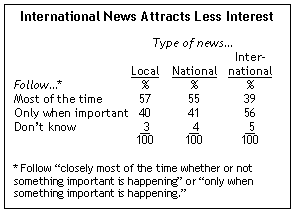
This sets the stage for a more general, if obvious, finding: most Americans have an interest in news directly in proportion to how it impacts their daily lives:
A 57% majority follows local community news closely most of the time, whether or not something important is happening. Similarly, 55% follow national news most of the time. By contrast, only 39% follow foreign news most of the time, and the majority (56%) follows it only when something important is happening.
I should note that I’m a distinct outlier, in that I’m only peripherally aware of local news even though I’m an avid consumer of national and international news. And, again, these trends vary demographically:
While interest in local news is fairly consistent across major demographic groups, interest in national and international news is driven in part by socioeconomic factors. College graduates are significantly more likely than those who never attended college to follow both national and international news most of the time, not just when something important is happening. In addition, those with higher annual incomes follow national and international news on a more consistent basis.
 There’s also a huge gender gap:
Men are particularly drawn to news about science and technology, sports, business and finance, international affairs, and Washington politics. For example, fully 71% of those who follow science and technology news very closely are men, while only 29% are women.
Women, on the other hand, make up a disproportionate share of the audiences for celebrity and entertainment news, health news and news about religion. Among those who follow health news very closely, 64% are women while 36% are men. In addition, women outnumber men among those who closely follow news about the weather, travel, culture, and community news.
Can Larry Summers have his job back, now?
Given that only a slight majority of the public follows national news regularity and that two-thirds tend to ignore international news, would it surprise you to learn that people are generally ignorant on these subjects? Me neither. For the record, though:
About half of Americans (53%) can correctly identify the Democrats as the party that has a majority in the U.S. House of Representatives. In February 2007, shortly after the Democrats gained control of the House after a dozen years of GOP rule, many more people (76%) knew the Democrats held the majority.
The public is less familiar with the secretary of state (Condoleezza Rice) and the prime minister of Great Britain (Gordon Brown). About four-in-ten (42%) can name Rice as the current secretary of state. The public’s ability to identify Rice has not changed much over recent years: In April 2006 and December 2004, shortly before she was sworn in, 43% could correctly identify her.
The prime minister of Great Britain is not well known among the public. Just more than a quarter (28%) can correctly identify Gordon Brown as the leader of Great Britain.
Overall, 18% of the public is able to correctly answer all three political knowledge questions, while a third (33%) do not know the answer to any of the questions.
Steve Benen doesn’t know whether to laugh or cry.
Maybe my perspective is skewed because I just finished reading Rick Shenkman’s “Just How Stupid Are We?” but at a certain point, the political world is going to have to come to grips with the fact that a striking percentage of the electorate has no idea what’s going on.
That’s been the case since, oh, Walter Lippman’s day.
I argue that representative government, either in what is ordinarily called politics, or in industry, cannot be worked successfully, no matter what the basis of election, unless there is an independent, expert organization for making the unseen facts intelligible to those who have to make the decisions. I attempt, therefore, to argue that the serious acceptance of the principle that personal representation must be supplemented by representation of the unseen facts would alone permit a satisfactory decentralization, and allow us to escape from the intolerable and unworkable fiction that each of us must acquire a competent opinion about all public affairs. It is argued that the problem of the press is confused because the critics and the apologists expect the press to realize this fiction, expect it to make up for all that was not foreseen in the theory of democracy, and that the readers expect this miracle to be performed at no cost or trouble to themselves. The newspapers are regarded by democrats as a panacea for their own defects, whereas analysis of the nature of news and of the economic basis of journalism seems to show that the newspapers necessarily and inevitably reflect, and therefore, in greater or lesser measure, intensify, the defective organization of public opinion.
The mass of people have never been particularly informed about the world around them. While news junkies may sneer at those who don’t share their avocation for public affairs, the fact of the matter is that there’s not much reason for the average American to spend his precious free time reading about, say, the intricacies of the situation in South Ossetia. Not only does it have a negligible impact in his life, his knowing much about that topic would have precious little impact on public policy.
For that matter, those who spend their lives making it their business to know about such things wildly vary in their opinions about them! Even those at the highest levels — former secretaries of state, national security advisors, and the like — share no consensus at all about what to do about these matters or, in some cases, rather fundamental facts about them. What hope does an amateur have of mastering such a subject?








