
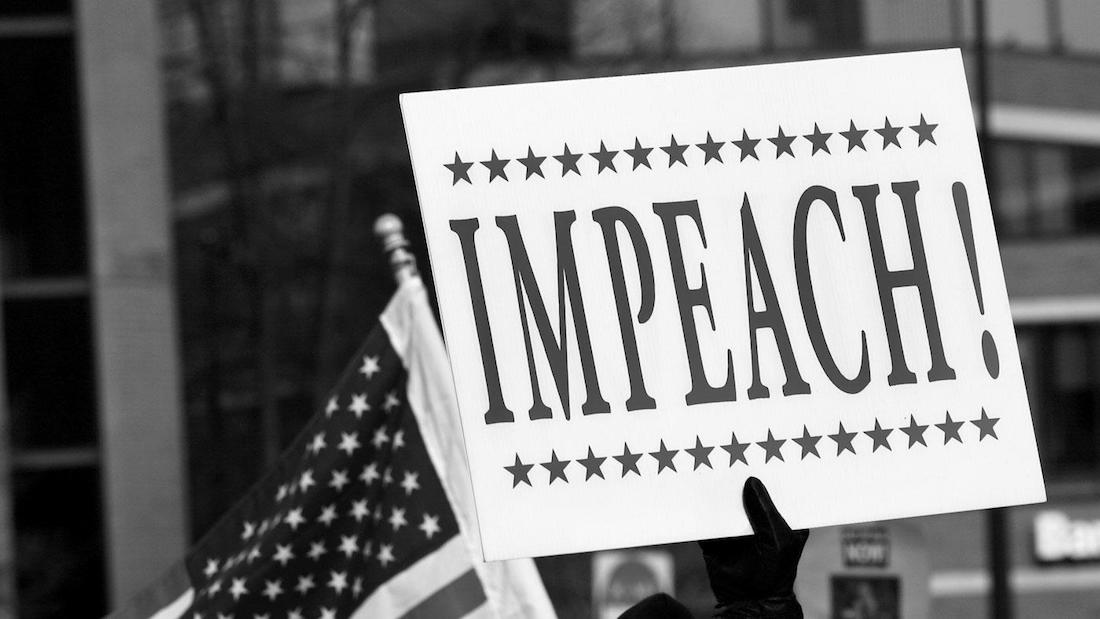

Legal scholars Jean Galbraith and Michel Paradis document rather extensively that, in the very action that created the concept of “executive privilege” in American law, President George Washington and his advisors explicitly excluded its application to an impeachment inquiry.
President George Washington’s decision to withhold diplomatic papers from the House of Representatives with respect to the Jay Treaty has become an important precedent in current debates over executive privilege. […] Washington clearly signaled that executive privilege would not be available if the House were pursuing an impeachment inquiry. In withholding the papers, he wrote that, “It does not occur that the inspection of the papers asked for can be relative to any purpose under the cognizance of the House of Representatives, except that of an impeachment, which the resolution [requesting the papers] has not expressed.”
They cite several internal documents from the same period demonstrating that Secretary of State Timothy Pickering, Treasury Secretary Oliver Wolcott, Secretary of War James McHenry, Attorney General Charles Lee and even Alexander Hamilton (at that point, a private citizen) all believed that the only circumstances under which the President was obligated to share the internal deliberations of government in negotiating the treaty—as opposed to the finished product itself—to the House of Representatives was pursuant to an impeachment inquiry.
Galbraith and Paradis also note that,
It bears emphasizing that this mulling over the possibility of impeachment was not theoretical. The Jay Treaty was a controversy that roiled the new Republic. It created a rift that would never close between James Madison and Washington. There had been popular outcry that Washington was a traitor or at best senile. And some had spoken openly of impeachment. This backdrop makes the unity of opinion regarding the House’s entitlement to documents in an impeachment proceeding all the more impressive.
Now, the musings of Washington and his top advisors in 1796 aren’t dispositive. There has been the passage of 225 years and all manner of precedent, including rulings by the United States Supreme Court. Still, these declarations carry a certain gravitas.
Oddly, as the Findlaw summary makes clear, this question has not been settled by the courts. With respect to demands for documents in judicial proceedings, the courts have long held to a principle of presumptive but not absolute immunity. But, in disputes between the Executive and Legislative branches, the courts have largely punted, treating the matter as a political question to be resolved via the political process.
As a non-lawyer, I would argue that the President has an absolute right to refuse to release Executive branch documents—and certainly those pertaining to his own communications and decisions—to the Congress, even in the case of impeachment. This isn’t because the President is a king but simply because, practically speaking, no one has the power to make the President do otherwise. As with other Presidential malfeasance, the remedy is impeachment. Refusal to turn over documents subpoenaed by an impeachment inquiry strikes me as prima facie obstruction of justice, an impeachable offense.









