
Op-For‘s John Noonan argues in today’s Weekly Standard that it’s time to rethink the curriculum at West Point and the other service academies.
West Point and all of the service academies promote math and engineering above all other disciplines. Thayer wanted math savvy artillery officers. The Navy sought officers with a firm grasp of engineering to keep their ships running and navigate the seas under the harshest of combat conditions. And the Air Force desired officers capable of operating the service’s cutting-edge technology. It’s the perfect academic infrastructure for a young cadet, if we expect him to fight the Cold War.
Unfortunately, we are fighting a new war. Tomorrow‘s war. This is a war where we fight an enemy who understands that the battlefield lies in the human heart, not in the skies or on the seas. And while the liberal arts curriculum is precisely the school of thought needed to effectively prepare our cadets to fight in the 21st century, not one of the service academies offers a Bachelor of Arts degree.
An Army platoon leader would be better equipped to administer to tribes in Anbar province if he had a degree in International Affairs and a minor in Arabic. A Marine infantry Lieutenant might be more effective unifying warlords in Afghanistan if he spent his four years at Annapolis studying the history of central Asia. U.S. Special Forces have been deployed to over 180 different countries since 9/11, and, to be sure, the military offers them the education needed to meet that goal. But in all that training an academy cadet will only get as much foreign study as he can squeeze into his schedule between orbital mechanics and advanced calculus.
As a political science/international relations PhD whose tenure at West Point was short circuited after three semesters of the math and engineering heavy curriculum, I’m certainly sympathetic to Noonan’s point of view. It’s hardly clear that the ability to handle differential equations is an essential skill for a combat commander; indeed most ROTC grads come from other backgrounds. Then again, there’s little reason to think overly technocratic officers are the reason for our failures at counterinsurgency. After all, men like David Petraeus, H.R. McMaster, and John Nagl managed to become experts at COIN despite the handicap of being honor graduates of the Military Academy.
Regardless, I would argue that the over-emphasis on advanced mathematics and engineering courses is outmoded. West Point, at least, has recognized this and been moving in the right direction for roughly a quarter century. They were offering social science concentrations as early as 1984 and began allowing cadets to declare majors, including in the social sciences, more than fifteen years ago. They also require courses in international relations and two years of a foreign language.
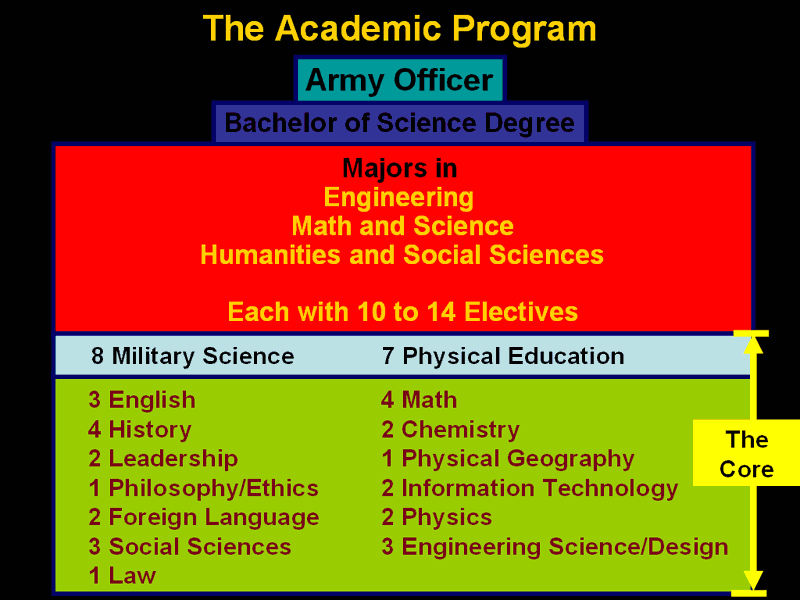
Here’s the basic curriculum as it stands now:

In addition to the military science and physical education courses, the core is roughly balanced, with 16 required humanities courses and 15 in mathematics/science/engineering. With the exception of the three engineering courses, it’s not radically more numbers-oriented than the typical bachelor of science degree at a civilian university. The eight military science courses, too, almost surely have a strong COIN component at this stage.
I wouldn’t mind seeing more history instruction and perhaps a mandatory year of Arabic language familiarization. Whether those would have made a substantial difference in Iraq, however, is doubtful.









