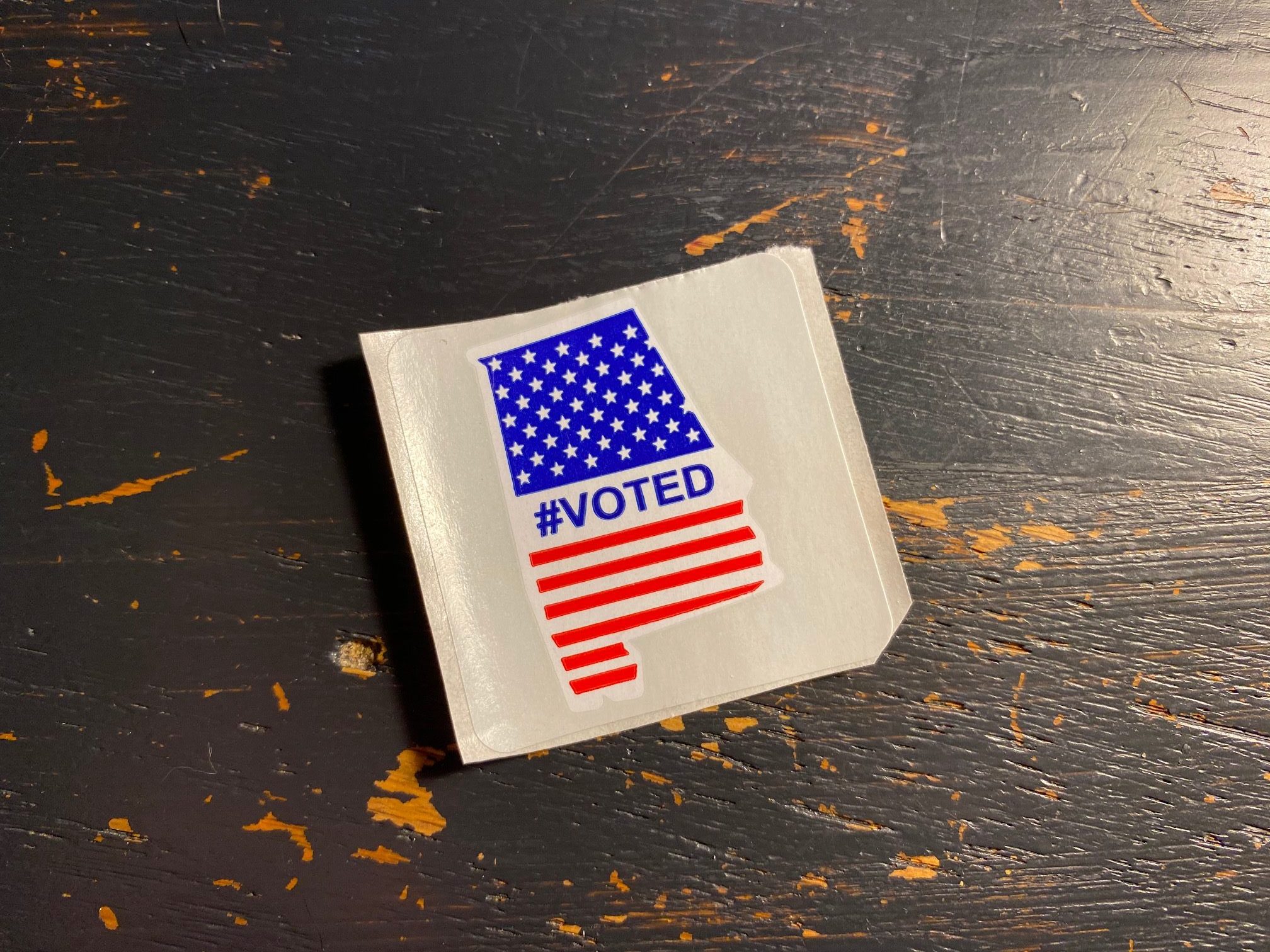
As Election Day approaches, I am doing what a lot of Americans are doing at the moment: giving the sample ballot a look.
Here’s the ballot for Montgomery County, AL:

The most prominent race is for Governor, as the state has a choice between a smart, manifestly qualified person who can talk about public policy using full sentences and even paragraphs, and Senator Coach, who can’t quite fully explain where he lives but is sure that Sharia Law is coming for us all, but only after all our kids are transitioned at school without so much as a permission slip being sent home. Because, you know, if there is anything that Muslim fundamentalists love, it’s trans people! There is also the very real threat of socialism and communism taking over as well!
If anyone is looking for a situation wherein yes, the voters should collectively know better, this is it. And it is also the kind of election that is least amenable to my reform arguments, because it is a straightforward contest for a single executive office in a partisan environment clearly skewed to one party.
Now, my design concerns are clearly relevant for the state legislature, as the way the districts are drawn heavily skews both chambers to the Republicans. As I noted in a piece I wrote in 2022, the state is roughly 60:40 R:D, and yet:
The legislature elected in 2018 had the following partisan breakdowns. The State Senate was 27 Republicans and eight Democrats or 77.14% to 22.86%. The State House of Representatives was 77 Republicans and 28 Democrats (73.33% to 26.67%).
The 2022 outcomes were similar.
But I digress.
Speaking as a voter, I will happily vote for Doug Jones over Tommy Tuberville, but the race is also a mini-morality play that illustrates that partisanship is the dominant force in American politics; Tuberville is likely to win in November because he is the Republican nominee in a heavily Republican state.
There is some hope that the anti-Republican mood will be enough to overcome the redrawing of my House district, but perhaps not. Because of the late-in-the-game redistricting fight that has all but guaranteed the outcome, I have paid very little attention to that race. I expect non-election nerds have paid even less attention (although the airwaves and my mailbox have both been focused on that contest).
So, voting against Tuberville will give me some psychic joy, and maybe just maybe Democrat Shomari Figures can win reelection to the House. But aside from that, the races are all essentially non-competitive. Indeed, it hit me that I barely know who is running for US Senate. While I am familiar with the Republican nominee for Senate, Bradley Byrne, as he has had a prominent career in the state for some decades now, I have already forgotten the Democratic nominee’s name (and I just looked a few minutes ago). I will vote for him, but I also know that it won’t matter in the slightest. Due to the non-competitive nature of that race, I am not even sure I have seen any commercials.
On the one hand, I understand that the state is overwhelmingly Republican, so I expect Republicans to do well in statewide races, but it is more than a little dispiriting that a state that should have an R-D split for Congress that is either 5-2 or even 4-3 under some conditions will more likely be 7-1, and most of the races are unlikely to be close.
I am a lifelong student of democratic governance and elections who even fancies himself a pro-democracy public intellectual, and I cannot get especially invested in elections in my state because there is no real competition for power.
Imagine how most citizens feel in terms of their engagement levels.
The reality is that almost all, if not all, of the races on the ballot are foregone conclusions.
There are 23 contested offices on the ballot, with between six and nine being uncontested (depending on one’s State Senate, State Representative, and Board of Education districts). There is a mix of D-only races and R-only races, reflecting that the state is predominantly Republican, but the county is majority Democrat. I would note that having a lot of uncontested offices is not a sign of a healthy democratic system.
When I look at a ballot like this, which is pretty typical for the United States, I see a couple of things.
First, it reinforces the role played by parties. Most people do not have adequate information to decide most of these offices, insofar as they do not have much in the way of personal information about candidates and the offices they seek beyond the top line, and so what do they do? They rely on the party label as the most significant bit of information they have. This is reinforced in Alabama since you can vote, with one mark, a straight ticket.
Second, it is a reminder that we vote for too many offices in the United States. The notion that the Revenue Commissioner for Montgomery County should be elected, to pick just one example, makes little sense.
What makes the second point all the worse is that there is only an illusion of having choices, especially in the case where offices are uncontested.