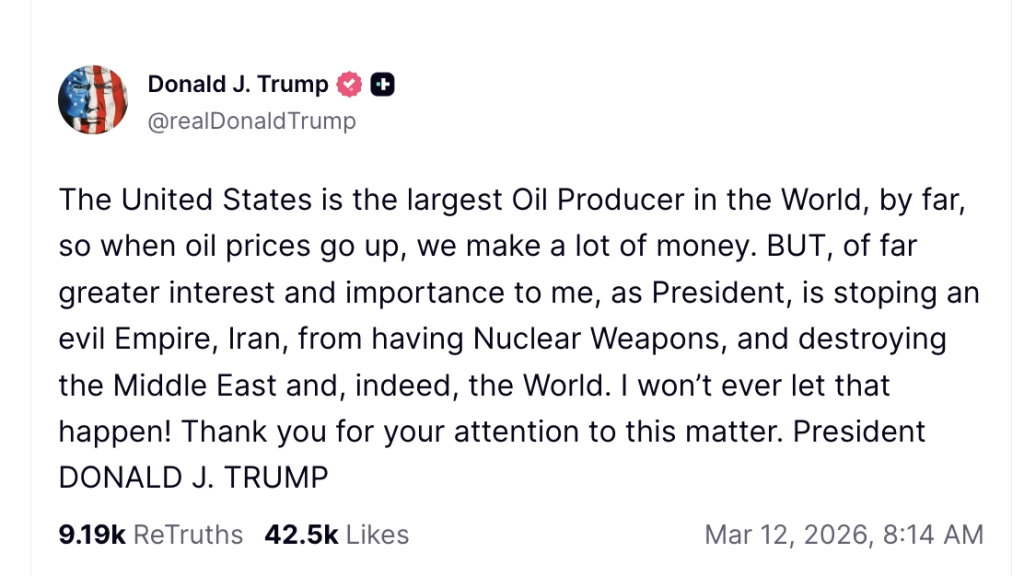
Of course, all snark and literary allusions aside, this is just another example of when he says that “we” make a lot of money, he doesn’t mean us normal people. He means, at best, the economy as a whole, but really just means the investor class. I bet he made quite a bit of money in the last couple of weeks, as it seems rather likely that some of his holdings are in oil stocks.
Steven L. Taylor is a Professor Emeritus of Political Science and former College of Arts and Sciences Dean. His main areas of expertise include parties, elections, and the institutional design of democracies. His most recent book is the co-authored A Different Democracy: American Government in a 31-Country Perspective. He earned his Ph.D. from the University of Texas and his BA from the University of California, Irvine. He has been blogging since 2003 (originally at the now defunct Poliblog).
Follow Steven on Twitter and/or BlueSky.
On the subject of impending shortages… Qatar has shut down their liquefied natural gas production. This also shuts down their helium production. Qatar produces about 35% of the world’s helium. They have already announced they will not be making their March deliveries. Spot prices have doubled. In addition to being essential for MRI medical imaging, helium is also critical in integrated circuit production. The big semiconductor companies in Taiwan and South Korea are making the kinds of comforting noises about diversified suppliers that I associate with “in two weeks, the wheels are going to fall off”.
When oil tankers idled outside the Strait of Hormuz and Brent crude spiked past $120 a barrel, something peculiar happened in Beijing. Nothing. No emergency meetings of the State Council. No frantic calls to Gulf monarchies. No diplomatic missions dispatched to broker ceasefires. Chinese state media covered the Iran war with the detached interest one might reserve for a natural disaster in a distant country—regrettable, certainly, but fundamentally someone else’s problem. For a country that imports more crude oil than any other on earth, the calm was remarkable. It was also strategic.
The Iran war has become an unexpected stress test for how China thinks about power, vulnerability, and opportunity in the global energy system. Beijing’s response reveals a country that is far less exposed to oil shocks than conventional wisdom suggests, yet still deeply aware that the geopolitics of energy can quickly turn economic advantages into strategic advantages.
What the conflict has clarified is the emerging architecture of China’s energy statecraft: build structural insulation at home, avoid military entanglement abroad, and convert crisis conditions into technological and industrial advantage. Whilst the United States scrambles to reassure allies while redeploying missile defences from Korea, and manage yet another Middle Eastern quagmire, China has been quietly constructing an alternative model—one in which energy security flows not from aircraft carriers in the Persian Gulf but from solar panels in Xinjiang, battery factories in Jiangsu as well as coal mines in the North-West. The world is taking note.
@Michael Cain:
Also about 20% of all treaded nitrate ferilisers (a lot is not traded, but it will still spike prices), 20% of liquefied natural gas, 25% of ammonia, 10% of global aluminium production, 15% of ethylene, about 5% of all petrochemicals.
In addition, which seems to being widely missed: the GCC states rely on imports for about 85% of their food requirements
@charontwo:
China is going to be hurt, and badly, by the shortages, price rises, and falling demand.
But there’s little they can directly do at this point.
Given that, the obvious play is to prep the ecnomy as best as possible for an emergency, then sit back and wait to scoop up any diplomatic and economic benefits.
For instance, a role as an intermediary.
Or part of a post-war “stabilisation coalition”.
And to benefit from a lot of countries who are coming to view a US combining recklessness and incomptence (and in particualr the US-Israel partnership) as a positive threat to their key interests.
Plus a lot of increased demand for solar panels and wind turbines.
It’s hard to know what El Taco means, because he has no idea himself.
Saw something yesterday, photoshop of a warrior in ancient Chinese armor with Trump’s face, General Don Tzu’s Art of War, “ If I don’t know what I’m doing, then neither does my enemy.”
I damn sure hope Dems are already making an ad featuring this!!!
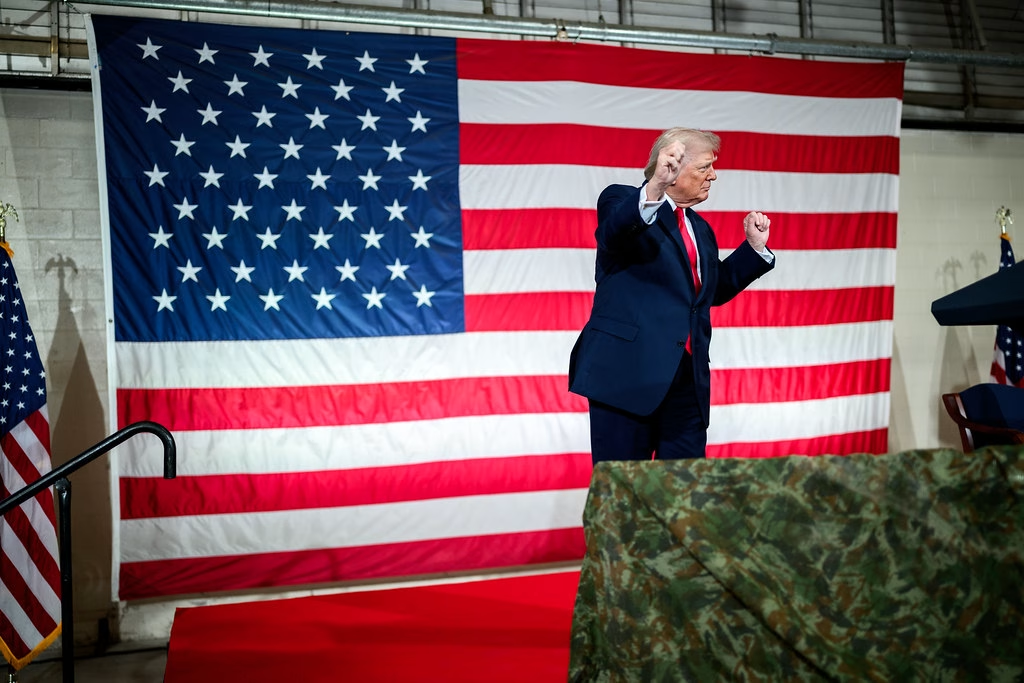
That photo…I love when he does the mental floss dance with his itty bitty hands…
On the subject of impending shortages… Qatar has shut down their liquefied natural gas production. This also shuts down their helium production. Qatar produces about 35% of the world’s helium. They have already announced they will not be making their March deliveries. Spot prices have doubled. In addition to being essential for MRI medical imaging, helium is also critical in integrated circuit production. The big semiconductor companies in Taiwan and South Korea are making the kinds of comforting noises about diversified suppliers that I associate with “in two weeks, the wheels are going to fall off”.
@Michael Cain:
Do you have links?
I’m so glad Trump is “stoping” the Evil Empire.
@charontwo:
Gasworld
Reuters
The interpretation of Taiwan and South Korea’s remarks is my own :^)
@Michael Cain:
Thanks
@CSK: Didn’t the Evil Empire used to have three members?
@gVOR10:
Yeah. Now it only has one: Iran.
How China is affected by Donny’s excellent adventure, an analysis:
“Link”
On the other hand, he’s threatening other countries to bail him out of the mess he’s made in the Gulf (I know what I said).
@Michael Cain:
Also about 20% of all treaded nitrate ferilisers (a lot is not traded, but it will still spike prices), 20% of liquefied natural gas, 25% of ammonia, 10% of global aluminium production, 15% of ethylene, about 5% of all petrochemicals.
In addition, which seems to being widely missed: the GCC states rely on imports for about 85% of their food requirements
@charontwo:
China is going to be hurt, and badly, by the shortages, price rises, and falling demand.
But there’s little they can directly do at this point.
Given that, the obvious play is to prep the ecnomy as best as possible for an emergency, then sit back and wait to scoop up any diplomatic and economic benefits.
For instance, a role as an intermediary.
Or part of a post-war “stabilisation coalition”.
And to benefit from a lot of countries who are coming to view a US combining recklessness and incomptence (and in particualr the US-Israel partnership) as a positive threat to their key interests.
Plus a lot of increased demand for solar panels and wind turbines.
@Kathy:
Saw something yesterday, photoshop of a warrior in ancient Chinese armor with Trump’s face, General Don Tzu’s Art of War, “ If I don’t know what I’m doing, then neither does my enemy.”
@gVOR10:
The alternative ending of Machiavelli’s The Prince:
Possibly.
Or Clausewitz:
😉