
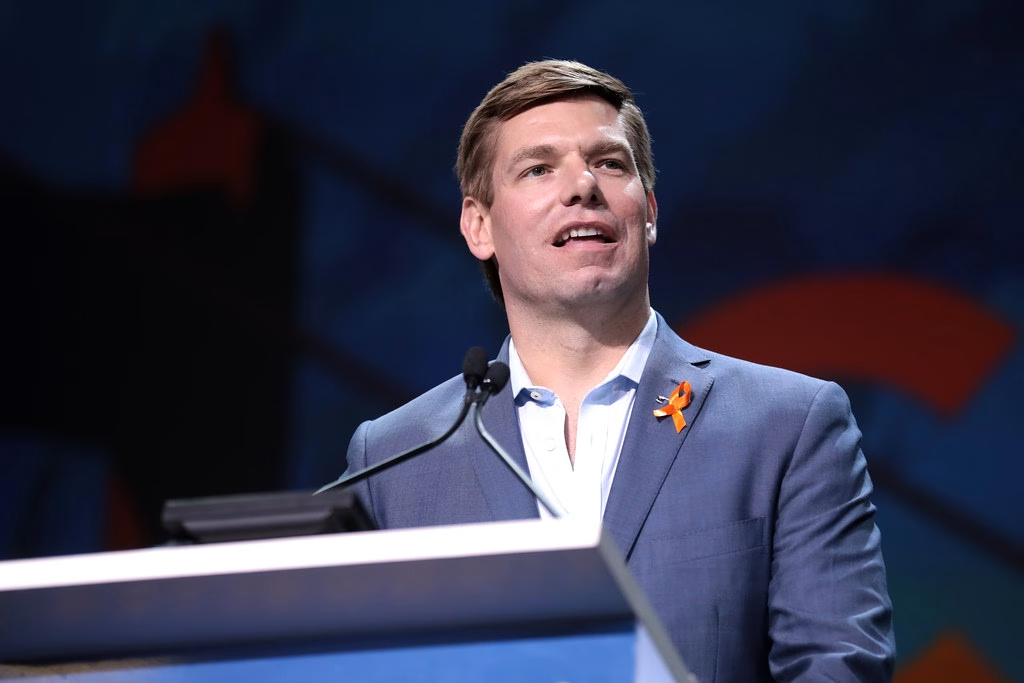
I must admit, I was highly skeptical when four women came out of the woodwork to accuse Eric Swalworth of sexual misconduct all at once. After all, he’s been in Congress since 2013, served as impeachment manager for Trump’s second impeachment trial, ran unsuccessfully for the 2020 Democratic presidential nomination, and has been running for California governor for five months and was the frontrunner among Democratic contenders. So, he’s been a very-high-profile figure for quite a long time, during which there has been ample opportunity to come forward. Let’s just say that the timing seemed convenient.
Yet, as in so many other high-profile cases, it turns out that there have been rumors for quite some time that somehow did not make the mainstream news.
POLITICO (“The whisper network that caught up to Eric Swalwell“):
Five months before Arielle Fodor, better known on social media as “Mrs. Frazzled,” helped set in motion the downfall of Rep. Eric Swalwell, she was singing his praises on Instagram.
“You know how I love to tell you when I meet a politician who acts like a normal human and not a robot!” she posted the day after the California Democrat launched his campaign for governor. “Eric is that.”
It was a fairly anodyne post for Fodor, a prodigious professional poster. But it drew an unusual response: Three people privately warning her that Swalwell was no good.
Those messages were the embers of a firestorm that in short order incinerated Swalwell’s campaign, and is now engulfing what remains of his political career.
Swalwell suspended his campaign Sunday, days after multiple news outlets reported on allegations that he sexually harassed women, had sexual relationships with subordinate staff and, in two cases, committed sexual assault. Swalwell has denied accusations he had nonconsensual sex with anybody, though he acknowledged “personal failings.”
The broad contours of Swalwell’s alleged behavior, if not the specifics, did not come as a surprise to many working in and around politics, especially in Washington. The 45-year-old cable news darling and Trump antagonist had developed a reputation for unsavory and sometimes unwanted behavior toward women. Those warnings were shared in whisper networks but rarely traveled outside the circle of political insiders.
That is, until Swalwell sought a promotion to lead the nation’s most populous state and a pair of content creators worked to spill that open secret into public view. His breakneck undoing is a testament to the striking power of a new media ecosystem in which influencers with huge audiences can not only publicize politicians, but control the political conversation. Their growing clout has thrust campaigns into a new digital Wild West, where long-buried allegations and unsubstantiated rumors can find their earliest stages of vetting, a warning for politicians at all levels, including in the run-up to 2028.
[…]
Swalwell did not respond to a request for comment on a detailed list of questions. This account is based on 20 interviews with campaign staffers, content creators, lawmakers, and people from major labor and business organizations. Many were granted anonymity to speak candidly about private discussions.
Together, they tell the story of Swalwell’s political implosion — and a political establishment now confronting its own role enabling his rise.
“Were we willing to delude ourselves or not ask questions that should have been asked? One thousand percent,” said one veteran Sacramento lobbyist who worked with interests backing Swalwell. “Did people see what they want to see or hear what they want to hear or not ask the questions they didn’t want the answers to? One thousand percent.”
Through his ubiquitous cable news hits and prominent roles in President Donald Trump’s two impeachments, Swalwell had made himself a national figure in Democratic politics. But when he launched his campaign for governor on Nov. 20, he was essentially a stranger in California’s political circles.
[…]
But as he courted political insiders, Swalwell’s blank slate became the pitch. People could see what they wanted to see — to progressive labor unions, he was an anti-Trump warrior, to business groups, he was a moderate ex-prosecutor. His campaign strategists would acknowledge to lobbyists he was light on policy, but argued that just meant he was still malleable.
The “something for everyone” pitch arrived precisely when Sacramento power players were feeling especially gloomy about the governor’s race. Many had waited to see if Kamala Harris would jump in and then pinned their hopes on Alex Padilla; both opting out of the race threw the contest wide open. Now it was November, and practically none of the major interests had chosen a candidate. Operatives were getting antsy.
The top three contenders — Swalwell, Katie Porter and Tom Steyer — were all relative outsiders to the insular world of the Capitol. Swalwell relied on two of his House colleagues, Reps. Adam Gray and Jimmy Gomez, who both served in the state Legislature, to introduce him around town. Gradually, key members of Gavin Newsom’s circle joined his campaign, and the governor’s chief consulting firm Bearstar Strategies stood up a pro-Swalwell independent expenditure committee. Newsom never endorsed in the contest, but having his team on board boosted Swalwell’s credibility.
But as Swalwell was cruising into the upper echelons of the political class, he was dogged by a social media post that Mike Trujillo, a longtime political consultant, had dashed off in early December.
“I guess Swalwell can enjoy today but folks know he slept with many of his interns while he was married, sexually harassed others while engaged, has a ton of weird texts late at night saved on former interns phones still, he gets he will have to answer for his [sic] later in the campaign, right? Endorse at your own peril people. Yo [sic] have been fully warned, just doing my public service today,” he wrote.
Swalwell had been on Trujillo’s radar since 2017, after he said he heard a story — which has not been independently confirmed by POLITICO — about a friend of a friend who had a negative experience with the congressmember. Throughout the years, he had collected similar accounts, especially during Swalwell’s short-lived presidential campaign in 2019. When Swalwell went back to being one of 435 members of Congress, he found women who had been willing to talk lost interest in sharing their stories. But now, Swalwell was seeking a more powerful job.
Trujillo’s post went viral, getting more than 140,000 views. And it caught the attention of the Swalwell campaign, which sent him a cease-and-desist letter. Trujillo complied, but figured it was inevitable that Swalwell’s behavior would come to light.
“I thought, ‘Holy shit, everyone knows this is a thing. This’ll be the easiest story ever,’” Trujillo said. He continued to pitch reporters on what he knew.
Swalwell’s allies were quick to discredit the source, as Trujillo is known for his social media bomb-throwing. He is also a longtime aide to Antonio Villaraigosa, who is running for governor, and was working on an outside committee to support the former Los Angeles mayor.
[…]
Swalwell’s campaign aides encouraged Sacramento insiders to ask him directly about the rumors. Surrogates and staffers amplified his denials, passing the message along: There’s nothing to worry about. Allegations circulating are just rival campaigns looking to drag Swalwell down.
“I told him, ‘They’re going to ask some really tough questions.’ He answered them all perfectly. Everyone called back and said, “‘He denied this, denied that. We’re satisfied,’” a senior campaign leader said. “The dude deserves a fucking Academy Award for liar of the year.”
To Sacramento insiders used to politicians hedging their language, the flat denials sounded definitive.
“We’re so used to the qualifiers … and [he said] ‘I have never had any kind of relationship with anybody that I work with,” said one influential operative. “I feel so fucking stupid.”
Members of Congress said they also took Swalwell and key surrogates at their word. Two dozen of his colleagues endorsed him, lending his campaign credibility and a veneer of establishment backing. They have all since pulled their endorsements while voicing shock at the allegations.
“These members, if they thought there was anything — do you think they would have endorsed him?” said one lawmaker who supported Swalwell.
Many players took his assertions at face value or put perfunctory effort into digging around themselves. Meanwhile, the money was beginning to flow, and both pro-Swalwell and anti-Steyer outside groups were hitting the airwaves.
“He was about to be the next governor,” said the senior campaign leader. “He was a week or two shy. You could feel the momentum. Everybody believed it.”
Most of the rest of the story focuses on the social media campaign that ultimately brought him down was orchestrated. While interesting, the real story would seem to be how the DC and California media missed the story completely for years. I strongly suspect it was for the same reasons as his big money donors went along: he’s a charming guy and they wanted to believe him.









