
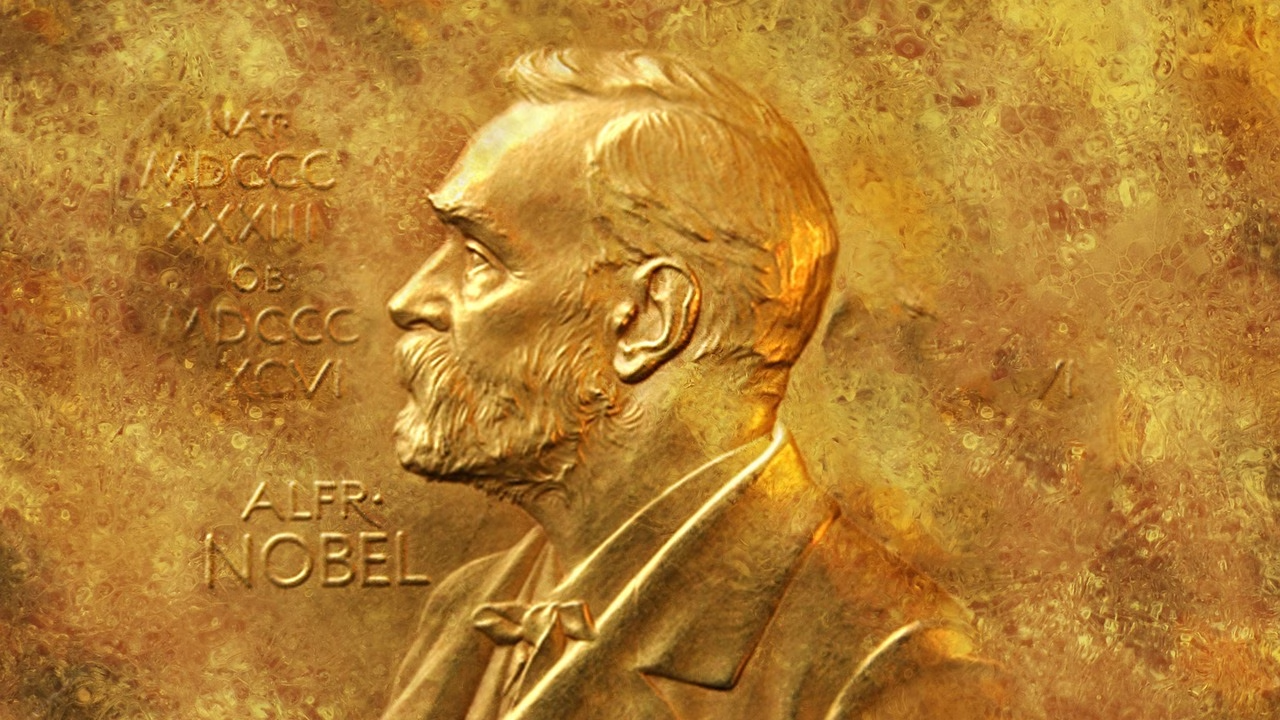
The Atlantic‘s Gisela Salim-Peyer asks a good question: “Why Does Anyone Care About the Nobel Prize?” After a longish anecdote, she explains,
The Nobel is the honor above all honors. The achievements it rewards—in science, literature, and peace—contribute “to the greatest benefit of mankind,” a tagline any other respectable award committee would be too shy to claim. How did a single award from the small nation of Sweden become the undisputed highest honor in the world? The marketing whizzes at Harvard Business School haven’t written a case study on the genius of the Nobel Foundation, but perhaps they should. The Nobel is one of the greatest branding exercises in history.
We all know the basic origin story:
Establishing a prize is easy. The hard part is getting anyone to care. Alfred Nobel, a businessman who made his fortune selling dynamite and explosives in the 19th century, was not an obvious candidate to become the namesake of the most prestigious distinction in the world. Nor were Swedish scientists, as opposed to French or British, clearly the ones who should award it. Some biographers link Nobel’s idea to establish a prize for sciences, culture, and peace to the moment he learned that a newspaper had prepared an obituary for him with the phrase “merchant of death” in the headline. That’s not how he wanted history to remember him.
So, how did it happen?
For the Nobel to become the Nobel, a few people had to get a few things really right. When rich individuals bequeath all their wealth to something other than their would-be heirs, their would-be heirs tend to resist. According to the historian Elisabeth Crawford, the author of The Beginnings of the Nobel Institution,this is one of the biggest obstacles rich men have had in using prizes to secure their legacy. The Italian businessman Jerôme Ponti, for example, had more or less the same vision as Nobel. But after his surviving relatives learned that he had donated his fortune to national academies headquartered in London, Paris, and Vienna in 1874, a group of them successfully litigated to void the will. In the 1890s, the executors of Nobel’s estate had to be a bit more clever. They preemptively reached an agreement with Nobel’s two living nephews, one of whom was particularly gracious and persuaded the rest of the family to honor the late Nobel’s wishes.
A second reason the Nobel prevailed over prizes of similar ambition was that Sweden turned it into a nationalist project. Nobel himself did not mention anything about Swedish interests, but the government and the press interpreted his bequest as a call to action for the nation as a whole. “The Swedish scientific society could not have been invested with a more glorious task,” a newspaper editorial declared. The effort turned out to be well timed. In the early 1900s, a new prize in Sweden might have seemed unlikely to compete in prestige with one given by the French Academy of Sciences or the Royal Society in London. But when World War I struck, neutral little Sweden had a claim to objectivity that the great powers didn’t.
But, wait, there’s more:
Finally, both Nobel and the executors of his will designed the rules wisely. Most prestigious prizes at the time were international only in theory; judges tended to favor their countrymen. Nobel requested that each award be given to the “worthiest person, whether or not they’re Scandinavian.” The Nobel Prize committee became the first to systematically solicit nominations from institutions abroad, turning the award into a sort of contest among nations. And one of the executors of the will had the idea of rewarding achievements no matter when they had been made, rather than just the work or discoveries of the previous year. This was a clever move, not just because some discoveries can take time to reveal their worth, but also because it turned winning the Nobel into a more sweeping victory.
So, essentially a lifetime achievement award from a neutral country trying to burnish its own image. And, of course, timing is everything:
Fortified with its elegant design choices, the Nobel quickly established a first-mover advantage. Universities can come up with new medals in physics, but they will never be able to give the same one that Albert Einstein won. Prizes with more generous cash stipends exist—the Breakthrough Prize, created by Mark Zuckenberg and other tech billionaires, pays $3 million, compared with Nobel’s sum of about $1 million, which co-winners must share—but many people would still prefer to win an award that their parents have heard of.
While obviously not at the same level of prestige, the Rock and Roll Hall of Fame is in a similar position. While it has many critics for its rather arcane politics and oft-bizarre choices, with some artists who were barely one-hit-wonders inducted and some multi-platinum-selling acts excluded—not to mention its odd definition of “Rock and Roll*”—it began at exactly the right time to honor most of the genre’s pioneers while they were still alive. In 1986, when its first class was inducted, the likes of the Beatles and Rolling Stones were still short of eligibility, allowing it to focus on the acts that founded and influenced the genre. Forty years later, we might be able to come up with a more cohesive set of honorees, but there would be no way to re-create the magic.
The same is true of the most prestigious universities. No amount of money will create another Harvard or Princeton. Timing may not be everything but it matters a whole lot.
Architects and mathematicians might protest that the Nobel doesn’t recognize achievements in their professions, that more people should know about the Pritzker and the Fields. But nobody said prizes were fair. What prizes are meant to be is cheap: Societies can save money by having everyone work toward a grand goal and rewarding only the best. Prizes are prestige in material form. Joseph Stiglitz, who won the economics Nobel in 2001, explained to me that this is precisely their advantage. In many markets, say knowledge and cultural industries, people seek excellence for its own sake, and so money is not the best incentive. America would create more total welfare, Stiglitz argues, if instead of rewarding pharma companies with monopoly patents, we gave drug researchers a prestigious prize with a cash stipend. For that plan to work, of course, we would have to convince people that the prize is indeed covetable, like the Swedes did.
I’m skeptical of this, frankly. There are all manner of prizes that are prestigious within a field, including the aforementioned Pritzker and Fields. Are people really competing for them, or just doing their best work and hoping to be recognized? The counterexamples that come to mind are the Academy Awards and the Pulitizer, which do seem to influence artists to take certain roles and reporters to tackle certain types of investigative reporting.
Which, Salim-Peyer seems to suggest, may not be all that great a thing:
Prizes aren’t all great. They distort fields by pushing hopefuls to do the type of work the prize jury will like. According to the economic historians Avner Offer and Gabriel Söderberg, the Nobel in economics—the only one that Alfred Nobel didn’t stipulate in his will—was used to build legitimacy for free-market reforms in Sweden, elevating the precepts of neoliberal economic theory to the same status as laws of physics. The main ideology the Nobel Foundation appears to be committed to, however, is the importance of preserving the prestige of the Nobel Prize—and in this it has succeeded. If there were a prize for prizes, the Nobel would win every year.
Certainly, its awardees are guaranteed a bit of press coverage every year. Then again, despite largely avoiding most pop culture reportage, I think I see more reporting on the various entertainment industry awards than I do the Nobel.
_____________
*This goes beyond the questionable inclusion of R&B and even rap acts into the Hall. The very first class had country pioneer Jimmie Rodgers, with Hank Williams Sr. joining him the next year. Both were dead years before “Rocket 88,” widely considered the first rock song, was released. Indeed. Rodgers barely lived to see the invention of the electric guitar. Dolly Parton’s induction in 2022 and Willie Nelson’s in 2023 were not as ground-breaking as suggested.









