


In preparing for an event where I will be a speaker this coming weekend (the Pulaski Institution’s Regional Summit: Place and Democracy in the Mid-South–if you happen to be in the Little Rock area, come on down), I was looking at some numbers from elections in the southern states. Mostly, I was expanding some of the analysis I did on Alabama for series for Pulaski (Lack of Competition and Election Skepticism Down South).
This is not a full blown analysis, but why not get a blog post out of the work?
I am concerned, as many readers know, about the fact that the US House in particular (but also other legislative bodies in the US, including at the state level) do not reflect the actual partisan preferences of the voters. The usage of single-seat districts distorts the relationship between voters and the elected (and it is not just, or even primarily, because of gerrymandering–it is inherent to single-seat districts, especially because the House is too small) .
As I have noted before (both in the link above, but elsewhere also), Alabama has a House delegation heavily tilted towards the Republicans in a way that does not reflect the overall electorate. Moreover, those elections are not competitive. This may be rectified to some degree by new maps that the federal courts forced on the state. Same voters, new map, different outcome.
In 2022, the House delegation in the state was 6 Rs and 1 D. It will likely be 5 Rs and 2 Ds after the November elections. The basic structure of the electorate has not changed. All that has changed is how the lines are drawn.
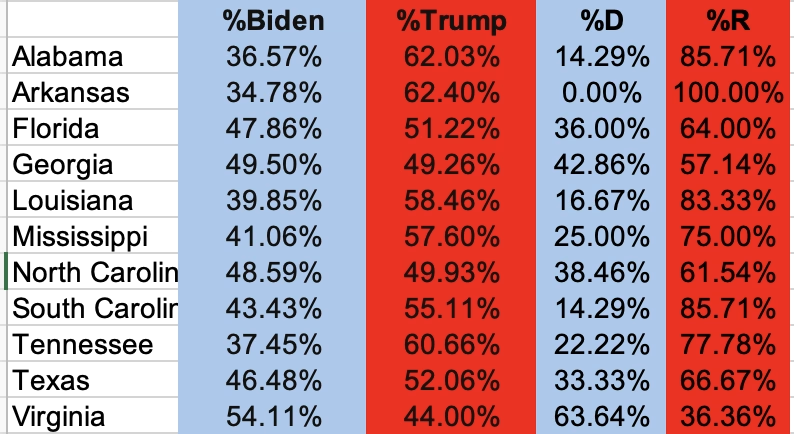
Alabama is predominantly a Republican state. As such, one should expect a Republican majority in its House delegation. A simple metric to measure partisan preference is the presidential vote. In 2020, the state voted 62.03% for Trump and 35.57% for Biden. But, the ratio of R:D in the House was 6:1 or 85.71% to 14.29%. That is a substantial disjuncture. As my linked article above notes, there are a couple of ways to try and measure the R:D ratio in the population, but there is no way that it is democratically appropriate for the state to only have 1 House seat.
Assuming it ends up with two, the ratio will be 71.43% of the seats belonging to Republicans and 28.57% belonging to Democrats. While that is closer to the estimated overall partisan breakdown, it still over-represents Republicans.
Let’s turn to an even more egregious example, the state of Arkansas where the event that sparked this post will be held. The current House delegation is 4 Rs. So, 100% of the Arkansas House delegation belongs to one party. And, like Alabama, Arkansas is a very Republican state. In 2020 it voted similarly to Alabama: 62.40% for Trump (0.37% more than AL!) and 34.78% for Biden. If Arkansas’s House seats were allocated in a way that that was at all commensurate to its partisan breakdown, we would expect a 3:1 ratio (which would still over-represent Rs a bit, but there are mathematical limits to how proportional small numbers can be divvied up).
Moreover, Arkansas House elections, like those in Alabama, are utterly uncompetitive. The average margin of victory in 2022 in the four House elections was 39.98%. But, I would note, Trump’s margin in the state was 27.62%.
It is also worth noting that the state legislature’s partisan breakdown does not reflect the statewide partisan preferences as measured by the presidential contest. While there is room for some local-level variance, the reality is that this is almost certainly the effect of single-seat districts and the distribution of voters across the state. I noted similar patterns in Alabama. The source for the below is Ballotpedia.
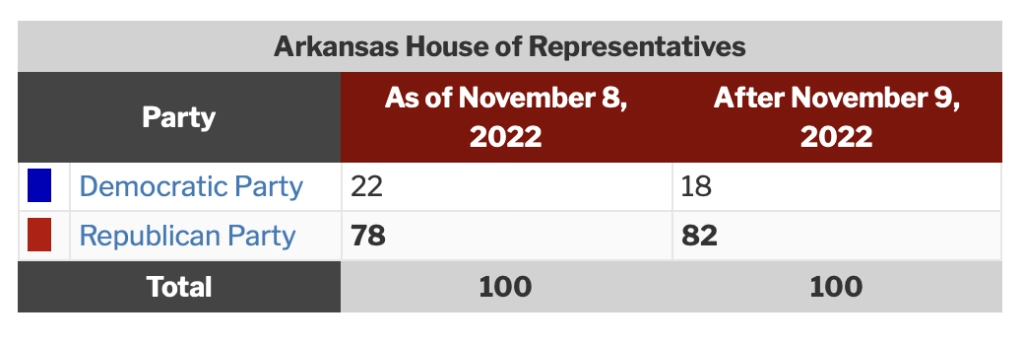
Not only do these types of circumstances lead to policy outcomes that disproportionally favor one set of partisan preferences, they undercut any incentive for the Democrats to attempt to be seriously competitive in the state. This leads to party atrophy (which I can attest is the case in the Alabama). Nobody wants to run if they know they are going to lose, especially not quality candidates. Losing means less money and less robust organizations. And that cycles just worsens over time. Ultimately, it isn’t good for anybody, at least not those who want healthy politics and governance. Competition sharpens the competitors. Lack of competition dulls them.
Here are all the former states of the CSA to define “The South” and their votes for presidential in 2020 and their House delegations as elected in 2022. The right hand columns are the percentages of US House seats by party in the respective states.
And yes, if we looked at some Democratically controlled states, we would see similar pro-Democratic outcomes. This is a broad problem in terms of representation nationally. I am focusing on the south here because it is the theme of the conference.
Just to provide some data along these lines, however, I will pick two egregious non-southern examples. Both Connecticut and Massachusetts have 100% Democratic House delegations. However, 39.21% of CT voters and 32.14% of Massachusetts voters voted for Trump. In a more representative system both states should be sending an R (or Rs) to the House.
All of this illustrates the problem with Red State and Blue State thinking. All states have substantial numbers of Republicans and Democrats and processes and structures wall off voters in a way that make them unimportant is a crime against the very idea of representative democracy.









