
Barack Obama moved to within 200 delegates of securing the Democratic presidential nomination yesterday, scoring a 56-42 blowout in North Carolina while narrowly losing, 49-51, in Indiana. Barring revelations that would make the Wright affair look insignificant in comparison, the race is all over but the shouting.
Obama Wins the Night
AP’s Calvin Woodward:
On the rebound, Barack Obama left Hillary Rodham Clinton with fast-dwindling chances to deny him the Democratic presidential nomination after beating her in North Carolina and falling just short in an Indiana cliffhanger. Obama was on track to climb within 200 delegates of attaining the prize, his campaign finally steadying after missteps fiercely exploited by the never-say-die Clinton. His campaign dropped broad hints it was time for the 270 remaining unaligned party figures known as superdelegates to get off the fence and settle the nomination.
[…]
Clinton vowed to compete tenaciously for West Virginia next week and Kentucky and Oregon after that, and to press “full speed on to the White House.” But she risked running on fumes without an infusion of cash, and made a direct fundraising pitch from the stage in Indianapolis. “I need your help to continue our journey,” she said.
And she pledged anew that she would support the Democratic nominee “no matter what happens,” a vow also made by her competitor.
Polarizing, protracted and often bitter, the contest is hardening divisions in the party, according to exit polls from the two states. A solid majority of each candidate’s supporters said they would not be satisfied if the other candidate wins the nomination. Fully one-third of Clinton’s supporters in Indiana and North Carolina went beyond mere dissatisfaction to say they would vote for Republican John McCain instead of Obama if that’s the choice in the fall.
[…]
In both states, Clinton won six in 10 white votes while Obama got nine in 10 black votes, exit polls indicated. It was a slightly better performance than usual by Clinton among whites, while Obama’s backing from blacks was one of his highest winning percentages yet with that group.
Adam Nagourney of the NYT:
Despite narrowly winning Indiana, while losing North Carolina, Senator Hillary Rodham Clinton did not fundamentally improve her chances of securing the Democratic presidential nomination. If anything, Mrs. Clinton’s hopes for overtaking Senator Barack Obama dwindled further on Tuesday night.
For Mr. Obama, the outcome came after a brutal period in which he was on the defensive over the inflammatory comments of his former pastor. That he was able to hold his own under those circumstances should allow him to make a case that he has proved his resilience in the face of questions about race, patriotism and political mettle — the very kinds of issues that the Clinton campaign has suggested would leave him vulnerable in the general election.
Beating Mr. Obama in Indiana, a state he had once been confident of winning, was an achievement for Mrs. Clinton. But it was hardly the kind of strong victory she posted in Pennsylvania and Ohio. And when paired with his comfortable victory in North Carolina — which Mr. Obama pointedly described in his victory speech as “a big state, a swing state” — it hardly seemed enough for Mrs. Clinton to convince so-called uncommitted superdelegates to rally around her candidacy.
While it remains all but impossible for Obama to win enough delegates to secure the nomination before the convention, Clinton has no chance of overtaking him in the delegate count or the (meaningless, mathematically flawed) popular vote. Mike Allen notes that she’s trying to move the target.
The campaign of Sen. Hillary Clinton (D-N.Y.) has begun urging party officials and news organizations to include the disputed Florida and Michigan delegations when figuring the number of delegates needed to win the nomination. That unorthodox approach could put her in striking distance of Sen. Barack Obama (D-Ill.) over the next month.
Harold Ickes, Clinton’s chief delegate strategist, said in a telephone interview that the senator is likely to finish the primary and caucus season on June 3 “substantially less than 100 delegates behind” Obama’s total if those two states are included. “We don’t believe that this party is going to go forward into a presidential race without seating both Florida and Michigan,” Ickes said.
Clinton has thus far been unsuccessful in her attempts to include those states, stripped of their delegates, into the mix. It’s unfathomable that Howard Dean and the Democratic Powers That Be would change their mind at this late stage, in effect handing it to Clinton, barring some monumental scandal hurting Obama.
Indeed, both Tim Russert and Matt Drudge have proclaimed Obama “the nominee.”
The Popular Vote
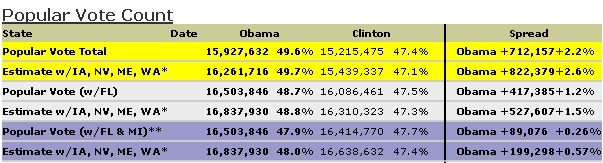
To the extent that the argument that superdelegates should obey the “will of the voters” as reflected in the popular vote — which pretty much anyone who isn’t a die-hard Clinton supporter agrees is absurd — it looks as though Obama will win that, too. Here’s the latest estimate by the folks at RealClearPolitics:

No matter how you slice it, it’s razor thin. There’s simply no reason for either candidate to think they have some great “mandate” if these numbers mean anything (which, by the way, they don’t). Still, the only way Clinton has a shot at taking the lead is with the inclusion of Florida and Michigan.
Does Hillary Finally Quit?
Several commentators think Clinton may finally have seen the light last night. TNR’s Michael Crowley asks, ” Does Hillary Know It’s Over?” He thought Clinton sounded “dispirited” last night. And Josh Marshall muses,
NBC just reported that Hillary Clinton is holding no public events tomorrow. We’d earlier reported that she’d cancelled her morning show appearances. But that’s not that surprising. There’s not a lot good to talk about. But canceling all public appearances, if that’s what they’re saying, is a different story.
So, obviously, she’s going to pack it in and graciously concede, right?
Not bloody likely. This is a Clinton we’re talking about here. Hillary Clinton, no less. While candidates always say they’re going to keep campaigning until it’s pried from their cold, dead hands right up until the point when they drop out, it’s simply not in this woman’s DNA to concede defeat.
We’ll be hearing murmurs from the Clinton camp for years to come about how this was stolen from her and that, if only Florida and Michigan had counted, it would have been hers. That’s doubly true if Obama loses to John McCain in November.
The Limbaugh Effect
The most bizarre question going around is the degree to which Rush Limbaugh’s “Operation Chaos” influenced this thing. “Not enough,” would seem the obvious answer given that Clinton underperformed the polls in both states.
ABC’s Jake Tapper reports having met one voter who was heeding Limbaugh’s commands and, if he could find one, there must be thousands! millions!
There were anecdotal reports of big turnout in Republican precincts in Indiana — with, presumably, Republican voters asking for Democratic presidential ballots.
Were they Republicans swept up in Clintonmania or Obamamania? Or did they have something more devious on their minds?
Most of the Republicans voting for Clinton or Obama this election season have been voting sincerely for those candidates — or so they told us, at any rate.
Jonathan Chait thinks he’s found a proxy for measuring the “Limbaugh Effect.”
One exit poll question asks Indiana voters who they would support in a Clinton-McCain contest. 17% of them say McCain. Of those voters, 41% say they would vote for McCain over Clinton. In other words, these voters, 7% of the Indiana electorate, voted for Clinton in the primary but have no intention of supporting her in the fall.
Now, this isn’t a precise measure of the “Limbaugh effect” — no doubt there are some Republicans who backed Obama in the primary out of anti-Clinton sentiment, but plan to vote for McCain in November. But it is a good place to start when making a ballpark estimate. And it’s a sizeable number — 7% may wind up being as big as her margin of victory.
HuffPo’s Sam Stein adds more fuel to this fire:
Thirty-six percent of primary voters said that Clinton does not share their values. And yet, among that total, one out of every five (20 percent) nevertheless voted for her in the Indiana election. Moreover, of the 10 percent of Hoosiers who said “neither candidate” shared their values, 75 percent cast their ballots for Clinton.
These are not small numbers. By comparison, of the 33 percent of voters who said Sen. Barack Obama does not share their values, only seven percent cast their ballots in his favor. Basically, more people who don’t relate to Clinton are, for one reason or another, still voting for her. These are not likely to be loyal supporters.
On a broader level, among the 17 percent of primary goers who said they would choose Sen. John McCain over Hillary Clinton in a hypothetical general election match-up, 41 percent of that group came from Clinton’s own camp. In essence, roughly seven percent of Clinton support in Indiana (40 percent of 17 percent) said they would defect to the Republican should she end up the nominee. That would be a difficult punch to stomach in November. In 2004, nearly 1 million Indianans voted for John Kerry. A seven percent defection rate would have meant 70,000 less votes.
Did these Limbaugh people lie to pollsters, too, convincing them that they were likely Democratic voters? Otherwise, we need to account for the fact that fewer Clinton voters showed up at the polls — despite huge turnout — than in the polls.
Prediction Games
In our predictions yesterday morning, Dave, Alex, and I all picked the outcomes correctly. Alex came closest on the margins, picking Clinton to win Indiana by 5 points and Obama to win North Carolina by 10 points. SoloD was even closer, guessing 4 points and 10 points, respectively.
John Zogby, whose polls I dismissed as an outlyer in that post, got it pretty close, it turns out. He had a 14 point gap in NC but, alas, had Obama winning Indiana by 2. He missed that one.
The Needling and the Damage Done
The biggest concern for Democrats — and, indeed, much of the impetus for “Operation Chaos” — was that a prolonged nomination fight would bloody the eventual winner, damaging his chances against McCain in the Fall. The exit polls would seem to provide some evidence that this has happened.
Marc Ambinder worries about a ” Democratic Party crack-up.
Forget the horse race numbers for a moment: if the surveys are accurate, the polarization within the Democratic Party has reached critical levels. Nearly six in ten Obama supporters in Indiana say they would be dissatisfied if Clinton were the nominee — that’s (I believe) the high percentage of Obama supporters who have ever said that.
In both IN and NC, two thirds of Clinton supporters say they’d be dissatisfied if Obama were the nominee — I believe that’s the highest number recorded for that question, too.
The percentage of Clinton voters who say they’d choose McCain over Obama in a general election is approaching 40% in Indiana. Put it another way: in North Carolina, less than HALF of folks who voted today for Hillary Clinton are ready to say today that they’d definitely vote for Obama in a general election.
But this is just a furthering of existing trends, with partisans of each candidate digging in their heels. Remember all those Republicans who said they’d never vote for McCain? Or would vote for Hillary rather than McCain? Where are they now? Sure, some of them will never come home and that’s likely true for some Clinton voters, too. But history tells us that people get over these things and revert to form come election day.
The racial gap, which actually widened last night, is a legitimate concern. Blacks rallied to Obama in even greater numbers than previously and Clinton got slightly higher white support, especially among the “working class” (a term I truly despise, as it implies that those putting in 60 hours a week at high paying jobs don’t work).
Then again, Obama is almost certainly going to get the nomination. Which means the black base isn’t going to be alienated.
The question, then, is whether white Democrats are going to stay home in November — or even vote for McCain — in significant numbers. Why would they do that? Are we to believe that 40-odd percent of Democratic primary voters simply won’t vote for a black man? Or that the seemingly paper thin ideological differences between Clinton and Obama loom so large that her supporters will abandon the party in droves? That just doesn’t make sense.
Race and the Race
Interestingly, Andrew Sullivan — who yesterday was fearful that race would be a big factor in the postmortems — couldn’t be more pleased with the way things turned out.
Here’s what now seems obvious: African-American voters killed the Clinton candidacy. It is a fitting end to the Clintons’ campaign and an almost Shakespearean coda to their career. The Clintons were exposed in their long-running exploitation and reliance on minority votes. No group was more loyal to them than African-Americans; and in the end, like everyone else, African-Americans realized that the Clintons are frauds, disloyal to the core, cynical to their finger-tips, and finally, finally, returned the favor.
[…]
After what the Clintons did in this campaign, and what they’ve revealed about themselves, and their alliance with Fox News and Bill Kristol and Pat Buchanan, this couldn’t be more appropriate.
This will be history’s verdict: in the end, the Clintons were defeated not by Republicans, but by African-American Democrats. How wonderful. How poignant. In the end, the karma gets you. Maybe it had to be this way. But this final coup de grace against these awful, hollow, cynical people is a beautiful, beautiful thing.
It’s a good thing those African-Americans showed up! (Although, for the life of me, I’m not sure what Fox News, Bill Kristol, and Pat Buchanan have to do with anything.)
It’s doubtless true that black voters were decisive, propelling Obama to a huge win in North Carolina and making it close in Indiana. Indeed, there were so many absentee ballots in Gary that they were up late at night counting them.
On the other hand, let’s not forget that Obama got a handful of white votes, too. Like, 40 percent of them in these two states. And that he won numerous primaries and caucuses in states with negligible black populations.
Indeed, if Obama has been somehow transformed by this process into “the black candidate,” he’s doomed. Even presuming that he’ll energize that bloc like no candidate in recent decades, driving out turnout to record levels, we’re still talking about 12 percent of the population and less than that of the eligible voting population. Remember, too, that 90 percent of blacks routinely vote for the Democratic nominee anyway.
Fortunately for his party, though, Obama is far more than the Great Black Hope. He’s energized the youth vote and seems to have turned that phrase into something other than an oxymoron. A goodly number of Republican-leaning moderates have found him appealing. He’s going to be a very formidable candidate in the fall in a country that’s 74 percent white and where the voters will likely be closer to 80 percent white.
Race is going to be a factor in the election, of course, just as it always is. The “race gap” has always been much greater than the vaunted “gender gap.” But the contest will ultimately be decided on issues, personalities, charisma, trust, fear, and the same litany of intellectual and visceral issues that always decides these things.









