
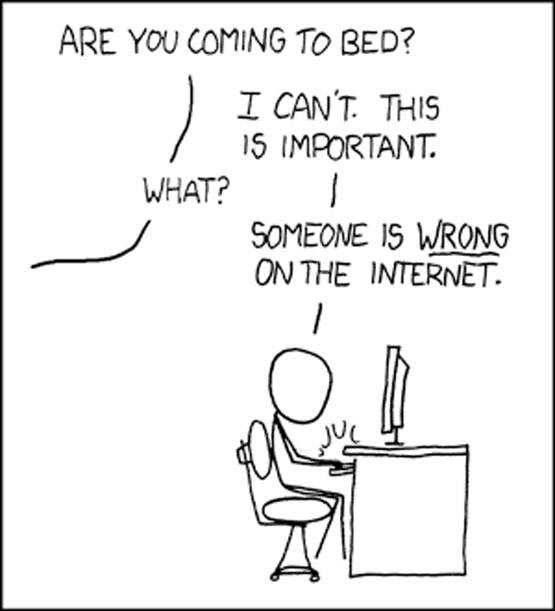

The xkcd cartoon above became an instant classic when it was released in February 2008. Alas, Cueball might as well get some sleep.
The Washington Post has ended its “What Was Fake on the Internet” column because, as Caitlin Dewey explains, the sort of people who share these stories don’t care about evidence.
We launched “What was Fake” in May 2014 in response to what seemed, at the time, like an epidemic of urban legends and Internet pranks: light-hearted, silly things, for the most part, like new flavors of Oreos and babies with absurd names.
Since then, those sorts of rumors and pranks haven’t slowed down, exactly, but the pace and tenor of fake news has changed. Where debunking an Internet fake once involved some research, it’s now often as simple as clicking around for an “about” or “disclaimer” page. And where a willingness to believe hoaxes once seemed to come from a place of honest ignorance or misunderstanding, that’s frequently no longer the case. Headlines like “Casey Anthony found dismembered in truck” go viral via old-fashioned schadenfreude — even hate.
There’s a simple, economic explanation for this shift: If you’re a hoaxer, it’s more profitable. Since early 2014, a series of Internet entrepreneurs have realized that not much drives traffic as effectively as stories that vindicate and/or inflame the biases of their readers. Where many once wrote celebrity death hoaxes or “satires,” they now run entire, successful websites that do nothing but troll convenient minorities or exploit gross stereotypes. Paul Horner, the proprietor of Nbc.com.co and a string of other very profitable fake-news sites, once told me he specifically tries to invent stories that will provoke strong reactions in middle-aged conservatives. They share a lot on Facebook, he explained; they’re the ideal audience.
[…]
Frankly, this column wasn’t designed to address the current environment. This format doesn’t make sense. I’ve spoken to several researchers and academics about this lately, because it’s started to feel a little pointless. Walter Quattrociocchi, the head of the Laboratory of Computational Social Science at IMT Lucca in Italy, has spent several years studying how conspiracy theories and misinformation spread online, and he confirmed some of my fears: Essentially, he explained, institutional distrust is so high right now, and cognitive bias so strong always, that the people who fall for hoax news stories are frequently only interested in consuming information that conforms with their views — even when it’s demonstrably fake.
Had I written this column as normal this week, I probably would have included, say, this widely shared post on Before It’s News that claimed an Alaska judge called for Obama’s arrest. But Quattrociocchi has found (and this is perhaps intuitive) that the sort of readers who would unskeptically share such a far-fetched story site are exactly the readers who will not be convinced by The Washington Post’s debunking.
To me, at least, that represents a very weird moment in Internet discourse — an issue I also addressed earlier this week. At which point does society become utterly irrational? Is it the point at which we start segmenting off into alternate realities?
While Dewey is mostly right about the tenor of the times, she makes two major errors here. First, while things may be getting worse, the phenomenon she describes was alive and well at the time “What Was Fake” started. Megan Garber wrote a piece for The Atlantic summarizing Quattrociocchi’s findings back in March 2014. Second, while middle aged conservatives may be especially prone to this behavior right now given a Democratic president and rapid upheaval in social norms, the phenomenon is widespread across age and ideological cohorts.
The Google Scholar link for the work in question provides a couple of pages but, alas, they are not in a format that allows cutting and pasting. But, essentially, the finding is that those who feel their core viewpoints are being undermined by mainstream news, social policy, and even scientific evidence are most likely to seek out silos that supply information that support their biases and that these people will tend to therefore see those sources as legitimate, even if they’re low-credential, or even seemingly obviously fake. Further, they’re subject to believing that the other side is winning owing to conspiracy plots that would seem objectively absurd. They point to wild claims about the World Economic Forum and the notion that “AIDS was created by the U.S. Government to control the African American population” as examples. The research was done on Italian users of Facebook, not Americans, but the psychology would almost certainly be the same.
Having run this site for just shy of 12 years, I’ve seen all of this firsthand. One early insight came after a May 6, 2003 posting titled “Jesse Jackson” which begins,
George Will once wrote, “Nowadays no diplomatic farce is complete without a cameo appearance by Jesse Jackson.” Truer words have never been spoken.
In the weeks that followed, several people somehow mistook that page as being Jackson’s personal site, leaving comments soliciting help from the iconic civil rights leader. Several similar episodes happened over the years. Even back in 2003, when the site was much less professional looking in terms of design, people did not seem to have the inclination to take the few seconds it would take to orient themselves to the site they were visiting. To most people, a website is a website is a website. Anything seen on the Internet, on Facebook, on Twitter, or whathaveyou is equal to anything else on those mediums. An article on the Harvard.edu domain from a Nobel Prize-winning expert on a subject and another one on Reddit by ScienceIzBullshite423 debunking said expert are accorded equal status, with the “tie” broken based on which side of the “debate” one prefers.
The same happens routinely with parody postings on the site. It happens all the time even with sites that do nothing but parody, such as The Onion or Duffel Blog. I’ve seen Congressmen go onto the old “Colbert Show” and treat it like an appearance on “60 Minutes,” seemingly oblivious that the host was doing a parody of a talk show.
Of course, it doesn’t help that, in the dog-eat-dog competition for eyeballs, even legitimate sites like the Post itself engage in gimmickry on a routine basis to drive traffic. To note one silly example, the “Most Popular” sidebar to Dewey’s post led me to an article headlined ”Goodbye, Good Old Greek Yogurt“ and tells us in the lede that “popularity in the American food world can be a fickle thing, and the Greek yogurt business is learning that first hand. After years of double digit growth, Americans’ enthusiasm for the trendy yogurt seems to be cooling.” Reading slightly further we learn that the product, which was essentially unavailable in the US market before 2007, is now a mature product whose sales are flat. That doesn’t rate a mention in the nation’s most prominent newspaper, much less a misleading, click-bait headline. But since most people will encounter the story via their Facebook feed and not bother to actually click through and read it, the perception will now exist that no one is eating Greek yogurt anymore.
Regardless, Dewey’s central point remains valid: it’s hard to see much point in trying to engage in honest debate in this environment. Which is a major contributing factor to the Blog Fatigue I wrote about a couple weeks back.









