Despite years of loudly proclaiming otherwise, the United States intelligence community now reports that Iran halted its nuclear weapons program in 2003.
Mark Mazetti, NYT:
A new assessment by American intelligence agencies concludes that Iran halted its nuclear weapons program in 2003 and that the program remains on hold, contradicting an assessment two years ago that Tehran was working inexorably toward building a bomb.
The conclusions of the new assessment are likely to be major factor in the tense international negotiations aimed at getting Iran to halt its nuclear energy program. Concerns about Iran were raised sharply after President Bush had suggested in October that a nuclear-armed Iran could lead to “World War III,” and Vice President Dick Cheney promised “serious consequences” if the government in Tehran did not abandon its nuclear program.
[…]
“Some combination of threats of intensified international scrutiny and pressures, along with opportunities for Iran to achieve its security, prestige, and goals for regional influence in other ways might — if perceived by Iran’s leaders as credible — prompt Tehran to extend the current halt to its nuclear weapons program,” the estimate states.
The new report comes out just over five years after a deeply flawed N.I.E. concluded that Iraq possessed chemical and biological weapons programs and was determined to restart its nuclear program. The report led to congressional authorization for a military invasion of Iraq, although most of the N.I.E.’s conclusions turned out to be wrong. The estimate does say that Iran’s ultimate goal is still to develop the capability to produce a nuclear weapon.
The national security adviser, Stephen J. Hadley, quickly issued a statement describing the N.I.E. as containing positive news rather than reflecting intelligence mistakes. “It confirms that we were right to be worried about Iran seeking to develop nuclear weapons,” Mr. Hadley said. “It tells us that we have made progress in trying to ensure that this does not happen. But the intelligence also tells us that the risk of Iran acquiring a nuclear weapon remains a very serious problem.” “The estimate offers grounds for hope that the problem can be solved diplomatically — without the use of force — as the administration has been trying to do,” Mr. Hadley said.
That’s one way of looking at it, I suppose. Another way of looking at it is that the problem in question doesn’t exist.
Of course, that points to another problem: An intelligence system that so incentivizes bureaucratic backside covering that it overemphasizes threats and disregards contrary information.
Last month, Mohamed ElBaradei, director general of the international Atomic Energy Agency, had reported that Iran was operating 3,000 uranium-enriching centrifuges, capable of producing fissile material for nuclear weapons. But his report said that I.A.E.A. inspectors in Iran had been unable to determine whether the Iranian program sought only to generate electricity or also to build weapons.
The N.I.E. concludes that if Iran were to end the freeze of its weapons program, it would still be at least two years before Tehran would have enough highly enriched uranium to produce a nuclear bomb. But it says it is still “very unlikely” Iran could produce enough of the material by then. Instead, today’s report concludes it is more likely Iran could have a bomb by the early part to the middle of the next decade. The report states that the State Department’s Bureau of Intelligence and Research judges Iran is unlikely to achieve this goal before 2013, “because of foreseeable technical and programmatic problems.”
I’m no expert but I’d guess it’ll take even longer than that if Iran isn’t actually working on nuclear weapons.
You can read the unclassified report [PDF] at the The Office of the Director of National Intelligence.
ABC News has more analysis. This is, as one might imagine, the top story at Memeorandum. Key reax:
- Dan Drezner: “One obvious implication: whatever slim chance there existed of a U.S. military intervention in Iran over the next 13 months just got way, way slimmer.”
- Steve Benen: “Phrases like ‘we were right’ probably aren’t prudent right now.”
- Sean-Paul Kelley: “Iran halted its ARMS program in 2003, not it’s nuclear energy program. The distinction is important. Cheney and his cronies have been trying to muddy the waters for a long time now in an attempt to conflate the two, but they are very, very different.”
- Jeffrey Lewis: “I can’t quite believe the IC agrees with something that Paul Kerr and I have been arguing was possible for years — that the bureaucratic consolidation undertaken in late 2003 may have choked off the clandestine program, at least for now. I mean, we were just making educated guesses.”
- Sharon Weinberger: “The key findings . . . don’t need much explaining.”
- Kevin Drum: “This isn’t just an NIE with a few dissenting footnotes, it’s an NIE whose primary conclusion is that Iran hasn’t been seriously working on a nuclear weapon for the past four years…”
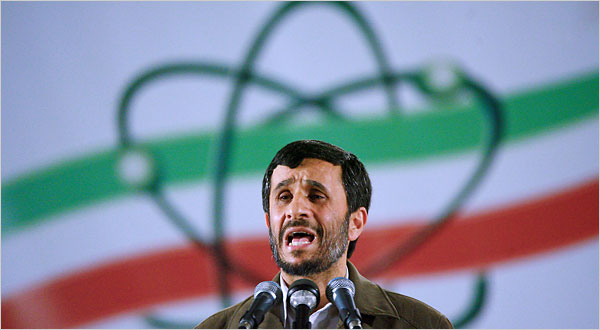
Photo credit: Majid Saeedi/Getty Images.