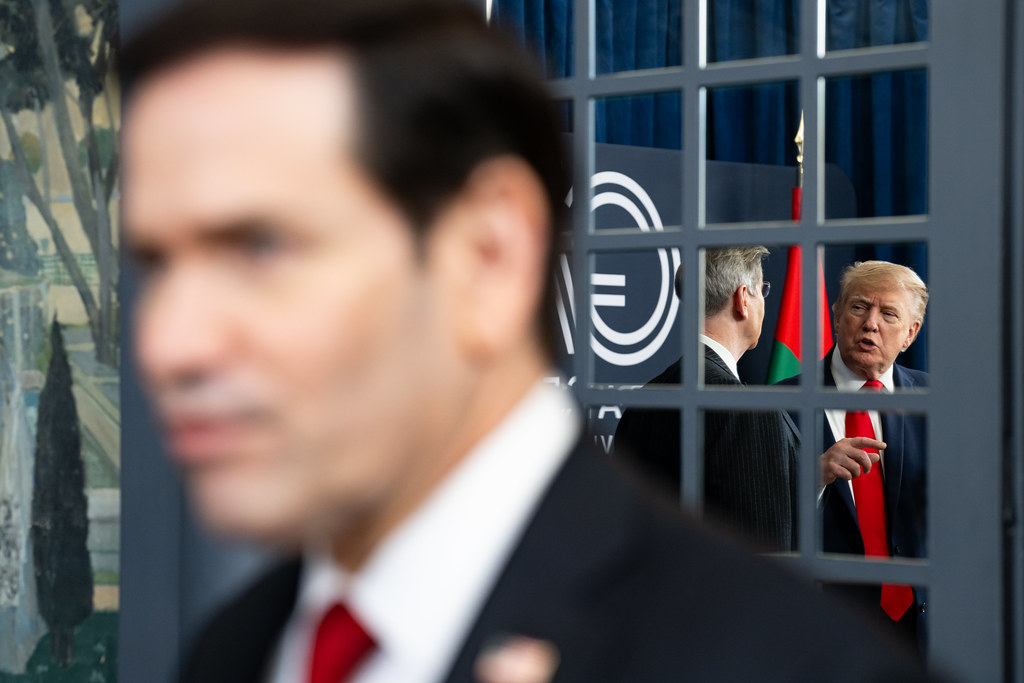
NYT (“Rubio Dismisses Reports He Will Leave His Jobs to Run for President“):
Secretary of State Marco Rubio on Thursday dismissed reports that he was planning to leave the Trump administration and declined to answer questions about his political future.
Working for President Trump until the end of his term has “always been my plan,” he said in an interview with The New York Times.
Responding to the news reports that he was mulling an exit, Mr. Rubio said, “I don’t know where these things come from, to be honest with you.”
“I love the work I’m doing,” he continued. “And plus I always laugh when they say he’s going to leave his job. I go, ‘Which one?’”
Mr. Rubio, who is also Mr. Trump’s national security adviser, declined to answer questions about whether he was considering running for president in 2028.
“I literally will not talk about 2028 anymore,” he said in the interview, in his White House office. “I just won’t do it.”
Mr. Rubio has said that he would support Vice President JD Vance if he ran for president.
“JD is a very good friend of mine,” he told NBC News in May. “If JD runs for president, I think he’d be a phenomenal candidate. I’ve said publicly, and I’ll say it again, I’ll be the first person to sign up and support him.”
NY Post (“Marco Rubio insists he won’t quit Trump admin — but demurs on growing 2028 buzz“) adds:
Bloomberg News reported [paywalled-jj] that Rubio has discussed the possibility of stepping down with White House officials and that he and his advisers are going over future options.
“This fake news is nothing more than a fabricated hoax being peddled by anonymous sources with no factual information,” White House spokesperson Beni Rae Harmony said in a statement. “Secretary Rubio is a fearless fighter for President Trump and the MAGA movement.”
Meanwhile, GOP sources and UK government figures told The Independent they view Rubio as the leading candidate to succeed President Trump and expect the secretary of state to resign in an effort to “distance himself from the Iran war.”
[…]
Rubio, who was defeated by Trump in the 2016 presidential primary, is indeed viewed as a serious future GOP presidential contender but has unfinished business at the State Department and isn’t expected to depart anytime soon, multiple sources told The Post.
The former senator’s plan from day one of the Trump administration was to stay on board all four years, according to a senior administration official.
Rubio has even said he won’t take a vacation, the official noted, only halfway joking.
Inside the corridors of the West Wing, Rubio remains a power player.
He has an office next to Vice President JD Vance and a powerful ally in chief of staff Susie Wiles, whom he’s known for years as they both rose in Florida Republican politics.
Wearing the double hat of secretary of state and national security adviser, Rubio is in the room for every national security conversation, alongside Wiles and Vance. The trio have a good working relationship and are often in lockstep.
He spends most of his work time in the West Wing, knowing in this White House, proximity to Trump is the proximity to power.
Another factor that may keep Rubio from leaving the administration is that his foreign policy goals have yet to be accomplished: the main one being Cuba.
The son of Cuban immigrants, his longtime goal has been to see the island rid itself of its communist regime, which Trump has hinted he could do.
Rubio wouldn’t be expected to depart until his family’s homeland is free.
“The midterms blew up Vance’s [2028 prospects] and Rubio’s stock is soaring,” Dan Eberhart, a GOP donor, said. “I don’t think he can go home to Miami until he’s toppled the regime in Cuba.”
Eberhart and other sources noted Vance, who is also the Republican National Committee’s finance chair, can raise money from 2028 on the job, while Rubio cannot, due to the constraints on political activities a secretary of state can engage in.
“I guarantee you, the moment Marco would say, ‘I’m going to resign and I want to run,’ he’ll raise so much money it would make your head spin,” another Florida GOP source said.
The source noted Rubio has been clear he’ll stand back if Vance is in for 2028, but said the disastrous midterms had put Vance in a “pickle — to put it lightly” and intensified calls for Rubio to jump in the fray.
“My guess is that he’ll be president one day, whether it’s before JD or after,” a Republican operative close to the White House said.
However, a top Republican strategist indicated that waiting for 2032 if Vance runs and loses in 2028 “has always been his plan.”
Rubio turned 55 in May, so he would be 57 on Election Day 2028. That’s roughly the median age upon first inauguration. He’s already older than Bill Clinton and Barack Obama were at the end of eight years in office.
Were Vance to be the 2028 nominee—and the odds of that dropped Tuesday precipitously—Rubio would be 61 the next time he got a shot at the nomination. And that’s presuming Vance lost the general election. And, rather than facing an open White House, he’d be up against a Democratic incumbent, a much more daunting challenge.
Conversely, if Vance won, Rubio would have to wait until 2036. Not only would that put him at 65—older than all but five first-time Presidents (albeit, granted, the two oldest are the two most recent)—but he’d be in the unenviable position of trying to get elected to a fourth straight Republican victory. No party has won four straight since FDR and Truman combined for five straight. Indeed, only once (Reagan in 1980 and 1984 and Bush 41 in 1988) has a party won three straight since then.
Like Gavin Newsom (who has pledged not to run if Kamala Harris makes another bid), Rubio has boxed him in by repeatedly pledging to support Vance. Presumably, he’d be Vance’s running mate if Vance wins the nomination. But, again, the math would seem to indicate that this is Rubio’s last best chance.
In terms of the merits, I have little sense of how competitive Rubio would be for the nomination. He was a rising star in the party, but didn’t fare all that well in 2016. But, yes, he’d easily raise enough money to finance a robust campaign.
By the time Virginia voted in 2016, Trump had all but secured the nomination. Jeb Bush, my preferred candidate, had already dropped out. I was torn between Rubio and John Kasich for what amounted to a protest vote, ultimately pulling the lever (well, filling in the bubble) for the latter.
Had Rubio gotten the nomination, I would have happily voted for him over Hillary Clinton. Alas, his toadying to win Trump’s favor in the decade since, while understandable from an influence standpoint, has tarnished him considerably in my eyes. The Democrats would have to work hard to nominate a candidate that would make me choose Rubio.
And, sadly, Rubio is likely the best-case scenario for a 2028 Republican nominee. While I’m unlikely to revert to the party of my youth, I would very much prefer both parties nominate candidates—especially at the presidential level—whose election would not be a disaster for the country.