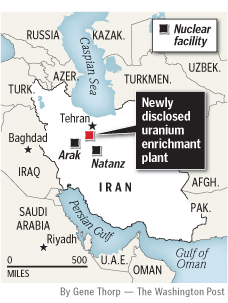

Presumably in anticipation of the announcement by the United States, France, the United Kingdom, or Israel of the existence of their previously-undisclosed uranium enrichment plant, the Iranian government has admitted that they have a second, secret plant:
PITTSBURGH, Sept. 25 — President Obama and the leaders of France and Britain on Friday blasted Iran’s construction of a previously unknown uranium enrichment facility and demanded that Tehran immediately fulfill its obligations under international law or risk the imposition of harsh new sanctions.
“Iran is breaking rules that all nations must follow,” Obama said, detailing how the facility at Qom had been under construction for years without being disclosed, as required, to the International Atomic Energy Association. “International law is not an empty promise.”
British Prime Minister Gordon Brown accused Iran of “serial deception” that he said “will shock and anger the whole international community, and it will harden our resolve.”
“We will not let this matter rest,” Brown said. ” . . . Iran must abandon any military ambitions for its nuclear programs.”
One of the criticisms that has long been laid at the feet of the process that the international community has been going through with respect to Iran is that pretty much by definition the IAEA’s certification efforts are limited to the facilities that Iran has disclosed. How can we be confident about what is or isn’t going on in facilities the Iranians have refused to disclose? This latest revelation can’t help but cast more doubt on the Iranians’ continued protestations that their nuclear development is strictly for peaceful purposes under the principle of “where there’s smoke, there’s fire”. If their intent was peaceful, why not disclose this second plant before events forced them to?
Following the revelation there will, no doubt, be heightened calls for tighter enforcement of existing economic sanctions, new economic sanctions, even military action. I think there’s no prospect whatever that the United Nations Security Council will vote for military action against Iran, indeed, I’d be very surprised if even with this disclosure the Council voted to impose additional economic sanctions on Iran.
As NATO members debate whether they should remove their forces from Afghanistan and, considering the close relationship between Germany, in particular, and Iran I would be very surprised if military action against Iran would be contemplated as a NATO mission.
Frankly, I think that there are no additional punitive actions, military or otherwise, that will be imposed on Iran.
Geoffrey Forden of Arms Control Wonk urges that we seize this opportunity to impose additional, more stringent inspection regimes:
This revelation of a covert facility might be just the bargaining chip the West needs to force the measures necessary to build up confidence Iran is not establishing other secret plants. We need assurances about the people who Iran needs to establish a new plant. That level of confidence can only be achieved by the most intrusive inspections imaginable: working side-by-side with the Iranian scientists and engineers involved in enrichment. Under an agreement for a multinational enrichment center, Westerns would start working in the existing Iranian facilities the day after an agreement is signed. Of course, it is vital that we not give Iran any more time to establish other covert plants while we are not watching their people. It is time to realize that a multinational enrichment facility is the best way to prevent Iran from getting a bomb and, in fact, to roll back their indigenous enrichment capabilities.
I’m afraid this is overly sanguine about the world’s willingness to speak with a single voice in opposition to Iran’s project, whatever it may be.
UPDATE
Andrea Mitchell helpfully provides some evidentiary support for my skepticism about the likelihood of additional sanctions against Iran in the form of a quote from Russian President Medvedev:
I do not believe sanctions are the best way to achieve results. Sanctions were used on a number of occasions against Iran but we have doubts about the results. Nevertheless when all instruments have been used and failed, one can use international legal sanctions. That is common…I think we should continue to promote positive incentives for Iran and at the same time push it to make all its programs transparent and open. Should we fail in that case, we’ll consider other options.
By that time we’d no doubt be dealing with a fait accompli. As a permanent member of the Security Council, Russia’s veto will render additional sanctions impossible and as long as Russia’s veto is assured the Chinese can abstain, confident that no new sanctions will be imposed.