
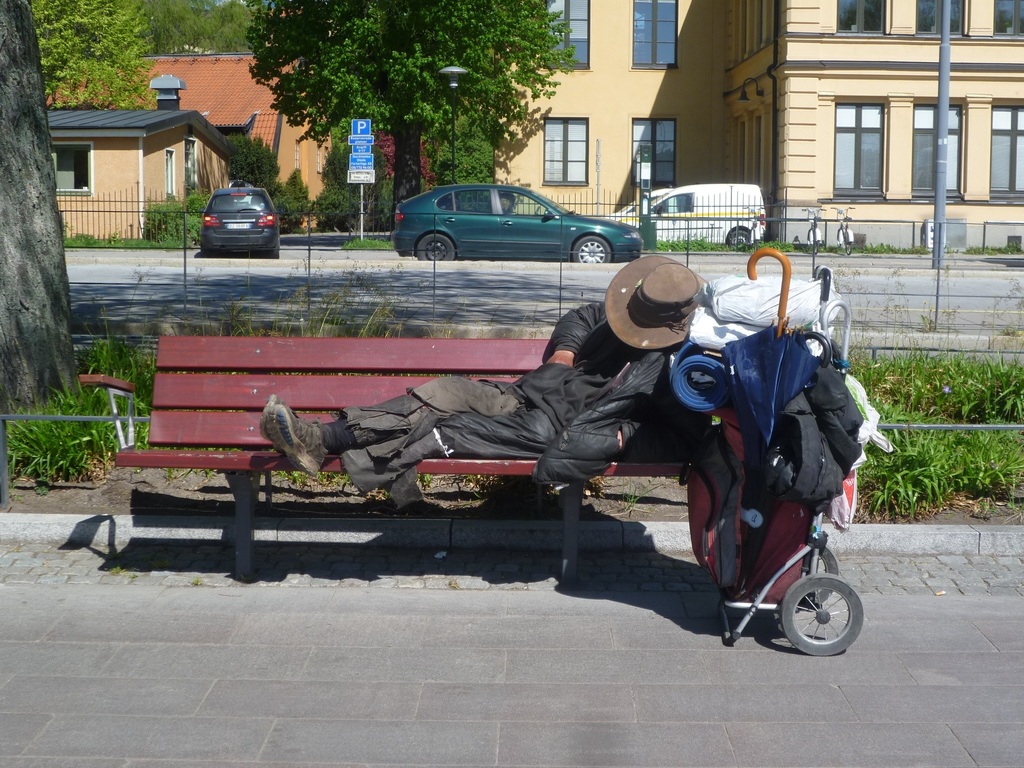

WaPo (“Supreme Court to review restrictions on homeless encampments“):
The Supreme Court said Friday it will consider whether state and local officials can punish homeless individuals for camping and sleeping in public spaces when shelter beds are unavailable.
The justices will review a lower court decision that declared it unconstitutional to enforce anti-camping laws against homeless individuals when they have nowhere else to sleep.
The U.S. Court of Appeals for the 9th Circuit, which covers Western states, including California, Oregon and Washington, first held in 2018 that the Eighth Amendment’s protection against cruel and unusual punishment prohibits cities from criminalizing public camping when shelter is unavailable.
The city of Grants Pass, Ore., asked the justices to overturn a similar recent decision involving civil fines and warned that the ruling would paralyze cities across the West from addressing safety and public health risks created by tents and makeshift structures. The 9th Circuit’s decision, the officials said, is standing in the way of a comprehensive response to the growth of public encampments.
“The consequences of inaction are dire for those living both in and near encampments: crime, fires, the reemergence of medieval diseases, environmental harm and record levels of drug overdoses and deaths on public streets,” lawyers for the city told the high court.
The city’s position has some surprising support from California Gov. Gavin Newsom (D) and Democratic leaders of cities, including San Francisco and Portland, Ore., that are on the front lines of the homelessness crisis driven in part by the high cost of housing.
In response, lawyers for the homeless individuals said Grants Pass is essentially punishing homeless residents for existing within city limits and urged the justices to uphold the 9th Circuit ruling. Nothing in the decision, they said, prevents cities from dismantling homeless encampments.
Ed Johnson, director of litigation at the Oregon Law Center, said the Constitution does not allow cities to punish people for having an involuntary status, including being involuntarily homeless.
[…]
In 2013, Grants Pass began enforcing ordinances that make it unlawful to sleep on public sidewalks and streets, and prohibit camping in public places, including in parks. The city enforces its rules through civil citations. If a person has been cited twice, officers can bar that person from a city park for 30 days.
There are no homeless shelters in the city and two privately owned housing programs only serve a small fraction of the homeless population, according to court filings.
While it’s arguably cruel to tell people with nowhere else to go that they can’t sleep on public sidewalks are camp in public parks, the idea that it’s “cruel and unusual punishment” under the 8th Amendment struck me as weird, since we typically apply the clause to the nature of the punishment itself.
SCOTUSBlog’s Amy Howe adds some context:
The question is one that the U.S. Court of Appeals for the 9th Circuit, based in San Francisco, has grappled with repeatedly in recent years. In Martin v. City of Boise, the court of appeals held that punishing homeless people for public camping would violate the Eighth Amendment’s ban on cruel and unusual punishment if they did not have access to shelter elsewhere. The court of appeals reasoned that, just as the city could not punish someone for their status – being homeless – it also could not punish them for conduct “that is an unavoidable consequence of being homeless.”
Scanning the linked opinion, I see this pertinent discussion:
The Cruel and Unusual Punishments Clause “circumscribes the criminal process in three ways.” Ingraham, 430 U.S. at 667. First, it limits the type of punishment the government may impose; second, it proscribes punishment “grossly disproportionate” to the severity of the crime; and third, it places substantive limits on what the government may criminalize. Id. It is the third limitation that is pertinent here.
“Even one day in prison would be cruel and unusual punishment for the ‘crime’ of having a common cold.” Robinson v. California, 370 U.S. 660, 667 (1962). Cases construing substantive limits as to what the government may criminalize are rare, however, and for good reason — the Cruel and Unusual Punishments Clause’s third limitation is “one to be applied sparingly.” Ingraham, 430 U.S. at 667.
Robinson, the seminal case in this branch of Eighth Amendment jurisprudence, held a California statute that “ma[de]the ‘status’ of narcotic addiction a criminal offense” invalid under the Cruel and Unusual Punishments Clause. 370 U.S. at 666. The California law at issue in Robinson was “not one which punished [d]a person for the use of narcotics, for their purchase, sale or possession, or for antisocial or disorderly behavior resulting from their administration”; it punished addiction itself. Id.
So, in fact, the ruling here is on sound, if dated, footing. Indeed, considering that the very act of taking most non-prescription narcotics, the forerunner to becoming addicted to them, was itself illegal, the Robinson precedent is especially interesting here. After all, it’s not a crime to be homeless.
But, interestingly, the Martin opinion then undermines the argument in the next paragraphs:
In Powell v. Texas, 392 U.S. 514 (1968), however, the court elaborated on the principle first articulated in Robinson. Powell concerned the constitutionality of a Texas law making public drunkenness a criminal offense. Justice Marshall, writing for a plurality of the Court, distinguished the Texas statute from the issue in Robinson on the ground that the Texas statute made criminal not alcoholism but conduct—appearing public while intoxicated. “[A]ppellant was convicted, not for being a chronic alcoholic, but for being in public while drunk on a particular occasion. The State of Texas thus has not sought to punish a mere status, as California did in Robinson; nor has it attempted to regulate appellant’s behavior in the privacy of his own home.” Id. at 532 (plurality opinion)
Interestlingly, the Martin opinion turns to Justice Byron White’s solo Powell concurrence arguing that, for many chronic alcoholics, homelessness may be an unavoidable consequence, and thus essentially a status. He just didn’t think that was the case in this particular instance. The four dissenters agreed with Powell on the first point but not the second.
The four dissenting Justices adopted a position consistent with that taken by Justice White: that under Robinson, “criminal penalties may not be inflicted upon a person forbeing in a condition he is powerless to change,” and that the defendant, “once intoxicated, .. . could not prevent himself from appearing in public places.” Id. at 567 (Fortas, J.,dissenting). Thus, five Justices gleaned from Robinson the principle that “that the Eighth Amendment prohibits the state from punishing an involuntary act or condition if it is the unavoidable consequence of one’s status or being.”
It’s rather odd to build one’s case on a dissenting opinion. But, in this instance, we actually have a majority agreeing on this particular principle, even though the actual holding in the case went in the other direction.
Now, I disagree wholeheartedly with Powell dissenters. To the extent one’s conduct is harmful, the degree to which you can’t control your predilection to such conduct strikes me as irrelevant. That a rapist has mental health problems that make controlling their anger and impulses extremely challenging surely doesn’t make them free to rape. That an alcoholic is compelled to drink doesn’t give them a license to drive intoxicated.
But, of course, sleeping in public is a markedly different sort of offense than rape or drunk driving. It seems to me that, to the extent the Cruel and Unusual Punishment Clause is implicated here, it’s simply a balancing test between the impact of homeless encampments on the community and the seeming cruelty of punishing a homeless person for sleeping outdoors when he has nowhere indoors to go.
Naturally, the WSJ Editorial Board (“Is There a Constitutional Right to Vagrancy?“) is having none of it. Alas, they hang their case on a falsehood:
A panel of the Ninth Circuit Court of Appeals in 2022 blocked the Oregon town of Grants Pass from enforcing “anti-camping” laws on public property. The judges said the Eighth Amendment’s ban on cruel and unusual punishment prohibits cities from arresting or imposing penalties on homeless people for squatting on public property if there aren’t enough shelter beds for every vagrant.
Progressives have used the ruling to sue to stop cities across the West from enforcing similar laws. Under the appellate court’s precedent, a police officer in, say, San Francisco can’t cite a homeless person who has set up a tent inside a public playground even if he has been offered temporary housing.
Both of these assertions are wrong. Most obviously, as their own summary in the preceding paragraph notes, the ruling specifically applies only in cases where shelter is unavailable. But, also, both Martin and Grants Pass make it clear that municipalities can impose reasonable time, place, and manner restrictions. I’m rather certain the court would allow prohibitions of camping on school grounds or a playground in order to keep kids safe. It’s just that the city can’t simultaneously provide inadequate shelter for its homeless population and then punish the for sleeping anywhere outside.
They also cite the dissenting judge:
In a fiery dissent, Judge Patrick Bumatay explained that nothing in “the text, history and tradition” of the Eighth Amendment “comes close to prohibiting enforcement of commonplace anti-vagrancy laws.” The court’s “sweeping injunction has no basis in the Constitution or our precedent,” he added. “San Francisco should not be treated as an experiment for judicial tinkering.”
“Our decision is cruel because it leaves the citizens of San Francisco powerless to enforce their own health and safety laws without the permission of a federal judge,” Judge Bumatay wrote. “And it’s unusual because no other court in the country has interpreted the Constitution in this way.” This may be one reason the High Court agreed to hear the Grants Pass appeal.
The Supreme Court actually started striking down vagrancy laws way back in 1972. But those decisions were based on the vagueness of the laws and an inherent right to travel freely, not the Cruel and Unusual Punishments Clause.
While some of my views have shifted leftward over the years, I’m still fundamentally a law and order guy. Citizens should have a right to walk the streets without stepping over people camping on the sidewalks and to not have their public parks turned into drug-infested communes. Apparently, even the likes of Gavin Newsom agree; if nothing else, their constituents seem to.
But that expectation has to be coupled with some obligation to provide basic services for these people. I don’t really know what exactly that entails. Many, if not the overwhelming number of them, are mentally ill and/or addicts. We decided decades ago that locking them up wasn’t the answer. And, obviously, providing them food and shelter indefinitely is expensive. But issuing them citations with fines they can’t pay isn’t the answer, either.









