
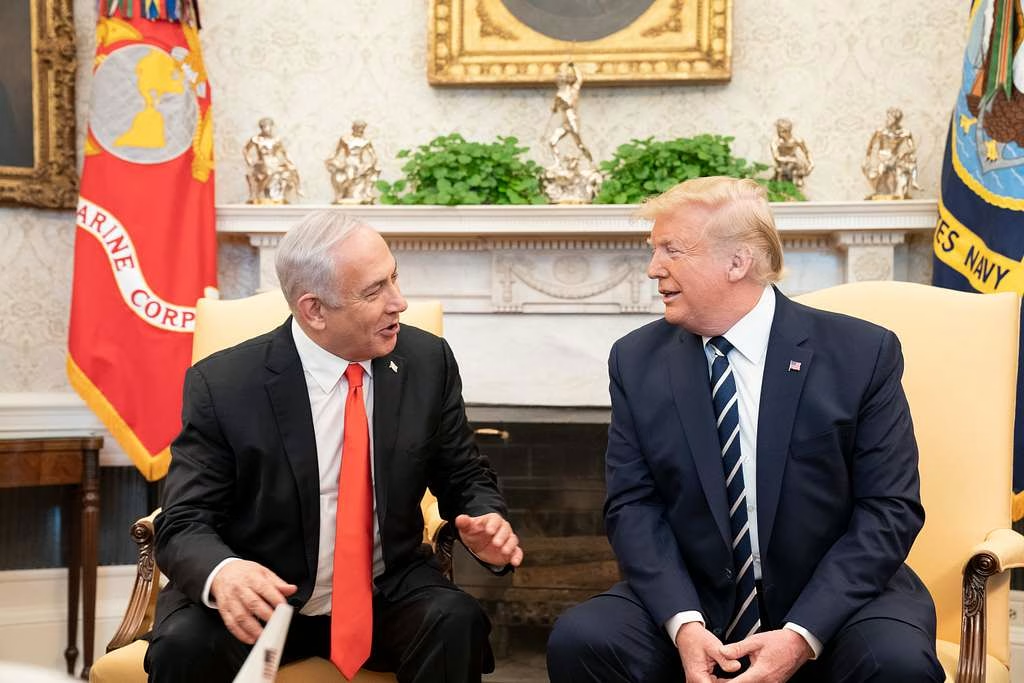
WaPo Exclusive (“U.S. intelligence warns Israel is likely to undermine Iran peace deal, officials say“):
U.S. intelligence agencies have warned the Trump administration that Israeli Prime Minister Benjamin Netanyahu is likely to take steps that will undermine President Donald Trump’s effort to reach a lasting peace deal with Iran, as the Israeli premier faces intense political pressure to continue waging his country’s war in Lebanon, current and former U.S. officials said.
Israel appears intent on maintaining military operations against Iran’s proxy Hezbollah in Lebanon, an aim that would flout a core element of the fledgling agreement that calls for an end to hostilities in that country, according to intelligence reports, including one circulated this week, said the officials.
The analysis comes at a moment of growing tension between Netanyahu’s government and Trump administration officials, who have publicly warned Israel against launching attacks against Hezbollah that might derail Trump’s deal.
On Friday, Israel launched airstrikes across southern Lebanon in response to a Hezbollah drone strike that killed four Israeli soldiers. As clashes continued, U.S. and Iranian officials said they postponed talks due to begin in Switzerland on Friday. Vice President JD Vance, who was to lead the U.S. delegation, postponed his trip.
If Netanyahu redoubles his military campaign in Lebanon, he would not only threaten the framework for an agreement signed by the United States and Iran on Wednesday, but he could rupture the relationship with an American president that has been integral to his political fortune.
Speaking at a news conference in France on Wednesday to announce the U.S.-Iran “memorandum of understanding,” Trump said that he has a “little dispute over Lebanon” with Netanyahu and has urged the Israeli leader to not “knock down a building every time somebody walks into it that’s from Hezbollah.”
[…]
The new U.S. intelligence report concludes that in the face of national elections this fall, Netanyahu’s political survival is linked to showing his domestic audience that he will not withdraw troops from Lebanon and that he is intent on escalating the fighting with Hezbollah, said one U.S. official familiar with the report. The official, like others interviewed, spoke on the condition of anonymity because of the matter’s sensitivity.
The U.S. intelligence report also describes Israel’s frustration with the terms of the Trump peace memorandum, which undermine its broader objective of maintaining maximum pressure on Tehran, according to a current and former official.
NYT (“Israel Is Likely to Continue Attacks in Lebanon, U.S. Intelligence Concludes“) adds:
Mr. Netanyahu is under intense domestic pressure to continue operations against Hezbollah’s ongoing attacks on northern Israel. Israel views Hezbollah, the potent militia and political group in Lebanon funded by Iran, as a critical threat, and officials there do not believe the attacks can go unanswered.
[…]
The cease-fire deal is deeply unpopular in Israel, where commentators criticize its failure to address Iran’s missile program, its requirement that U.S. forces leave the region and, especially, its constraints on Israeli military operations in Lebanon.
Israel is not a party to the accord, which was signed this week. But the Israeli ambassador to the United States, Yechiel Leiter, said on Friday that his country had committed to an immediate cease-fire and “halted all offensive operations” in Lebanon. He insisted Israeli forces would remain in southern Lebanon and said Israel would never compromise on its security.
The recent intelligence assessments show the skepticism inside American spy agencies that such commitments will hold, given the security concerns.
[…]
Those recent intelligence reports outline what has been obvious in public: Mr. Netanyahu and other Israeli security officials are uncomfortable with the memorandum of understanding between the United States and Iran. At the same time, relations between President Trump and Mr. Netanyahu are strained, even if there is little indication the Israeli prime minister will give up on the relationship.
Officials said Mr. Netanyahu was counting on relations with Mr. Trump strengthening once more before he faces Israeli voters this fall. Mr. Netanyahu’s standing and influence with Mr. Trump has waxed and waned before, though the high stakes of the accord with Iran appears to have pushed relations to a low.
[…]
At a news conference to promote the U.S. deal with Iran, Mr. Vance lashed out at members of Mr. Netanyahu’s cabinet who had criticized the United States or Mr. Trump over the cease-fire.
“Donald J. Trump is the only head of state in the entire world who is sympathetic to the nation of Israel at this moment in time, and he happens to be the head of state of the world’s superpower,” Mr. Vance said. “If I was in the cabinet of the Israeli government, I might not be attacking the only powerful ally that I have anywhere left in the entire world.”
Winston Churchill famously remarked, “There is only one thing worse than fighting with allies, and that is fighting without them.” Even though Iran is a common adversary, Israel and the United States have differing national security goals and domestic pressures.
Netanyahu is fighting for his political survival, which surely factors into his calculations here. But he also reflects a widespread consensus in Israel that Iran and its proxies must be dealt with once and for all.
President Trump, meanwhile, feels little direct threat from Iran and is facing considerable backlash from his own party over the war. Despite the advice of his handpicked Joint Chiefs chairman and the rest of the professional national security establishment, he clearly believed he could effect regime change and secure a quick, decisive win. Once that proved not to be the case, he began looking for a way to get out while being able to claim victory.
The fact that Trump’s team negotiated the deal without Israel adds to the challenge here. Vance isn’t wrong about Israel’s current world standing. But there are considerations of national pride at stake even beyond the security issue.
And let’s not forget that Hezbollah has a vote here, too. They’re unlikely to accept a permanent ceasefire that leaves Israel in control of substantial parts of Lebanon.









