
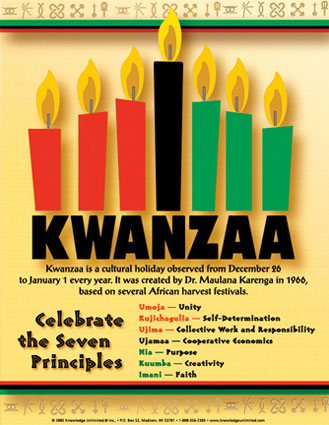
 Reason‘s Michael Moynihan notes that Kwanzaa seems to have been quietly dismissed from the zeitgeist.
In the days leading up the Christmas, one couldn’t help but notice that references to Kwanzaa, the decades-old African-American holiday that captured so many dull minds during the Great Culture Wars of the 1990s, were almost nonexistent. Kwanzaa, an afrocentic celebration of black self-reliance (or something) that so spooked the “war on Christmas” types, has largely disappeared. Back in the day, its champions and critics alike thought it could potentially replace Christmas in the very Christian African-American community.
But now, silence.
Does anyone remember that back in the early 1990s, AT&T ran television ads suggesting that blacks call their families during Kwanzaa using their telephone service? That stores stocked Kwanzaa candles and kente clothes? That student unions were festooned with Marcus Garvey’s pan-African flag? In 1995, a local activist triumphantly told The Boston Globe, “We’re at the point now where Kwanzaa has gotten so big that we feel like Santa Claus is really on the way out.”
So, what happened?
It is, perhaps, an encouraging sign of the times. In many respects, the Great Culture Wars are over, and while most black studies departments still embrace the balkanizing principles of multiculturalism, the great majority of African Americans have little interest in dressing up like Jim Brown and lighting candles that symbolize the workers controlling the means of production.
Or, perhaps, it was just a fad and, like pet rocks, mood rings, and disco, the novelty wore off.











