
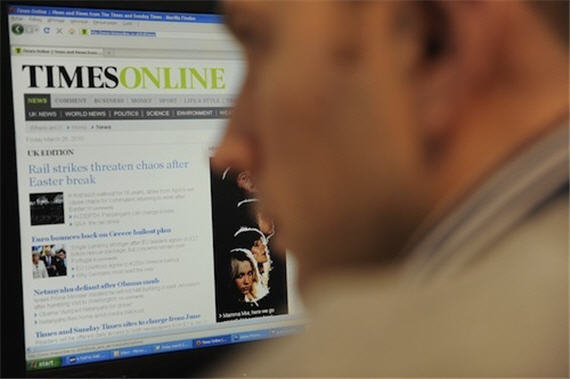
The venerable Times of London will soon go behind a paywall, hide their content from search engines, and offer less content. This is an odd business strategy.

News International has unveiled new-look Times and Sunday Times websites that, from next month, will only be accessible to people who pay to use them.
The papers’ new websites, which go live today, will be accessible for free as a taster for “about four weeks” before paywalls are introduced. Users must register to see any content beyond the front page.
There are fewer news stories on the new Times website, while the Sunday Times site offers magazine-style, multimedia-rich content — and both will block anonymous comments under articles.
The new strategy was described by the Times assistant editor, Tom Whitwell, as an “all or nothing” approach, with Times and Sunday Times content almost entirely set to disappear from search services such as Google News. “Clarity was something that was very important to the project,” he said. “If we ask people to pay we have to be very clear what they are getting.”
Which is what?
Whitwell said that there would be “a lot fewer stories” on the new-look Times website. This was echoed by the Sunday Times executive editor, Tristan Davies, who said the strategy for his site eschewed the “headlines [and] list-driven” news approach of many rivals.
Whitwell said that in the 18 months of developing the pay strategy for the Times he had seen an “infinite” number of ideas but that the digital plan was not to become a “news aggregator or a social network”.
“What we are trying to say is we are not going to show you all the news, [like] going to Google News and seeing 4,000 articles, we are going to give our take,” he said.
Whitwell said that the paper aims to build real, meaningful community relationships between journalists and readers. Part of this strategy will see users having to post under their real names only — there will be no anonymous posting or use of pseudonyms, which Whitwell believes does not build real community.
“The principle is to encourage comment under real names,” he said. A colleague added that the Times and Sunday Times would only consider allowing users to post anonymously if they had a real reason to protect their identity.
Now, I’m fine with encouraging posters to use their real name — and even requiring registration for commenting. But it simply makes no sense to wall off the content. Robert Andrews of PaidContent points out the flaw in the search strategy:
That means the sites – which are fine, focused products – could be passing up their greatest customer acquisition opportunity: their content itself. Non-members who reach a story page are greeted by a Times+ sign-up and login overlay, obscuring the article; there’s no taster, no excerpt and no way that anyone will find those articles via search sites.
It’s all a more conservative strategy than News Corp stablemate WSJ.com, but: “When we showed it to people, that was the model they preferred,” said Times executive editor Danny Finkelstein. “We’re completely unashamed about this. We’re trying to get people to pay for the journalism and we wanted to do it in a very simple way.”
Beyond that, as someone who actively seeks out content at The Times, I wholeheartedly endorse Alex Massie‘s hope that they figure out a way to make their enterprises profitable. But:
In one sense £2 a week is not a great sum to pay. If the Times were the only paper with an online edition one might even think it a bargain. But it isn’t and so that £2 a week starts to look like a heftier sum. I like Danny Finkelstein, Matthew Parris, Rachel Sylvester and Mike Atherton a lot but do I want to pay £104 a year to read them? Perhaps I do, but how many others will think there’s a big enough difference between their product and the stuff you can get for free?
I already read the Financial Times and Wall Street Journal much less than I otherwise would because of their schemes to force me to pay for content. While they presumably don’t care, they should. Not only would I otherwise be passing their content on to other potential customers through linking but I’m not giving them direct pageviews, either. In both instances, that means traffic and money going to presumably inferior competitors.









