

Eric Schmitt and Helene Cooper reporting for NYT (“Pentagon Taps Next Commander of U.S. Forces in Africa“):
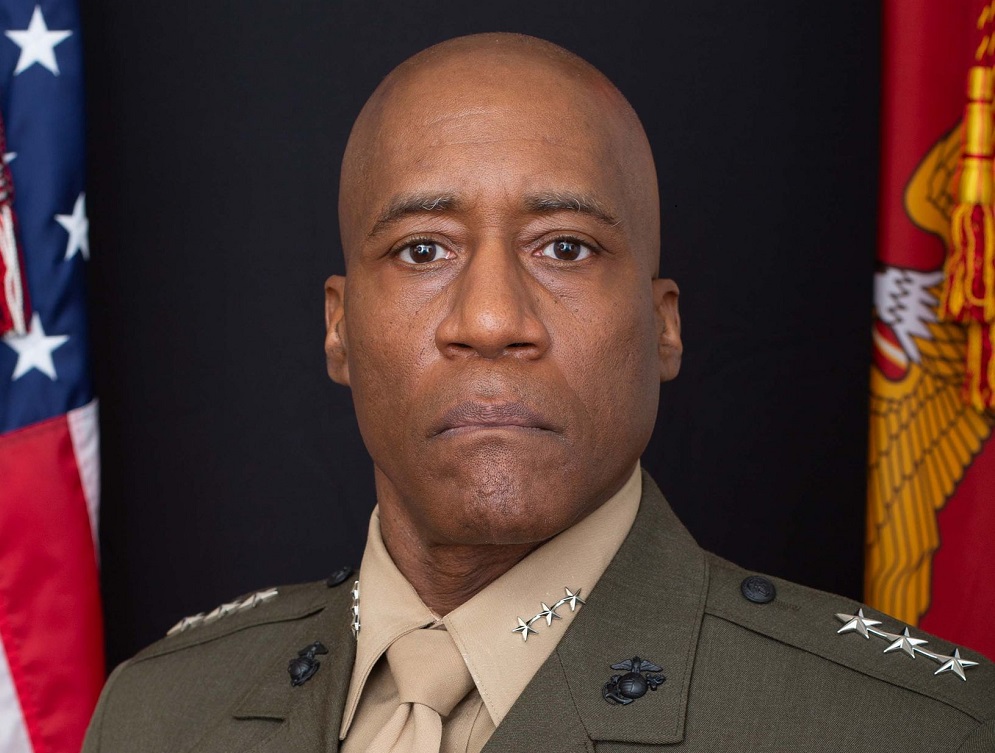
Defense Secretary Lloyd J. Austin III has recommended that the White House promote Lt. Gen. Michael E. Langley of the Marine Corps to be the next head of the military’s Africa Command, two U.S. officials said, in what would be a pathbreaking assignment.
If formally nominated by the White House and confirmed by the Senate, General Langley would become the first Black four-star Marine Corps officer. He would succeed Gen. Stephen J. Townsend of the Army, who is retiring this summer, said the officials, who spoke on the condition of anonymity to discuss personnel issues.
General Langley, who oversees Marine forces on the East Coast, has commanded at every level from platoon to regiment during his 37-year career and served overseas in Afghanistan, Somalia and Okinawa. He also has had several senior staff jobs at the Pentagon and at the military’s Central Command, which oversees operations in the Middle East.
“He’s a Marine’s Marine,” said Jim Mattis, a former defense secretary and retired Marine four-star general, praising General Langley’s operational and intellectual prowess.
But perhaps more significantly, a Black Marine is poised at long last to make four-star.
The Marine Corps has never had anyone other than a white man in its most senior leadership, four-star posts.
Since the Marines first admitted African American troops in 1942, the last military service to do so, fewer than 30 have obtained the rank of general in any form. Not one has made it to the top four-star rank, an honor the Marines have bestowed on 73 white men. Seven African Americans reached lieutenant general, or three stars. The rest have received one or two stars, the majority in areas from which the Marine Corps does not choose its senior leadership, like logistics, aviation and transport.
After an August 2020 New York Times article about the dearth of Black Marine generals, the Marine Corps commandant, Gen. David Berger, was asked why the corps had not promoted an African American to its top ranks in its entire 246-year history. “The reality of it is: Everybody is really, really, really good,” General Berger said in an interview with Defense One. “For every 10 we pick, every 12, we could pick 30 more — every bit as good.”
General Langley is “aware of the weight of this promotion,” said retired Lt. Gen. Ronald L. Bailey, the first Black man to command the First Marine Division, from 2011 to 2013. “I’ve known him since he was a first lieutenant. I know how bright he is, and he knows what this means.”
The promotion, General Bailey said, “is bigger than Langley. This is for our nation. It’s been a glass ceiling for years, and now Black Marines will see that this is possible.”
As I noted on Twitter this morning, the timeline is rather stark:
1st Black 4-star: USAF: Daniel ‘Chappie’ James, 1975
USA: Roscoe Robinson Jr., 1982
USN: J. Paul Reason, 1996
USMC: Michael E. Langley, 2022 (tentative)
Langley was commissioned in 1985.
James achieved four-star rank when I was 9 years old. His career and life were sadly cut short, as heart problems forced him to retire just two years after his promotion and he died shortly thereafter. Because I was living on an Air Force base at the time, I vividly recall the tributes. Thus, as long as I’ve been old enough to pay attention to such things, it never seemed like a big deal to me that a Black man could be a four-star general.
Colin Powell, who we just lost, was appointed Chairman of the Joint Chiefs of Staff, the highest post in our armed forces, in 1989. I was still a 2nd Lieutenant.
Langley, whom I’ve never met, was commissioned three years ahead of me and was thus a captain at the time. He would have been in junior high when James pinned on his fourth star and likely his freshman year at UT-Arlington when Robinson did the same.
In response to the 2020 piece referenced in the report, written exclusively by Cooper, I wrote a piece for Defense One titled “Fear of a Black General?” refuting the specific charges:
The story by the New York Times weaves around the case of Anthony Henderson, a star officer who began his Marine career in 1994 already holding a law degree (cum laude) and has “multiple combat tours, leadership experience and the respect of those he commanded and most who commanded him.” He was recently strategic advisor and military secretary to then-Navy Secretary Richard Spencer, who enthusiastically recommended him for promotion. And yet, Henderson has not yet made brigadier general in three tries. Some have attributed this to “a tendency to speak his mind,” which, while often a hurdle for promotion in a culture that prizes team players, carries some ugly historical baggage when applied to a Black man.
[…]
Yet the fact that one superstar Black officer has not yet been selected for a general’s rank is not proof of a race problem in the Marine Corps. As a recent RAND report on general and flag officer development shows, all the longstanding services (that is, excluding the new Space Force) have a cliff between colonel/captain and brigadier general/rear admiral, with none having a selection rate above 8 or 9 percent.
[…]
Yet because there are only 37 one-star generals in the entire Marine Corps, only 8 percent of these colonels will ever pin on even a single star. Indeed, it is a longstanding custom, as RAND notes, that “when a Marine Corps officer is promoted to the grade of O-7, they receive letters from other Marine Corps GOs including advice and a reminder that the distinction could just as easily been afforded to ten of their colleagues, and to take the responsibility of the rank seriously and humbly.”
It turns out, Henderson was selected for promotion in the very next board. Whether the NYT story influenced that is unknowable.
Regardless, I noted,
Still, while a single anecdote can be dismissed, the overall data is worrisome. The report notes that the Corps has seen only 25 Black officers make one-star rank, only six have made three-star, and “none has made it to the top four-star rank, an honor the Marines have bestowed on 72 white men.” Further, “Out of 82 Marine generals overall today, there are six African-American brigadier generals and one African-American major general.”
Obviously, America has a long history of racial discrimination and Black servicemembers were only relatively recently admitted to the officer corps as anything like equal members. Still, the Army had a Black one-star general, Benjamin Oliver Davis Sr., in 1940—eighty years ago next month. The Air Force’s Daniel “Chappie” James Jr. became the nation’s first Black four-star general in 1975. Colin Powell became Chairman of the Joint Chiefs of Staff in 1989. Michelle Howard became the first Black woman to pin on four-star rank in 2014. And Charles Q. Brown, Jr. became the first Black service chief just last month. Against this record, the Marines’ lack of even a single Black four-star merits investigation.
After offering some potential benign, bureaucratic reasons for this to have occurred, I observed,
To be sure, it is only recently that the Corps has had four-star officers in any abundance. Alexander Vandergrift, who became Commandant in 1944, was the service’s first four-star. The person holding that billet—and there have been only 20 commandants since—was for decades the only four-star general in the Corps. The Assistant Commandant didn’t become a four-star officer until Lew Walt assumed the billet in 1968. And, as shocking as it may seem today, no Marine held a unified combatant command billet until George Christ took the helm of Central Command in November 1985. So, not only has the opportunity for Marines, regardless of color, to make four-star rank been extremely limited but it has been biased toward infantry officers.
Still, given what we know about structural racism and unconscious bias, the fact that so few Black officers make it to the top of the Marine Corps should alarm senior leadership and spur deeper scrutiny. Since most of the “ducks” doing the picking are white men, it’s reasonable to suspect that this fact colors their vision of what a Marine general looks like.
This morning’s NYT report suggests that it was Austin, not the Marine Corps, that tabbed Langley for the role. But that may well be a mischaracterization; SECDEF will always have to nominate someone for a four-star assignment.









