A theme that runs through many posts and comments here at OTB, and really in the broader political zeitgeist, is how and why many Republicans have cleaved so deeply to Trump. While I think that answers for mass behavior differ from specific individual cases (and again is different for voters versus politicians), it is quite obvious that in some circumstances it is nothing more than the corrupting influences of ambition and power alongside revealed character.
This overall topic was already on my mind and it led me to read The Atlantic‘s profile of Utah Senator Mike Lee: Why Mike Lee Folded. I find Lee noteworthy insofar as he came into office as a Tea Party type in 2010, and was initially willing to play games of chicken with the national economy in the name of fiscal conservatism. But later, as the piece details, was a vocally anti-Trump in 2016, including leading a mini-rebellion at the RNC that year.
Indeed, between his anti-Trump behavior in 2016 and an interview with Lee and political scientists Julia Azari, Lee Drutman, and James Wallner on their podcast, Politics in Question (Do ideas or interests drive our politics?) that I listened to in the fall of 2020, I thought that maybe he was one of the reasonable ones, even knowing some of his Tea Party foolishness. I recall thinking that while he put on the airs of a serious thinker about the US Constitution, his understandings were more of the dorm room philosopher depth than anything else. I don’t usually expect too much depth out of politicians.
Still, I didn’t expect him to be central to the efforts to overturn the election. He ended up being a booster for both John Eastman and Sidney Powell. He also was a fake elector booster. These are, to me, disqualifying positions. I detailed a lot of this first in the post entitled Senators Graham and Lee Owe us an Explanation, but most especially in this one about Mike Lee’s Texts.
Two other examples that have brought Lee to my attention include:
- The Rhetorical Framing of HR1 (which has the subhead: “A truly silly characterization from Senator Mike Lee.”‘
- A foray by Lee into the “We’re a republic, not a democracy”: The Dark Side of “It’s a Republic, not a Democracy”. (So, basically, Dorm Room Philosopher confirmed).
I am not prone to wanting to do too much psychoanalysis via magazine article, but The Atlantic does a pretty good job of making the case that Lee lives in the shadow of his father (who was Reagan’s Solicitor General) and his brother (a member of the Utah Supreme Court) and, moreover, that his attachment to Trump could be a pathway to the AG’s office if Trump wins in November (which also makes him worth paying attention to).
The father, Rex Edwin Lee, is described in the piece as follows:
a giant of the conservative legal movement. Raised in small-town Arizona, Lee graduated as valedictorian from Brigham Young University and finished first in his class at the University of Chicago Law School. At 36, he was recruited to become the founding dean of BYU’s law school, a position he held until a newly elected president, Ronald Reagan, came calling. Serving as solicitor general during Reagan’s first term, Lee argued before the Supreme Court with “an astonishing rate of success,” according to the New York Times’ obituary, winning a great majority of his cases and earning renown, according to former Justice David Souter, as “the best solicitor general this nation has ever had.”
And unlike Senator Lee, the elder Lee apparently had a backbone.
But[Rex] Lee’s real legacy is independence as much as intellect. Not long after Reagan appointed him, the Times noted, “White House political aides soon discovered that he was not automatically their man.” Lee was reliably conservative on a host of matters—busing, abortion, prayer in schools—yet he sometimes set aside his own views, and those of the administration he represented, for what he described as “the broad interests of the nation.” The resulting conflicts with Reagan’s Republican Party, and criticism from far-right conservatives, wore Lee down. Resigning his post in June 1985, Lee remarked of the political pressure he faced: “I’m the solicitor general, not the pamphleteer general.”
What a concept!
At his funeral, Justice Byron White (a liberal, appointed by JFK), called Rex Lee, “the epitome of integrity.”
In terms of comparisons:
Like his father and brother, Lee attended BYU for his undergraduate degree. Unlike them, he stayed there for his legal studies. There was no shame in this; Rex, who had since returned to BYU, this time as the university’s president, had helped build the law school into one of America’s top-tier programs. Even so, it was apparent that Mike wasn’t a legal prodigy like Thomas. While the older Lee was clerking for the U.S. Supreme Court, the younger brother failed, in his first attempt, to qualify for the BYU Law Review. Classmates described this as a humiliating setback: The Law Review was effectively a prerequisite for earning prestigious clerkships down the line, and Lee was suddenly forced to consider the limitations of his own career.
You’d think that being a US Senator would be good enough to fill whatever void there is in Mike Lee’s life, but apparently not.
To be honest, Senator Lee comes across to me as pathetic and obsequience in pursuit of his ambitions in the piece. Moreover, like Lindsey Graham and Ted Cruz, he clearly calculated in 2016 that Trump would lose and so thought opposition to him would redound to his benefit and then had to do an about-face once Trump won the White House. It is a truly pitiful tale and one that underscores how weak and self-serving politicians can be (which is both disappointing and not at all surprising).
Thinking back to 2016, it is worth underscoring that Lee actually called on Trump to drop out after the Access Hollywood tape emerged.
After the convention fiasco, Lee went dark for a while. He mused to friends about leaving the GOP; about registering as an independent, or perhaps as a Libertarian. Then came the Access Hollywood tape in October 2016. Lee immediately called a meeting with his top staffers. They agreed that it was best for him to keep quiet and let the situation play out. A few hours later—to the shock of his aides—the senator posted a four-minute video online calling for Trump to quit the race.
How does he look back on all that now?
I had long wondered, given Lee’s foresight in diagnosing the dangers of Trumpism, whether he harbored any regret about allying himself with the man. Instead, the more we dwelled on Lee’s actions during the 2016 campaign—suggesting that Trump was an aspiring autocrat, attempting to sabotage his nomination, calling for him to quit the race—the more contrite Lee sounded for having doubted Trump in the first place.
“I was a jerk,” the senator said. “I was a jerk to him.”
It was a remarkable moment. After all of Trump’s cruel, ad hominem venom throughout that 2016 campaign, I said to Lee, you’re the jerk?
“Fair enough,” the senator said. “But his decisions don’t have to determine mine.”
The phrase “feet of clay” comes to mind.
I would recommend the piece in full (the link should be a gift link).
But as I ponder how we reached the point we find ourselves at, people like Lee have a lot to answer for, as they clearly are driven far more by ambition than principle (even if they tell themselves otherwise).
Moreover, it is instructive to note that people like Lee, Cruz, and Graham were willing to appear as Men of Principle when they thought Trump was going to lose to Clinton. But man, oh, man once Trump won, it was MAGA time, baby!
A reminder:
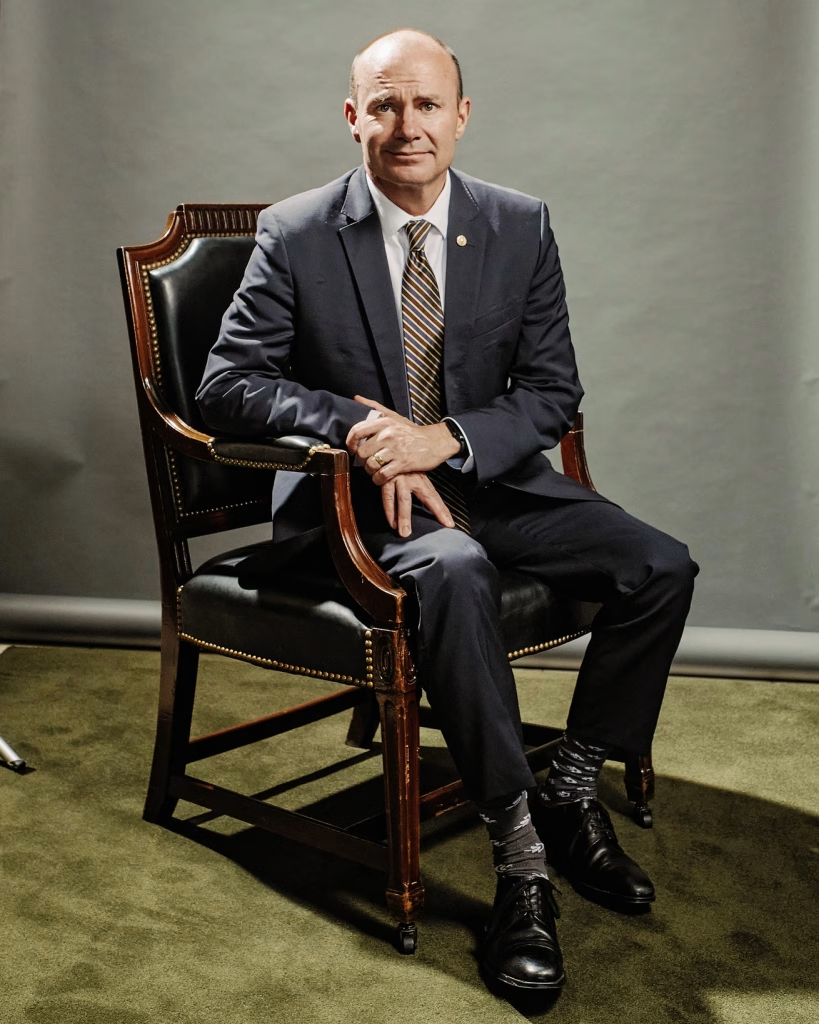
A closing thought. As a photographer, I find this image striking. The pose is pretty standard, if not cliched. But the look on Lee’s face just seems to capture the picture painted by the article.