Steve McIntyre at Climate Audit appears to have caught NASA and James Hansen quietly changing data that is available on NASA’s website.
Shortly after, NASA published their source code on Sept 7, we started noticing puzzling discrepancies in the new data set. On Sep 12, 2007, I inquired about the changes to Hansen and Ruedy, observing that there was no notice of the apparent changes at their website:
I’m sorry but this simply looks bad. This doesn’t address directly the validity of the various hypotheses about global warming, but this certainly does look dubious. It goes without saying that data is extremely important in science and when you are doing research and advocating policies that could cost trillions of dollars and have a major impact on the world economy being at least up front when you change the data strikes me as the best policy. For somebody so smart, James Hansen’s actions are incredibly dumb.
By this time, we’d figured out exactly what Hansen had done: they’d switched from using the SHAP version – which had been what they’d used for the past decade or so – to the FILNET version. The impact at Detroit Lakes was relatively large – which was why we’d noticed it, but in the network as a whole the impact of the change was to increase the trend slightly – enough obviously to make a difference between 1934 and 1998 – even though this supposedly was of no interest to anyone.
I work in a regulated industry and if I were to pull this kind of shenanigans with state regulators I could very well end up in some big trouble.
McIntyre provides this graphic for the impact of this change in the data:
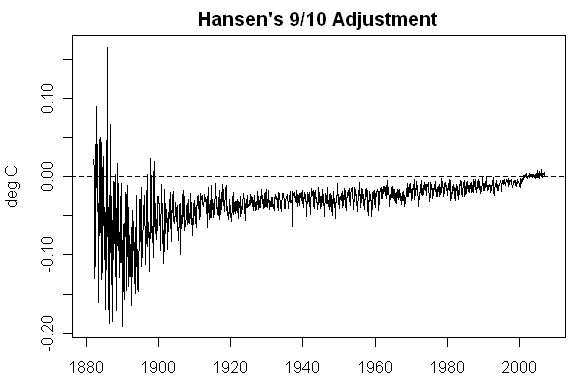
One commenter noted that if you were to smooth this graph out you’d get what amounts to a “reverse” hockey stick. This refers to the “hockey stick” for temperature anomalies found in the research of Mann, Bradley and Hughes. In that case, the hockey stick has the blade at the end of the data series with the most recent observations showing a very steep warming trend. This “reverse” hockey stick that Hansen has applied to the NASA data lowers earlier temperatures thus making the later years relatively hotter. So, not only do we have an un-announced change in the data, but also one that “helps” the global warming hypothesis.
This has lead McIntyre to wonder if perhaps researchers in global warming shouldn’t be required to adhere to a principle similar to one of the principles of the Generally Accepted Accounting Principles: the Principle of Permanence of Method. Basically, methods used by the account are always the same and are coherent when doing the type of work. That is, an account can’t use one method when working at one corporation and using an entirely different method at another corporation even though the work at both corporations are the same.
In response to the objection that accounting and GAAP and science are different subjects and hence such an expectation is unreasonable McIntyre has this response:
Now you may say that this is “science” and accounting principles don’t apply. And my response would be that I’d expect GAAP principles to be a minimum standard for the type of climate statistics being carried out by NASA. Even if NASA climate statisticians are unaware of GAAP per se, they should be adhering to the principles. Sharp practice is sharp practice, however it is gussied up.
I have to agree. One of the bedrock principles of science is that research can be replicated. By quietly changing the data makes it virtually impossible for another researcher to replicate previous results raising a whole bunch of rather unpleasant questions. Any scientist should make his data and source code freely available whenever possible, and given that Hansen is working on the public’s dime and pursuing a research program that could be very, very expensive this seems like a minimal standard to hold him to.
research of Mann