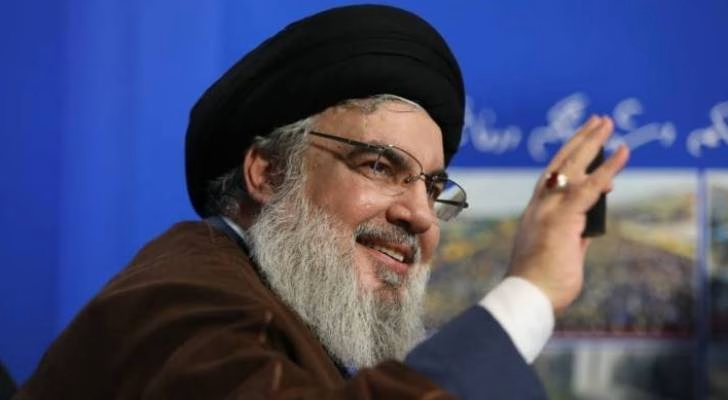
Publicly, at least the Biden administration is supporting Israel.
The White House, “Statement from President Joe Biden on the Death of Hassan Nasrallah“
Hassan Nasrallah and the terrorist group he led, Hezbollah, were responsible for killing hundreds of Americans over a four-decade reign of terror. His death from an Israeli airstrike is a measure of justice for his many victims, including thousands of Americans, Israelis, and Lebanese civilians.
The strike that killed Nasrallah took place in the broader context of the conflict that began with Hamas’s massacre on October 7, 2023. Nasrallah, the next day, made the fateful decision to join hands with Hamas and open what he called a “northern front” against Israel.
The United States fully supports Israel’s right to defend itself against Hezbollah, Hamas, the Houthis, and any other Iranian-supported terrorist groups. Just yesterday, I directed my Secretary of Defense to further enhance the defense posture of U.S. military forces in the Middle East region to deter aggression and reduce the risk of a broader regional war.
Ultimately, our aim is to de-escalate the ongoing conflicts in both Gaza and Lebanon through diplomatic means. In Gaza, we have been pursuing a deal backed by the UN Security Council for a ceasefire and the release of hostages. In Lebanon, we have been negotiating a deal that would return people safely to their homes in Israel and southern Lebanon. It is time for these deals to close, for the threats to Israel to be removed, and for the broader Middle East region to gain greater stability.
AP, “Biden and Harris call the Israeli strike killing Hezbollah’s Nasrallah a ‘measure of justice’“
The Israeli strike that killed Hezbollah’s Hassan Nasrallah was a “measure of justice” for victims of a four-decade “reign of terror,” President Joe Biden said Saturday.
[…]
“President Biden and I do not want to see conflict in the Middle East escalate into a broader regional war,” Vice President Kamala Harris said in a statement Saturday that echoed Biden’s description of a “measure of justice.” She added, “Diplomacy remains the best path forward to protect civilians and achieve lasting stability in the region.”
But Peter Baker and Julian Barnes report for NYT, “Strike on Hezbollah Deepens Disconnect Between Biden and Netanyahu“
No one inside the White House was crying for Hassan Nasrallah on Saturday. But the Israeli strike that killed Mr. Nasrallah, the longtime leader of Hezbollah, once again deepened tensions between President Biden’s administration and Prime Minister Benjamin Netanyahu’s government.
Israeli officials gave their American counterparts no advance warning of the strike on Friday, according to U.S. officials, who were already peeved that Mr. Netanyahu brushed off a U.S.-French 21-day cease-fire proposal. Now American officials worry that they face a wider war that could engulf the region after nearly a year of effort by Mr. Biden to head off such an escalation.
[…]
While the president and vice president refrained from publicly second-guessing Israel, American officials privately expressed frustration about what they saw as the latest example of a pattern of defiance by an ally that Mr. Biden has sought to support. The miscommunications and miscalculations of recent days have only underscored the disconnect between the American president and the Israeli prime minister.
The expanding Middle East war comes at a politically sensitive time for Mr. Biden and the White House as Ms. Harris races to build support for the election that culminates in about five weeks. More turmoil in the region could fuel criticism from the left and the right even as Ms. Harris would prefer to focus attention on what she calls the dangers of another term for former President Donald J. Trump.
Some Biden team veterans even speculated about whether Mr. Netanyahu was intentionally trying to help Mr. Trump win the Nov. 5 election given their past alignment — a theory that, true or not, highlights the deep mistrust and suspicion that have grown in recent months between Washington and Jerusalem.
Meanwhile, in an “exclusive,” Reuters reports, “Iran’s supreme leader taken to secure location, sources say“
Supreme Leader Ayatollah Ali Khamenei has been taken to a secure location inside Iran amid heightened security, sources told Reuters, a day after Israel killed the head of Iran-backed Lebanese group Hezbollah in a strike on Beirut.
The move to safeguard Iran’s top decision-maker is the latest show of nervousness by the Iranian authorities as Israel launched a series of devastating attacks on Hezbollah, Iran’s best armed and most well-equipped ally in the region.
Reuters reported this month that Iran’s elite Revolutionary Guards Corps, the ideological guardians of the Islamic Republic, had ordered all of members to stop using any type of communication devices after thousands of pagers and walkie-talkies used by Hezbollah blew up.
And The Telegraph reports, “Iranian general killed alongside Hezbollah chief“
Iran’s state-news service confirmed that Abbas Nilforushan, a top general in its Islamic Revolutionary Guard Corps (IRGC) who led operations in Lebanon, was also killed in the bombing.
Thus far, Farnaz Fassihi reports for NYT, “Iran Projects Caution After Israeli Strikes Against Hezbollah“
In the turbulent landscape of the Middle East, Iran’s aging supreme leader, Ayatollah Ali Khamenei, could always rely on the close alliance, unwavering loyalty and deep friendship of Hassan Nasrallah, the leader of the Lebanese militia Hezbollah.
When Israel killed Mr. Nasrallah in a massive airstrike on Friday, it abruptly wiped out a singular force in Mr. Khamenei’s hierarchy of close associates.
Iran had for 40 years nurtured Hezbollah as the main arm of its proxy network of militias, as a forward defense against Israel. But in the past two weeks, Hezbollah’s capacity began to crumble under wave after wave of Israeli attacks on its leadership, arsenal and communications.
Now, fissures have opened within the Iranian government over how to respond to Mr. Nasrallah’s killing, with conservatives arguing for a forceful response and the moderates, led by Iran’s new president, Masoud Pezeshkian, calling for restraint.
All of this has left Iran, and its supreme leader, in a vulnerable position.
Four Iranian officials who knew Mr. Nasrallah personally and had been briefed on events said that Mr. Khamenei had been deeply shaken by his friend’s death and was in mourning, but had assumed a calm and pragmatic posture. The officials, including two members of the Islamic Revolutionary Guard Corps, requested anonymity as they were not authorized to speak publicly.
[…]
Significantly, Mr. Khamenei signaled that it would be Hezbollah, not Iran, that would be leading any response to Israel, and that Iran would play a supporting role. “All of the forces in the resistance stand by Hezbollah,” Mr. Khamenei said. “It will be Hezbollah, at the helm of the resistance forces, that will determine the fate of the region.”
It was a striking sign, some analysts said, that Mr. Khamenei may have no way to effectively respond at the moment to Israel’s onslaught on his proxies. Faced with a choice between all-out war with Israel or lying low in the interest of self-preservation, he appears to be choosing the latter.
“They are completely checkmated by Israel at this moment,” said Sanam Vakil, the director for Middle East at Chatham House. “Khamenei’s statement is indicative of the gravity of the moment and the caution; he is not publicly committing to anything that he can’t deliver.”
Israel has been targeted by Iran since the 1979 Revolution and by what became Hezbollah and other Iranian proxies since 1982. Neither threat is likely to go away any time soon. Still, in the span of a few days, the senior leadership of Hezbollah and the IRGC have been killed, the communications networks of the IRGC and its proxies has been gutted, and Iran’s leader is cowering in fear for his safety. As “mowing the grass” goes, that’s an incredibly effective showing.