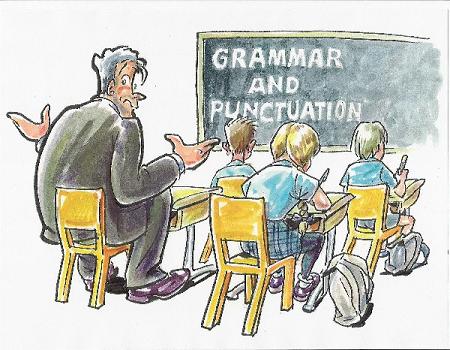
 I’m reliably informed that today is National Grammar Day:
Language is something to be celebrated, and March 4 is the perfect day to do it. It’s not only a date, it’s an imperative: March forth on March 4 to speak well, write well, and help others do the same!
Inspired by this, Alex Knapp’s “He Got Hung” post, and an off-topic discussion in a recent comment thread, it occurs to me that today is as good a time as any to reflect on the rather dramatic changes in American writing conventions over the thirty-odd years since I was taught writing as a schoolboy.
Also, to pass along the old Schoolhouse Rock caution that Grammar is not your grandma. Whatever that means.
Aside from the contortions in the language caused by gender equality — the end of the gender neutral masculine form, the acceptance of plural pronouns for singular antecedents to convey gender neutrality, and so on — the change that I’ve most noticed is the rapid decline in the use of capitalization. Things that were once considered proper nouns or proper adverbs have been demoted to ordinary forms. So, for example, while we still write “Secretary of Defense Robert Gates” — titles still get capitalized — we now usually write, “Robert Gates is secretary of defense.”
Likewise, academic subjects are no longer expressed in upper case unless they’re used as part of a title. We no longer say that someone studied History, Political Science, and Algebra. But someone can still be chairman of the Department of History (but not of the History Department — that’s now lower cased).
I never know where to put a comma anymore. We’ve certainly become much stingier in their use in recent years. The trailing comma in lists, for example, is gone. And a lot of subordinate clauses now get a free pass to the big table. I don’t know why. Nor does there seem to be much rhyme or reason.
Finally, the change that I’ve most noticed in my own writing in recent years — and in others’, too, since I’m an editor by occupation — is that em dashes have replaced most instances of parenthetical expressions. One almost never used a dash back in the day — which is why the convention with typewriters was a double hyphen — but parentheses were used all the time (and thus on the keyboard with the 9 and 0).
What about you? What changes have you noticed over the years?
UPDATE: Kevin Drum makes a valiant stand for the Oxford comma.
Following suit, commenter JimB points to the late William F. Buckley, Jr.’s caution of the difference between “red, white, and blue” shirts and “red, white and blue” shirts.
CDRealist ups him with a better example: “I’d like to thank my parents, Ayn Rand and God.”