
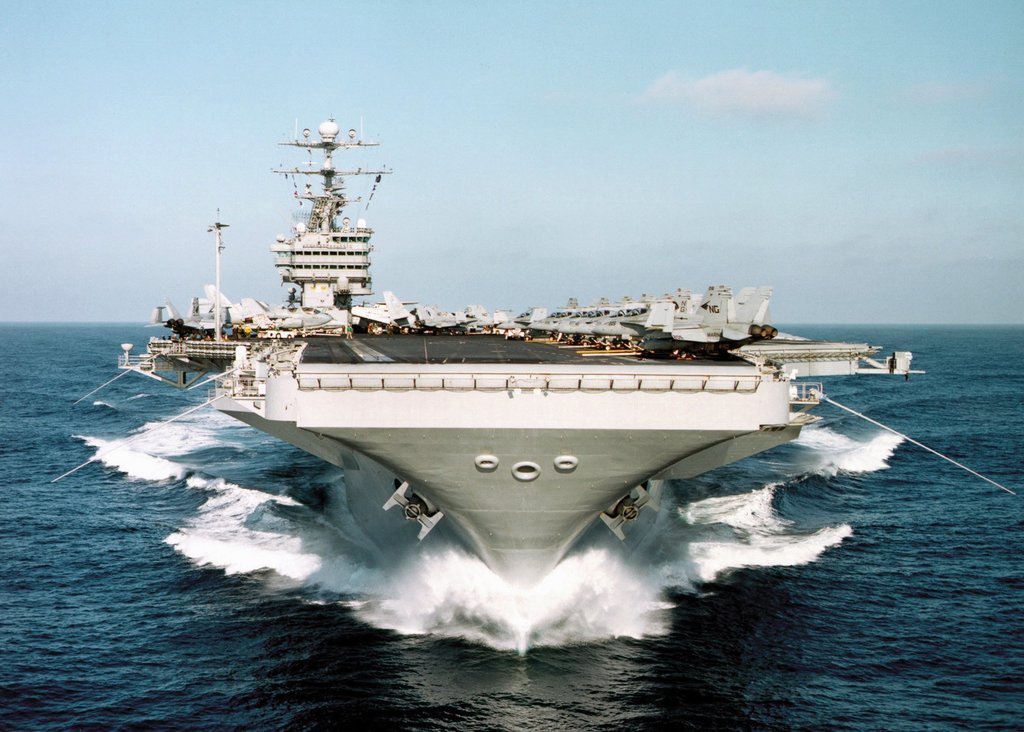

The Chief of Naval Operations wants people to stop worrying about how many ships are in the fleet and start thinking in terms of combat effectiveness.
The Navy’s top officer wants people to stop thinking about thesize of the fleet in terms of how many ships it has, and instead start thinking about what those ships can do.
Asked whether he thought unmanned ships would ultimately count against the Navy’s battle force of ships, which now stands at 289, Chief of Naval Operations Adm. John Richardson said he’d like to move away from thinking in terms of ship count.
“It’s kind of a theoretical discussion,” Richardson said. “The thing that really matters is how much naval power do those platforms deliver. That’s the thing we’re after, I’m not so caught up in what counts against the battle force.
“Because if that platform, manned or unmanned, delivers a requisite amount of naval power that’s available and assignable by the theater commander, then OK, that contributes to naval power.”
—David B. Larter, DefenseNews, “The Navy’s top officer wants you to stop counting his ships“
This would seem like a blinding flash of the obvious but it’s actually a somewhat bold, if not heretical, stance coming from a CNO.
The distinction may seem like an exercise in semantics, but for Congress, the number of ships in the fleet has always been a useful metric when discussing the need for a larger or smaller Navy. Even President Ronald Reagan made a specific ship count — 600 ships — an organizing goal and rallying cry.
Today, lawmakers in both the House and Senate have made the Navy’s current force-structure assessment goal of 355 ships a focal point of their efforts.Going after a concept like “total naval power” is somewhat more abstract and difficult to fit on a bumper sticker. However, the danger of chasing ship counts is that it could drive the Navy toward buying platforms it doesn’t need to meet a specific number, Richardson said.
“We have to be very careful to make sure that we’re not constructing something that counts on a tally but doesn’t contribute to naval power,” Richardson said. “At the end of the day, the real metric is power.”
The question will become relevant as the Navy prepares to roll out its force structure assessment later this year, which service leaders have intimated will likely grow the number of ships it needs to support the National Defense Strategy. Richardson’s answer represents a view widely held inside the Navy: that simply counting hulls is inadequate.
Again, this seems obvious. And it’s crucial in resolving such debates as to whether it makes sense to devote enormous resources to refueling the Truman at its midlife or, indeed, whether the aircraft carrier concept remains relevant if we’re basing our force posture around a future superpower conflict.
Still, smart people disagree.
However, others have argued that quantity has a quality of its own, and that for a variety of demands placed on the fleet outside of being able to fight and win a war — presence, training with partners and freedom of navigation operations, to name a few — at some point the service will need enough hulls to fulfill the mission.
Jerry Hendrix, a retired Navy captain and analyst with Telemus Group, has argued for years that numbers are critical to the Navy’s role in preserving the peace. Citing the 2007 maritime strategy, Hendrix said numbers matter.“In that strategy they found that preserving the peace was at least as important a mission as winning the war,” Hendrix said. “This idea of peacetime presence is crucial, and capacity is very critical in the peace preservation mission. You can’t surge trust and you certainly can’t be virtually present.”
Hendrix isn’t wrong. Moreso than any of the other military services, the Navy has an everyday mission other than preparing for combat and humanitarian assistance/disaster response missions. Those do indeed require platforms.
Then again, Richardson surely doesn’t dispute that. He’s making a broader argument: that we shouldn’t assess the Navy’s readiness purely in terms of vessels. The old “600-ship Navy” championed by John Lehman continues to have resonance and many in Congress and the halls of the Pentagon remain attached to that outdated metric. Ditto the number of carrier battle groups. Richardson is simply saying we need to think beyond raw numbers, not that numbers are meaningless.
The Army and Marine Corps have similar habits, thinking in terms of the number of soldiers/Marines, divisions, corps, and the like. The number of men under arms is a convenient shorthand for combat power. But the ground services are further along culturally in understanding that the raw numbers are only part of the story.









