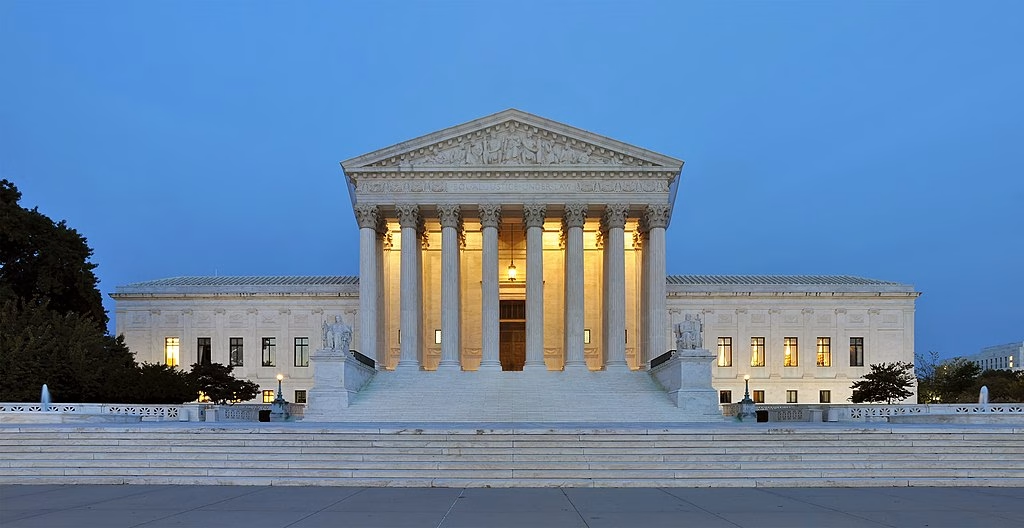

Jeannie Suk Gersen, a Harvard Law professor and contributor to The New Yorker, warns “The Supreme Court Is One Vote Away from Changing How the U.S. Is Governed.” While the incredible dysfunction of our government might have us longing for said vote, the change she forecasts is not of the beneficial variety.
The setup:
Gundy v. United States was about the “Sex Offender Registration and Notification Act,” known as sorna, which Congress enacted in 2006. The statute made it a crime, punishable by ten years in prison, for individuals convicted of a sex offense involving a minor to fail to register in each state where they live, work, or study. But Congress gave the Attorney General “the authority to specify the applicability” of these requirements to people convicted before sorna took effect. In 2007 and in 2011, Attorneys General Alberto Gonzales and Eric Holder said the requirements do apply to such people.
That group encompassed half a million people, including Gundy, who was convicted of sexual assault of a minor in 2005. After serving prison time for the crime, he went to live in a halfway house in New York in 2012. After he failed to register there, he was rearrested and convicted of the new federal crime. Gundy claimed that sorna violated the non-delegation doctrine, wherein it is unconstitutional for Congress to delegate its legislative power to the executive branch. He argued that letting the Attorney General determine whether the law applied to people like him left too much to be decided by an agency rather than by Congress.
Setting aside questions as to why the bill is known as sorna rather than the acronym SORNA, this doesn’t even strike me as a case that should make it to the Supreme Court. While I’d be amenable to the argument that retroactive application of what amounts to punishment is effectively an unconstitutional ex post facto law, the delegation of routine decisionmaking to the Attorney General would seem uncontroversial.
As Gersen explains,
For the better part of a century, the Court has permitted Congress to delegate broad policymaking authority to federal agencies. The Court has not struck down a statute under the non-delegation doctrine since 1935, when a conservative majority was hostile to progressive New Deal measures aimed at protecting workers and consumers. Since then, the increasing complexity of modern industrialized society has made it obvious that—even when Congress is not as dysfunctional as it is now—it’s not possible for Congress to legislate the technical details necessary to regulate the environment, health, safety, labor, education, energy, elections, discrimination, housing, and the economy.
As a result, executive agencies create regulations and implement binding policies. That has long been understood as both necessary for the country to function and consistent with the Constitution. The Court has applied a test: if a statute gives an agency discretion that is sufficiently constrained by an “intelligible principle,” then Congress is not unconstitutionally delegating legislative power. But many conservatives complain that that test has been applied in a lax way, so that any statute delegating any scope of authority appears to satisfy it. For example, the Court has repeatedly upheld statutes that give agencies only general guidance, such as to regulate in the “public interest,” or issue air quality standards “requisite to protect the public health.”
As noted in a recent post, even though I’m temperamentally conservative and skeptical of the vast expansion of Federal power and the rise of the Executive state, there’s simply no alternative to such delegation in a modern society. Congress simply doesn’t have the bandwidth or expertise to manage the details of lawmaking in a vast, complex, technologically-advanced world. They simply have to defer to experts in the Executive bureaucracy and then conduct oversight, effectively reversing the Constitutional order.
We have five Justices on the Supreme Court, however, who think we’ve gone too far.
In Gundy, all four liberal Justices, in a plurality opinion by Justice Elena Kagan, hewed to the prevailing approach, finding that Congress provided enough guidance limiting the agency’s discretion to pass constitutional muster. Three conservative Justices, in a dissent by Justice Neil Gorsuch, said that the law impermissibly gave the Attorney General “free rein to write the rules,” and was unconstitutional. Justice Samuel Alito cast the deciding vote that enabled the liberals to prevail this time, but his three-paragraph concurrence made clear that the victory may be short-lived. He said that if the majority “were willing to reconsider the approach we have taken for the past 84 years, I would support that effort.” A conservative majority was lacking here because of the absence of Justice Kavanaugh. [Who had not been confirmed at the time the Court heard oral arguments in the case and therefore had to recuse himself. -jhj] Next time there’s a similar case before the Court, his vote will make for a different result.
We are now explicitly on notice that the Court will likely abandon its longstanding tolerance of Congress delegating broadly to agencies. What’s at stake is the potential upending of the constitutional foundations of the so-called “administrative state.” Today’s reality is that agencies, not Congress, make most federal laws. As Justice Kagan put it, if the delegation in Gundy were unconstitutional, “then most of Government is unconstitutional.”
Now, arguably, it is. But, despite my sympathy for a textual-historical approach to Constitutional interpretation, there has to be some concession to the practical realities of governing. Not to mention eighty years of precedent.
But Gersen seems to be over-interpreting Alito here.
What will happen then, when the conservative bloc prevails? The alarmist view is that the E.P.A. couldn’t have the power to decide how stringent pollution standards should be. The F.D.A. couldn’t have the authority to approve or deny applications to sell new medical drugs. The Department of Education couldn’t make rules for colleges and universities. The Department of the Interior couldn’t govern snow mobiles in national parks. The S.E.C. couldn’t regulate financial firms or securities. The F.C.C. couldn’t issue rules on net neutrality or Internet service providers. In sum, we would dwell in a world without the federal law that governs our lives.
I’m not reading Alito that broadly, however. Indeed, Alito CONCURRED in the judgment while Neil Gorsuch, Chief Justice Roberts, and Clarence Thomas dissented.
Still, his opinion, which I reproduce in its entirety below, is indeed cryptic:
The Constitution confers on Congress certain “legislative [p]owers,” Art. I, §1, and does not permit Congress to delegate them to another branch of the Government. See Whitman v. American Trucking Assns., Inc., 531 U. S. 457, 472 (2001). Nevertheless, since 1935, the Court has uniformly rejected nondelegation arguments and has upheld provisions that authorized agencies to adopt important rules pursuant to extraordinarily capacious standards. See ibid.
If a majority of this Court were willing to reconsider the approach we have taken for the past 84 years, I would support that effort. But because a majority is not willing to do that, it would be freakish to single out the provision at issue here for special treatment.
Because I cannot say that the statute lacks a discernable standard that is adequate under the approach this Court has taken for many years, I vote to affirm.
The Gorsuch dissent begins thusly:
The Constitution promises that only the people’s elected representatives may adopt new federal laws restricting liberty. Yet the statute before us scrambles that design. It purports to endow the nation’s chief prosecutor with the power to write his own criminal code governing the lives of
a half-million citizens. Yes, those affected are some of the least popular among us. But if a single executive branch official can write laws restricting the liberty of this group of persons, what does that mean for the next?
The argument that follows is long and winding. But, while it spends quite a bit of time—not unreasonably—warning of the rationale behind separation of powers and the Framers’ fears about handing off of legislative power to the executive, it also acknowledges not only that the Supreme Court started allowing delegation going back to Chief Justice Marshall’s tenure but that it was wise and reasonable to do so. He concludes:
In a future case with a full panel, I remain hopeful that the Court may yet recognize that, while Congress can enlist considerable assistance from the executive branch in filling up details and finding facts, it may never hand off to the nation’s chief prosecutor the power to write his own criminal code. That “is delegation running riot.” [emphasis mine–jhj]
Now, from my limited understanding of the facts of Gundy, I don’t believe Congress did that. Rather, it essentially ordered the Attorney General to apply registration to past convicts. The reason discretion was afforded was simply a recognition that, because it potentially applied to so many people, it was best to let those charged with the administration of justice figure out how and under what timetable to implement that mandate. The AG wasn’t tasked with writing a criminal code but rather with discretion as to how quickly to roll out the code Congress wrote.
Regardless, if we assume Kavanaugh will join forces with Alito and the three dissenters and thus create a five-vote majority, we seem to be in for some house-cleaning, not an overturning of the broad principle that Congress can delegate rule-making authority.
Indeed, Gorsuch flatly acknowledges longstanding principles:
First, we know that as long as Congress makes the policy decisions when regulating private conduct, it may authorize another branch to “fill up the details.” In Wayman v. Southard, this Court upheld a statute that instructed the federal courts to borrow state-court procedural rules but allowed them to make certain “alterations and additions.” Writing for the Court, Chief Justice Marshall distinguished between those “important subjects, which must be entirely regulated by the legislature itself,” and
“those of less interest, in which a general provision may be made, and power given to those who are to act . . . to fill up the details.”
Wayman v Southard was decided in 1825—almost 200 years ago now—and Gorsuch and company defer to it as gospel. After more discussion, we get to:
Second, once Congress prescribes the rule governing private conduct, it may make the application of that rule depend on executive fact-finding. Here, too, the power extended to the executive may prove highly consequential. During the Napoleonic Wars, for example, Britain and
France each tried to block the United States from trading with the other. Congress responded with a statute instructing that, if the President found that either Great Britain or France stopped interfering with American
trade, a trade embargo would be imposed against the other country. In Cargo of Brig Aurora v. United States, this Court explained that it could “see no sufficient reason, why the legislature should not exercise its discretion [to impose an embargo] either expressly or conditionally, as
their judgment should direct.”
Cargo of Brig Aurora is an even older case, dating to 1813. And, again, Gorsuch and company defer to it.
Third, Congress may assign the executive and judicial branches certain non-legislative responsibilities. While the Constitution vests all federal legislative power in Congress alone, Congress’s legislative authority sometimes overlaps with authority the Constitution separately
vests in another branch. So, for example, when a congressional statute confers wide discretion to the executive, no separation-of-powers problem may arise if “the discretion is to be exercised over matters already within the scope of executive power.”
Again, the dissenters are deferring to longstanding precedent.
So, what’s the fuss?
The argument is long and defies excerpting here but it boils down to the “intelligible principle” doctrine laid down in a 1925 case called J. W. Hampton, Jr., & Co. v. United States and its subsequent interpretation.
[W]hen Chief Justice Taft wrote of an “intelligible principle,” it
seems plain enough that he sought only to explain the operation of these traditional tests; he gave no hint of a wish to overrule or revise them
Basically, the dissenters think we should go back to those core principles and be wary of delegation that doesn’t fall within them. They believe the Court has become too lenient in applying the “intelligible principle” doctrine and thus allowed Congress to delegate actual policymaking judgment to the executive bureaucracy—a bridge too far.
The case law in question is sufficiently outside my scope of expertise that I don’t have a strong opinion as to whether that’s true or whether this revised thinking would too narrowly constrain Congress. But it’s not the radical undoing that Gersen suggests.
She closes,
The main idea of the non-delegation doctrine is that any law that is enforced against citizens must be approved by Congress. It’s not enough for Congress to say, “We should have a law on this subject and someone else will write and enforce it.” But this formulation is a rhetorical parlor trick. When building a house, one may have a strong idea of the kind of house one wants, but most of us have neither the knowledge nor the desire to make the thousands of key decisions about how to safely construct it. Those decisions are sensibly delegated to a contractor and an architect. A rule forbidding any delegation of that sort makes for very different, more rudimentary, building, and probably many fewer buildings built.
I’m not persuaded that this analogy is correct or, more importantly, that the application of the three principles Gorsuch points to wouldn’t permit Congress to subcontract in this fashion.
The more robust non-delegation doctrine that the conservative Justices desire would mean a change in the nature and scope of the federal government’s role in our lives. Conservatives favor making it difficult for the federal government to regulate, because, when it does, it risks impinging on our liberties. And, if the federal government does less, states may do more. The impact of this change will ultimately depend on which elected officials are in power, and that is really up to us, not the Supreme Court.
Again, I’m insufficiently expert to know how severe the impact would be. The three articulated and longstanding principles strike me as allowing rather robust delegation of the details so long as the broad policy is set by Congress.
Further, to the extent that delegation violates the provisions of the Constitution, it really is up to the Supreme Court, not to us and our elected officials, to draw the line.