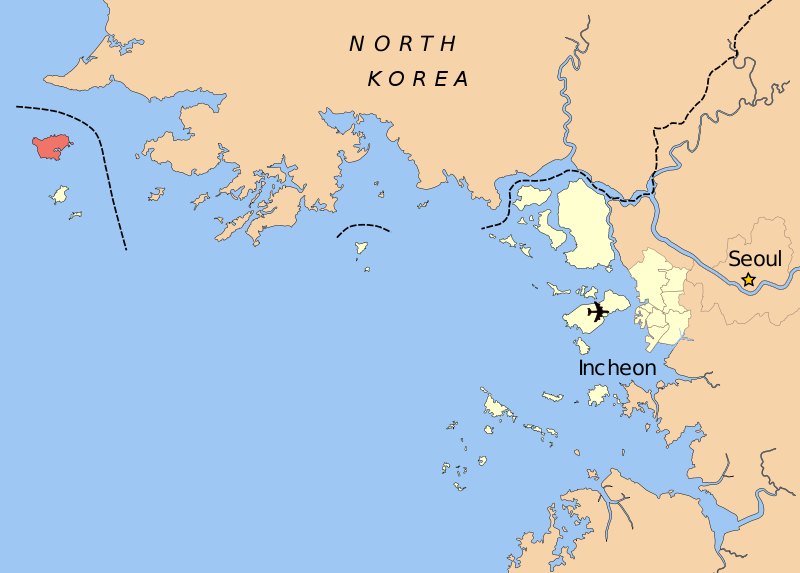

Tensions continue to rise on the Korean Peninsula in the wake of the sinking of the South Korean naval vessel ROKS Cheonan by a North Korean torpedo on March 26, 2010 with the loss of the lives of 46 South Korean sailors. When the attack, presumably by a North Korean miniature submarine, occurred, the South Korean vessel was not, apparently, in disputed waters as has been reported by some news media but in South Korean waters. The attack was unprovoked.
The latest ratcheting comes in the form of the North Koreans rejecting an agreement that has been in place for some time to prevent accidental naval clashes with the South and a report from the United Nations that, surprising to no one, North Korea has been trading missile and nuclear technology to Iran, Syria, and Burma in defiance of a UN ban.
I’d like to draw your attention to a couple of analysis and opinion pieces on the situation. In the first at The Moderate Voice Jerry Remmers presents what to my eye is a pretty good report on the situation and the positions in which the various players—North Korea, South Korea, China, Japan, and the U. S.—find themselves. He concludes:
It boils down to this: Does Wen Jiaboa and Beijing believe Clinton’s assertion that the U.S. is “resolute” in backing South Korea means the U.S. going to war if the situation escalates that far? Stay tuned.
In the second Steve Green of Pajamas Media reflects on the good, the bad, and the ugly in the situation in his characteristically sardonic fashion:
The good news: It’s unlikely that North Korea has enough gasoline to fight for more than a few days.
The bad news: they could really mess up the South in less time than that.
The worse news: nobody knows what would happen after the inevitable North Korean collapse, but everybody knows that nobody could afford it.
The downright scary news: even a wildly unspectacular North Korean invasion would serve as a test of our CINC’s mettle — a test we can’t be certain he’d pass.
This morning the New York Times editorializes on importance of China in the situation:
There is only one country with any chance of getting through to North Korea. That is China, the North’s major supplier of aid, food and oil. As tensions on the Korean Peninsula continue to spiral — frighteningly — upward, China is refusing to get involved.
China has only one concern: avoiding any crisis that might unleash huge refugee flows. If it believes that the status quo is conducive to stability, it is mistaken.
That is factually incorrect. China’s interests in North Korea are broader than that in several notable ways. First, the reunification of Korea is anathema to the Chinese. It presents the prospect of a U. S. ally on their border.
It would be a setback in their assertion of themselves as the East Asian regional superpower.
Over the period of the last fifty years China has devoted substantial time, energy, and resources to North Korea. The collapse of the regime there would be embarrassing to the Chinese leadership. That’s not a trivial concern to them. It would put their reputation as shrewd, pragmatic operators at stake.
The crisis on the Korean peninsula is already producing adverse consequences for the Chinese. Japan’s Prime Minister has broken his campaign promise, reversed course, and signed on to a plan to maintain 25,000 U. S. troops on Okinawa. Indeed, he’s dismissed one of his subordinates over the matter. As the situation in Korea worsens, the Marines look that much better.
China’s interests in North Korea go beyond preventing a flood of refugees. Their plans for their own neighborhood and their standing in the world are at stake, too.