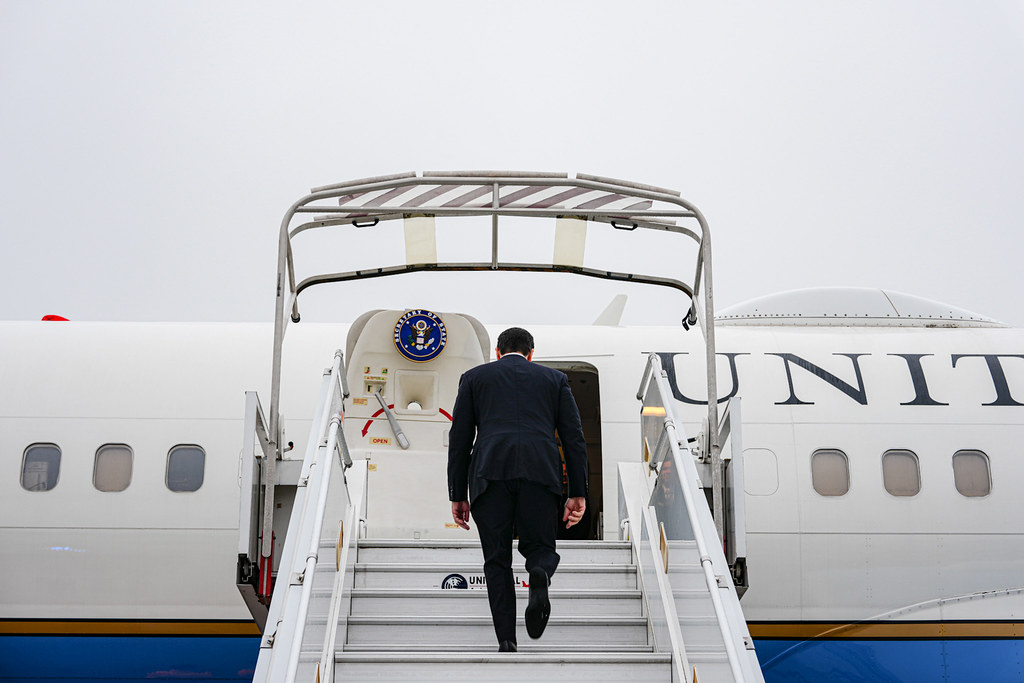
WaPo (“Flying by pricey military jet, Rubio rarely misses a Florida football game“):
On a recent early November Saturday afternoon, it was a C-37 that touched down, carrying the team’s most recognizable parent, a blue polo replacing his usual suit and tie. Security officers roamed the north end of Gainesville Regional Airport as a line of five unmarked SUVs crept up, swept up their passenger and rolled off toward campus.
Half an hour later, Secretary of State Marco Rubio was down on the field, chatting with Florida Coach Jon Sumrall. Rubio’s son Anthony is a walk-on running back for the Gators, and Rubio has regularly flown in to catch his games, including at least five this fall.
Rubio says his trips are about something familiar to any parent: showing up. But they also come at a cost to taxpayers.
Since taking office last year, Rubio, a Florida graduate, has flown to at least 10 Gators football games, the State Department confirmed in response to a Washington Post analysis of flight records. He has traveled to Gainesville aboard government aircraft at least 23 times, including 15 trips the department characterized as solely personal.
Rubio’s personal travel, through nearly two years on the job, appears to significantly outpace that of his predecessors, former State Department officials said. And it’s adding up: The flights have cost the government more than $1.2 million, The Post found, using rates published by the Defense Department.
At first blush, this seems outrageous. But there’s an important twist:
Like the defense secretary and directors of the FBI and CIA, Rubio is barred from flying commercially for security reasons and is required, when traveling for personal reasons, to reimburse the government the equivalent of an economy-fare ticket.
So, Rubio has two choices: fly on expensive military jets or miss his son’s games. Granting that his son is a deep bench player, seeing the field only in the event of huge blowouts, that changes things considerably. And I suspect, were Rubio still in the Senate, he would gladly have flown commercial to see these games whenever possible.
Officials’ reimbursements are rarely made public, but the amounts required cover only a fraction of the true cost, occasionally leading to scrutiny and controversy for Republican and Democratic appointees alike.
But that’s the deal. He’s forbidden from flying commercial. So, either he flies military jets or he stays in DC. And, frankly, $1.2 million is chump change for ensuring the safety of the Secretary of State, who is, among other things, fourth in line to the presidency.
Rubio and the State Department declined to say how much he has reimbursed the government, but they defended the trips.
“I have and will continue to try and make it to as many events that are important to me personally and to my family as possible,” Rubio said in a statement, in response to questions from The Post.
Assistant Secretary of State Dylan Johnson said Rubio uses military aircraft to “ensure continuity of operations, continuity of government and access to secure communications at all times. And he will continue to do so.”
Again, flying aboard military aircraft isn’t the issue; he’s required to do so. The issue is the propriety of doing so for purely personal reasons.
Government ethics experts said that while Rubio’s travel complies with federal rules, it raises a question about stewardship of public money. The handful of government officials who aren’t allowed to fly commercially have little choice in how they travel, they said, but they retain control over how frequently they take personal trips.
“If this travel becomes something that is undermining the integrity of your service, are you really taking care of taxpayer dollars the way that you’re obligated to as a public official?” asked Cynthia Brown, senior ethics counsel at Citizens for Responsibility and Ethics in Washington, a nonpartisan watchdog organization.
Brown said the situation is “more of an optics issue than a violation,” but added that although it may not be “technically improper, it is something that I think is really important to shine the light on.”
I honestly don’t have a strong opinion on this.
There’s a longstanding philosophical debate about the limits of selfishness. In comic book circles, for example, there are those who argue Superman has no right to a private life. Depending on the era (his powers have fluctuated greatly over the decades), he’s essentially indefatigable. So, every hour he spends living as Clark Kent, dating Lois Lane, or hanging out with his pal Jimmy Olsen, he’s selfishly letting people die.
For we ordinary mortals, how much of the fruits of our labor are we entitled to enjoy? Theoretically, every dollar I spend on myself and my family beyond what’s needed for subsistence is a dollar that could have gone to feed the hungry or clothe the poor.
Public officials clog up the roads with their motorcades, creating substantial inconvenience for hundreds, if not thousands, of people. That’s often unavoidable when they’re conducting legitimate public business. But what should the limits be when they’re, say, doing fundraising? Attending family events?
When President Trump attends a sporting event, which he’s doing with increasing frequency, he creates massive inconvenience for the tens of thousands of real fans who paid hundreds of dollars apiece to be there. Is that objectionable?
Since time immemorial, Presidents have taken vacations, gone golfing, and otherwise engaged in personal recreation. It’s my longstanding view that we should not only not begrudge this, but actively encourage it, to preserve their mental health and decision-making ability. But it’s incredibly expensive to provide the security for these activities.
The report goes on for several paragraphs, none of which add significantly* to resolving the debate, before landing here:
[T]he practice has drawn scrutiny across administrations, raising questions about whether expensive flights were justified, how much officials reimbursed the government, and how much taxpayers ultimately paid.
During the Biden administration, the Transportation Department inspector general audited former transportation secretary Pete Buttigieg’s use of government aircraft after congressional Republicans questioned his travel. The transportation secretary is not among the Cabinet members required to travel on military aircraft.
The senator who requested the investigation: Rubio.
“American taxpayers deserve assurances that their tax dollars are not wasted by the government’s highest officials,” Rubio wrote in 2023 while asking for the review. “I am committed to both holding Secretary Buttigieg accountable for any fraudulent use of government aircraft, and ensuring compliance with DOT policies and procedures.”
Granting the rather huge caveat that, as Secretary of State, Rubio is required to use military jets while Buttigieg, as Secretary of Transportation, was not, there is more than a whiff of hypocrisy here.
Delaney Marsco, director of ethics at the nonpartisan Campaign Legal Center, said Rubio’s travel differs from the trips that prompted her organization to seek an inspector general investigation of Patel.
“It would be hard to say, ‘Okay, you can’t go see your son play in a football game,’” she said. Patel’s travel to sporting events and for golf and hunting was “different in kind” from a father traveling to see his son play. Still, she said, holding such a senior position can mean accepting limits on personal travel because of the public expense involved.
Again, $1.2 million against an annual federal outlay of $7 trillion is less than a rounding error. But, yes, maybe accepting limits on personal travel is just part of holding posts of high public trust.
*Rubio did fly to Gainesville a handful of times when his son’s team was not playing. But, since I don’t know why he was there, that doesn’t really change anything.