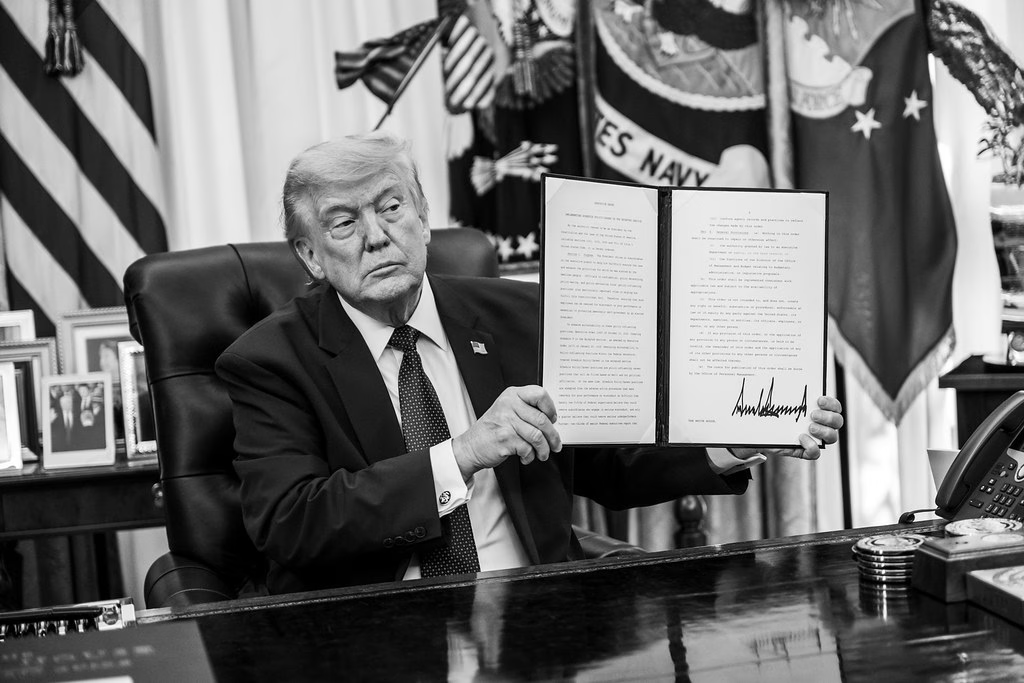
As Doug Mataconis noted yesterday, Mitt Romney made the following promise in reaction to the Supreme Court’s ruling on the PPACA:
“What the Court did not do on the last day in session, I will do on my first day if elected president of the United States, and that is that I will act to repeal Obamacare.”
It a promise he has made in various iterations for some time now.
Of course, it is at best a simplistic take on what a change in administration would mean, and at worst it is a gross misrepresentation of what a president can do.
There is little doubt that replacing Obama with Romney increases the odds of repeal. This is because an Obama second terms means that a hypothetical repeal would be vetoed (as there is no way that there will be a 2/3rds majority in both houses available to override such a veto). However, the election of Romney simply means that veto threat goes away, raising the chances of repeal from 0% to nearly 0%.
The real issue is, rather obviously, the issue of the make-up of the Congress, especially that of the Senate. While it seems likely, if not nearly certain, that the House will remain in Republican control, the Senate is a another matter. Further, as we should all well know by now, the Senate has increasingly operated under super-majority rules that require 60 votes to do much of anything, to to mention that individual Senators have been allowed a number of individual blocking (or, at least, delaying powers).
If the GOP is able to gain control of the House, Senate, and White House come January 2013, I expect that a large number of the party and their allies in the commentariat are going to discover great frustration with the power of the minority in the Senate and we will likely hear a lot of griping about how Democrats are blocking the will of the people who, they will argue, are opposed to the PPACA.
All of this leads to a number of observations:
1. It is unfortunate that we tend to reduce our understanding of government to the occupant of the White House. The candidates, reporters, supporters, etc. have a tendency to simplify the complex structure of the US government to the presidency. This is a disservice to the general public, as they tend to think that everything hinges on who the president will be, and it is lets Congress off the hook in terms of responsibility. This is all unfortunate, because it takes focus away from the institution that makes domestic policy and further deflects attention from the labyrinth that is legislating (even without taking into account the filibuster rule).
2. This all again raises the question of whether empowering the minority party in the Senate is a a good thing. If, in fact, the Republicans could successfully campaign on repeal and then gain control of the three key actors: House, Senate, and Presidency, shouldn’t they be allowed to enact that policy? Under our current system, it takes not just winning an election to be able to have a chance to put one’s policies into practice, but it requires landslides of historic proportions to be allowed to even try. And even then it takes a bit of luck. Consider that the PPACA would not have been passed in the first place had Al Franken not won a very close Senate race in Minnesota and had Arlen Specter not switched parties (because even given the strong Democratic showing at the polls in 2008, the Democrats still did not have 60 votes in the Senate—it took a party-switch to get it). Further, we end up with the specific version of health care remove that we did because it became frozen in place with the death of Senator Kennedy and his replacement in a special election by Senator Scott Brown.
Consider: unusual circumstances made the law possible, and unusual circumstances meant that further changes became impossible. These are not the signs of healthy institutional constructs and underscore the difficulties that Republicans will have with repeal.
3. Of course, the question of the popularity of repeal is more complicated than opponents of the policy make it out to be. Opponents claim, correctly, that polling indicates less than majority support for “Obamacare.” But, of course, supporters correctly point out that the individual components of the policy are mostly quite popular. So, Republicans can talk about supporting repeal, but if the legislative rubber ever actually meets the road, they will have a conundrum on their hands as to how to keep the popular parts whilst discarding the unpopular ones (like the mandate). Part of the problem there, of course, is that a lot of the popular ones (such as the provision on pre-existing conditions) won’t function properly without the mandate (or some other, likely also unpopular, mechanism, since the issue at that point is paying for the popular parts with less popular ones).
4. It is also worth noting that true, full repeal is not so easy, because there are the aforementioned popular provisions will be difficult to cancel, but unwinding a complex policy that has been at least partially implemented (and becomes increasingly implemented over time), is harder than simply voting on a repeal.
At a minimum, an honest assessment of this situation should focus on the roles played by separation of powers, bicameralism, and the filibuster, not on simplistic fantasies about new administrations.
I also think that it will be interesting to see how Republicans react to their circumstances should they find themselves in charge of unified government. I wonder how many supporters of repeal will be content with the notion that we have a number of anti-majoritarian elements within our institutions of governance.