 The percentage of Americans identifying as Republican has increased while support for Democrats has dropped off, Rasmussen reports.
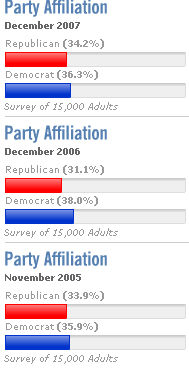
The number of Americans who consider themselves to be Republicans jumped nearly two percentage points in December to 34.2%. That’s the largest market share for the Republican brand in nearly two years, since January 2006 (see history from January 2004 to present).
At the same time, the number of Democrats fell to 36.3%. That’s down a point compared to a month ago. During 2007, the number of Democrats has ranged from a low of 35.9% in July to a high of 37.8% in February.
These results are based upon tracking surveys of 15,000 adults per month. The margin of sampling error is less than one percentage point, with a 95% level of confidence. Please keep in mind that figures reported in this article are for all adults, not Likely Voters.
Ed Morrissey thinks these trends reflect public dissatisfaction with the job the Democrats in Congress, particularly Speaker Pelosi, have done, along with a sense that the Democratic presidential field is not ready for prime time. Betsy Newmark credits Congressional Republicans having seen the error of their ways after their 2006 midterm defeat.
While I think these points have some merit — along with the simple fact that Democrats, with control of Congress, now have to actually participate in governing rather than simply blaming everything that goes wrong on the Republicans — – these movements are small and I would be cautious about reading too much into them. I also wouldn’t read much into the Adults/Likely Voters distinction in this particular type of survey, since it’s tracking attitude rather than attempting to predict behavior.
The real news seems to be the amazing consistency of party identification. Indeed, given that Republicans are slightly more likely to vote than Democrats, this would seem to reinforce the longer-term trend toward a “50-50” electorate.