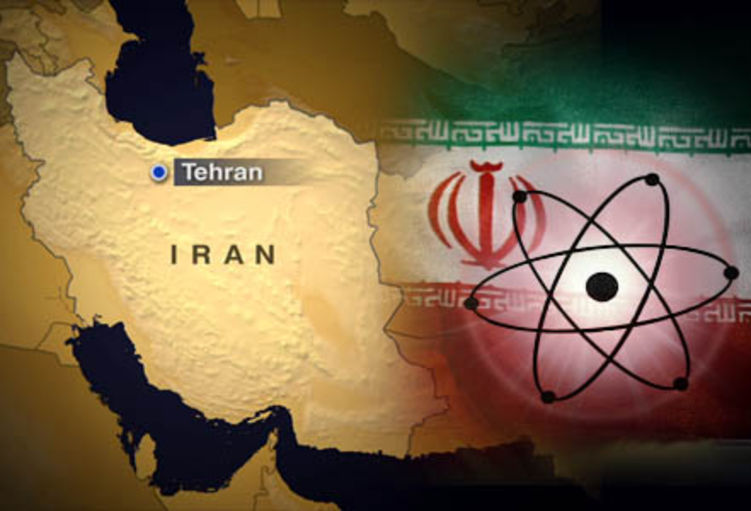

To listen to the rhetoric coming from the Republican candidates for President, you would think that President Obama has completely mishandled the issue of Iran’s nuclear program and endangered American interests in the process. He’s done nothing as Iran continues to inch ever closer to the point where it will be able to make a nuclear device of some kind, they say. And he’s failing to stand behind Israel as they face what is claimed to be an existential threat. When you actually look behind the rhetoric at what the candidates are proposing, it’s basically the same thing that the President is doing right now:
To rein in Tehran’s nuclear ambitions, Mitt Romney says he would conduct naval exercises in the Persian Gulf to remind Iran of American military might. He would try to ratchet up Security Council sanctions on Iran, targeting its Revolutionary Guards, and the country’s central bank and other financial institutions. And if Russia and China do not go along, he says, the United States should team up with other willing governments to put such punitive measures in place.
As it turns out, that amounts to what President Obama is doing.
As their tone on Iran escalates in advance of appearances via satellite Tuesday morning before the country’s most influential pro-Israel lobbying group, the Republican candidates for president have tried to draw stark contrasts between themselves and Mr. Obama when it comes to stopping Iran from getting a nuclear weapon. Mr. Obama’s Iran strategy, Rick Santorum said recently on “Meet the Press” on NBC, risked turning the United States into a “paper tiger.” Newt Gingrich said that on Iran, “we’re being played for fools.”
On Sunday, Mr. Romney, appearing in Atlanta, offered this: “If Barack Obama gets re-elected, Iran will have a nuclear weapon.” And on Monday, he wrote an op-ed article in The Washington Post comparing Mr. Obama to President Jimmy Carter, who he said “fretted in the White House” as Iran held American hostages for 444 days.
Mr. Obama and his backers have cried foul, saying the Republican candidates, in the quest to appear tough, are playing a dangerous game that could end up driving Iran closer to a nuclear weapon, as Mr. Obama implied in his own address Sunday to a pro-Israel group, the American Israel Public Affairs Committee.
Senator John Kerry, chairman of the Foreign Relations Committee, echoed that in an interview on Monday.
“To be making a blanket statement that if he’s president they’ll have one, and if Romney’s president they won’t have one, is the most craven political thing to say,” he said. “To make up differences is to play in Iranian hands.” Mr. Kerry said it could further drive up the price of oil, which helps Iran, as traders on world markets build in expectations of a military strike.
Though advisers to Mr. Romney say they see significant differences between his Iran policy and Mr. Obama’s, other Iran experts and former officials in Republican and Democratic administrations say they do not see how the Iran policies being espoused on the Republican presidential campaign trail would do much more to stop Tehran from getting a nuclear weapon. In the case of Mr. Romney, they said, his Iran policy is essentially Mr. Obama’s Iran policy.
“They seem to talk more in the realm of their imagination, and what they think will pass as good policy in an election campaign, as opposed to taking into account the realities on the ground,” said Abbas Milani, an Iran expert at the Hoover Institution at Stanford University who has advised the administrations of both Mr. Obama and President George W. Bush on Iran.
R. Nicholas Burns, the State Department’s top Iran negotiator under President Bush, said: “The attacks on Obama basically say, ‘He’s weak and we’re strong.’ But when you look at the specifics, you don’t see any difference.”
For instance, Mr. Romney’s Iran issues statement, available on his Web site, argues that to stop Iran from getting a nuclear weapon, he would “repair relations with Israel, increase military coordination and assistance, and enhance intelligence sharing to ensure that our allied capabilities are robust and ready to deal with Iran.” In addition, Mr. Romney calls for restoring the “regular presence of aircraft carrier task forces in both the Eastern Mediterranean and the Persian Gulf region simultaneously.”
But in recent years, the United States has always had one or two aircraft carrier strike groups deployed in the Persian Gulf region at a time, although there has generally not been one in the Mediterranean since 2003. However, American carriers do routinely transit the Mediterranean via the Suez Canal on passages to and from the United States and the Persian Gulf. There are also a number of American destroyers and cruisers regularly deployed to the Mediterranean.
As for assistance to Israel, while Mr. Obama and Prime Minister Benjamin Netanyahu of Israel have had a rocky personal relationship, the United States remains Israel’s most dependable ally. Last year, Mr. Obama drew global criticism when he opposed a Palestinian bid for statehood through the Security Council, and his administration boycotted a racism conference in Durban in 2009 on the grounds that it allowed anti-Semitic and Holocaust-denial views. Mr. Obama has also increased military aid to Israel and promoted sanctions against Iran’s nuclear program, with Europe agreeing to impose an oil embargo on Iran, a step unthinkable four years ago
Of course, neither Romney nor any of the other candidates are going to admit that there is even the slightest degree of similarity between their proposals and what the President has actually been doing for three years. Heck, they’re not even willing to acknowledge that there’s a high degree of similarity between President Obama’s approach to Iran and President Bush’s. But it would make sense that there is. For one thing, foreign policy itself is often an area where partisan differences are far less apparent than they are in the domestic policy world. Especially in the wake of the Iraq War, it’s hard to recognize that fact but the reality is that there are very few fundamental differences between the parties on these issues. If there are differences, they are usually tactical rather than strategic, and the differences are fairly marginal.
In the case of an issue like Iranian nuclear weapons, the differences are likely even less apparent. For one thing, there are very few people who disagree with the proposition that Iran obtaining nuclear weapons would not be a good thing. There are disagreements beyond that point over how imminent the threat is, whether the Iranians would actually launch unprovoked nuclear attacks rather than using their weapons capability in the manner the North Koreans have, and whether or not containment is an option should efforts to stop them from taking the final steps to weapons development fail. For the most part, though, everyone agrees that it would be in our interest to stop (in some way) the Iranians from going nuclear, the question that gets debated most often is how to o that without setting off a confrontation that would just make things worse. The other factor that makes differences over Iran policy less likely is the fact that, for domestic and international reasons, the United States will always be a close ally of Israel and Iran’s nuclear program is, for better or worse, the primary international security concern in Israel today. Just look at the near unanimity on this issue in the bipartisan speeches at this week’s AIPAC conference in Washington, and you’ll see what I mean. When it comes to Iran, Republicans and Democrats have far more in common than they do disagreements.
Personally I think that’s unfortunate. We could do with a far more vigorous debate on this issue than we are having right now. Outside of policy wonk circles, there’s nobody really discussing the question of whether we really need to worry about Iran as much as we are right now. Instead, there’s near unanimity that they are a serious threat to American, and Israeli, interests that will have to be dealt with before. As I’ve said before, I think this is party because there is already a bias in American public opinion against Iran that goes all the way back to the days of the Iranian Hostage Crisis. People seem to already accept the notion that war with Iran is inevitable, without considering whether it’s really in our national interests. That’s the problem sometimes with “bipartisan” foreign policy, nobody is questioning the fundamental point and, as a result, we may well be sliding into a war that we really don’t need to be fighting.
One final thought. What kind of signal does it send to the Iranians — or anyone else for that matter — when the opposition political candidates are essentially telegraphing rhetoric about foreign policy that is unlikely to live up to the policy they would actually enact if they were elected President? I can’t see how it helps. It’s fine to criticize the President’s policy choices on Iran, I’m not saying we shouldn’t do that, but when that strays over into saying that he’s essentially undermining the country’s security doesn’t that end up aiding our rivals overseas?