 Talk about being optimistic:
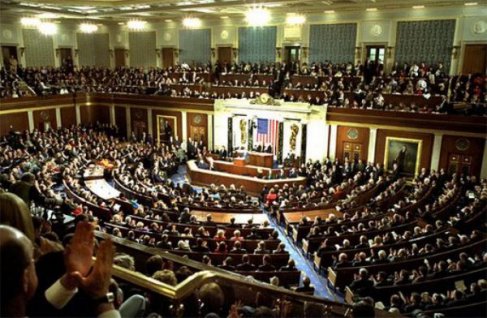
House Republican leader John Boehner recently said the GOP could pick up 100 seats this November. Now, the Republican National Committee’s political director says the party has its eye on 130.
“Our scoring as of today has us looking at about 130 House seats as potentially competitive,” Gentry Collins said Tuesday. He hastened to add: “Just to be clear, I’m making no claim that we are going to pick up 130 House seats.”
Republicans see the potential for significant gains this November as support for President Barack Obama and congressional Democrats slide. The GOP needs to win 40 seats to reclaim control of the House. Currently, Democrats hold 254 seats and Republicans 177 with four vacancies.
Asked when the GOP will start to focus on races and cull the list to those most likely to produce Republican victories, Collins said it hasn’t yet started.
“I’ve been expecting (the list) to shrink, to be candid with you. It’s been growing,” he said.
The bravado was pervasive as Republican state party chairs gathered outside Washington. They compared the political climate to 1994 when Republicans captured control of the House and Senate in President Bill Clinton’s first midterm elections.
Bravado is barely an adequate word to describe the RNC’s new estimates when you consider the modern historical record:
- In 1932, the Democratic Party picked up a net gain of 97 seats, after having picked up 52 seats in the 1930 elections
- In 1938, the Republican Party picked up 81 seats in an election that was arguably the first backlash against the New Deal. The Republicans further whittled down the once-dominant Democratic majority when they picked up 47 seats in 1942
- In 1946, the Republicans picked up an additional 55 seats, and regained control of the House for the first time since 1928
- Two years later, in 1948, the Democrats picked up 75 seats and began a period of Congressional dominance that lasted, nearly unbroken, for four decades.
- The Republican “Revolution” in 1994 was ushered in by a net gain of 55 seats for the GOP
- Finally, in 2006 and 2008, the Democrats picked up a total of 31 and 21 seats respectively.
Given this, a triple-digit gain, or even a gain of more than 50 seats is an historical anomaly and, even in the current political climate, it’s hard to see how the GOP would be capable of pulling off anything close to the scale of the massive changes that took place during the 1930’s or 40’s. In fact, a change like that has only been seen once in American history — in 1894 when Republicans gained 130 seats in what turned out to be one of a decisive realignment of American politics.
There’s no sign that any of that is at play in 2010. In fact, given the current status of the Generic Congressional Ballot, which shows Republicans hold only a slight lead over Democrats, it’s hard to see 2010 resulting in anything other than a razor-thin GOP majority at best, and that assumes that the economy doesn’t improve sufficiently for some of the heat to be taken off the Democrats in close districts.
So are House Republicans being overly optimistic ? I’d say that’s putting it mildly.