
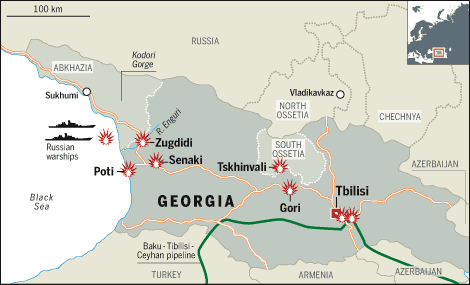
 Russian president Dmitry Medvedev has ordered what the press is describing as a “cease-fire” in Georgia. Given that he is not withdrawing Russian forces and is going to keep killing Georgian troops in South Ossetia in violation of international law, however, that term doesn’t quite seem to fit.
NYT:
The president said Russia had achieved its military goals during five days of intense fighting, which has seen Russian troops advance into Georgian territory and which brought strong denunciations from President Bush and other Western leaders. In a meeting with Defense Minister Anatoly Serdyukov shown on Russian television, Mr. Medvedev said: “The goal of the operation has been achieved. The security of our peacekeepers and civilians has been ensured.” But he also told Mr. Serdyukov to “eliminate” any enemy remaining in South Ossetia. “Whenever hotbeds of resistance and other aggressive plans emerge, make the decision and eliminate them,” he said.
The fighting appeared to continue in Georgia on Tuesday, and it was uncertain how quickly Mr. Medvedev’s statement would lead to an end to hostilities. Mr. Medvedev took the lead role in announcing the halt in contrast to previous days when the Russian prime minister, Vladimir V. Putin, was the dominant public figure in the crisis, even flying to the Georgian border to direct operations.
When asked about the cease-fire, Anatoly Nogovitsyn, a senior defense official, said military actions could continue. “If you receive the order to cease fire, this would not mean that we would stop all operations, including reconnaissance operations,” he said. A Russian withdrawal will occur only once a formal cease-fire had been reached, he added.
FT:
“They have taken the decision to end the operation to force the Georgian authorities into peace” Mr Medvedev said during a meeting with his defence minister and army chief of staff. “The aim of our operation has been reached, the safety of our peace keepers and the civilian population has been restored…the aggressor has been punished”.
Georgia said it welcomed Russia’s ceasefire declaration but it called on the international community to ensure that the conflict came to an immediate end. “This is a step forward. But the international community must ensure it means genuine peace on the ground and a genuine secession of the bombing,” Lado Gurgenidze, the Georgian prime minister, told the FT.
Mr Gurgenidze said an attack by Russian warplanes on the Georgian town of Gori and two nearby villages on Tuesday morning raised questions about the sincerity of the Russian ceasefire declaration. “There may be some time lag before the order from (Russian president) Medvedev gets through to the rank and file,” he said.
AP notes that intense fighting continues in Abkhazia and that international diplomatic pressure has intensified:
The U.N. and NATO had called meetings Tuesday to deal with the conflict, which blew up in South Ossetia and quickly developed into an East-West crisis that raised fears in former Soviet bloc nations of Eastern Europe. Five European presidents were headed to Russia and Georgia to mediate.
A separate FT piece notes, too, that Russian action has prompted substantial regional fallout.
The Baltic states, past victims of Kremlin attacks, have called on the European Union to suspend its drive for closer relations with Russia after its invasion of Georgia. “We have to review our policy. Can we consider a partner a country who behaves like this?” President Toomas Hendrik Ilves of Estonia said in an interview. He added: “It’s time to stop sticking our head in the sand.”
The presidents of Latvia, Lithuania and Estonia, together with Poland, issued a joint statement at the weekend warning that the Georgian conflict would be a credibility “litmus test” for Nato and the EU.
This immediately prompted a warning from the Russian ambassador to Latvia that they would pay for their attitude. “One must not hurry on such serious issues, as serious mistakes can be made that have to be paid for a long time afterwards,” Alexander Veshnyakov told the Baltic News Service on Monday.
When one contrasts this strong language with the much milder talk from France and elsewhere, we see, as my Atlantic Council colleague Jim Townsend noted yesterday, that Don Rumsfeld’s much criticized formulation of Old Europe and New Europe was on the mark.
UPDATE: Joshua Keating makes some interesting points:
That Dmitry Medvedev issued his instructions to the Russian military to pull out of Georgia just before he met with Nicolas Sarkozy for peace negotiations seems significant. Russia ended this war exactly when they wanted to, without waiting to be told.
It was also a nice touch that it was Medvedev who made the anouncement. Remember that it was Vladimir Putin who said “war has started” last Friday. This good-cop-bad-cop approach to world affairs seems quite effective for the tandem.
In the short term, at least. We’ve yet to see how it’ll play out in the international community. If, for example, this costs Russia G8 membership or a boycott of the Soshi games, it’ll be a loss. If their aggression comes at no cost, however, they’re big winners.
UPDATE: Nick Gvosdev is not optimistic of achieving the necessary transatlantic consensus to put much pressure on Russia.
The Western powers agree that Russia has used disproportionate force in its response to Georgia’s attempts to retake control of South Ossetia by force. All proclaim the desirability of an immediate cease-fire and the opening of a new round of negotiations and dialogue.
Beyond that, however, I don’t see a great deal of agreement. Certainly most Western Europeans–and I suspect privately Eastern Europeans as well–don’t believe that the Russo-Georgian conflict presages tanks rolling westward back into the heart of Europe. Nor do I foresee the major continental powers agreeing with the assessment of some US pundits that the armed clash in the Caucasus is an existential threat to the viability of the Euro-Atlantic community. A regrettable conflict, to be sure, perhaps demonstrating why Russia cannot or will not be fully accepted in the European family of nations. But a clash that nonetheless is containable to the Caucasus and should not be more widely internationalized.
My guess is that he’s right.









