
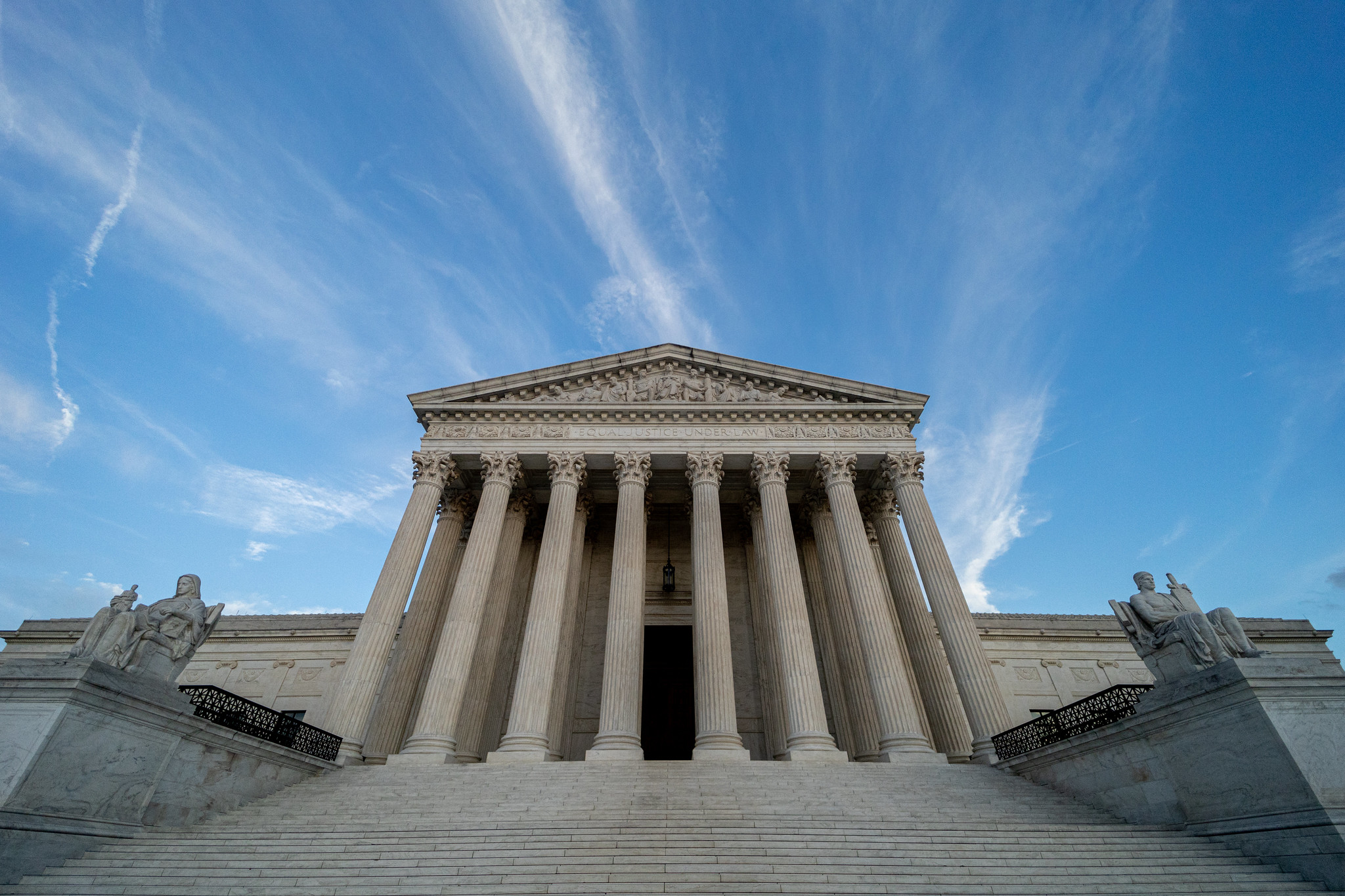
Via WaPo: Supreme Court keeps Trump on ballot, rejects Colorado voter challenge.
The justices said the Constitution does not permit a single state to disqualify a presidential candidate from national office, declaring that such responsibility “rests with Congress and not the states.”
There is a lot to be said, but I only have time for a quick observation (and it has been on my mind since oral arguments): the argument that the president is a national office and therefore a given state shouldn’t be allowed to make determinations about candidacies for a national office utterly ignores the fact that our elections are all administered by the states.
I was frustrated by this line of questioning during oral arguments (a started post on this subject remains in the draft folder) and I am frustrated by it now. I am frustrated because it seems to be vested in a fiction (that the election of the president, and mostly especially the nomination process) is national when it is clearly a state-by-state process.
Understand that my personal and professional preference would be that the election of the president be, in fact, a national process. But. It. Isn’t.
Again, this is especially true of the use of primaries for nominations, which isn’t even a constitutionally prescribed process.
Hence, my usage of “fiction” above because it pretends like there is a national remedy for this that is analogous to state-by-state level processes. I mean, yes, Congress could pass a law, but there is no other mechanism. I supposed if they argued simply that section 3 of the Fourteenth Amendment was not self-executing, and therefore required legislation, I could live with that. But to predicate even part of the reasoning on the idea that states aren’t where elections are fundamentally run is to ignore reality and is punting on any substantive decision about the real matter at hand, which is whether or not Trump did, in fact, foment insurrection.
And yes, I do understand that SCOTUS is making a distinction between federal offices and state offices. The problem is that the states conduct elections for federal officeholders, which makes the distinction that the Court is trying to make more complicated than it sounds.
This is all made all the more frustrating because regardless of the fact that the presidency is a federal office, the determination of who gets sworn in January 2025 will very much come down to state-level elections.
Look, while I am quite sympathetic to Colorado’s position, I understand the potential chaos that upholding it could unleash. But the fault is not Colorado’s. It’s Trump’s for behaving as he did post-2020 election.
I think the main thing that I find frustrating about this (apart from what I truly see as an utter disconnect about how elections are administered in the US) is that this is not a ruling that addresses the real problems we are facing in regard to the very real possibility that a fellow who said he understood and loved the rioters at the Capitol may well be the next president of the United States.
UPDATE (James Joyner): I concur with my colleague’s assessment that, in practice, there are no “Federal” elections, only elections for Federal offices administered by the several states. That said, there’s considerable judicial and legislative precedent for the notion that Congress has the ultimate say over elections for Federal offices.
I only had time to scan the main opinion, which I’ve highlighted in the attachment. I don’t find it particularly objectionable but am a bit surprised that they used the existence of Section 5 as the main rationale for arriving at their conclusion.









