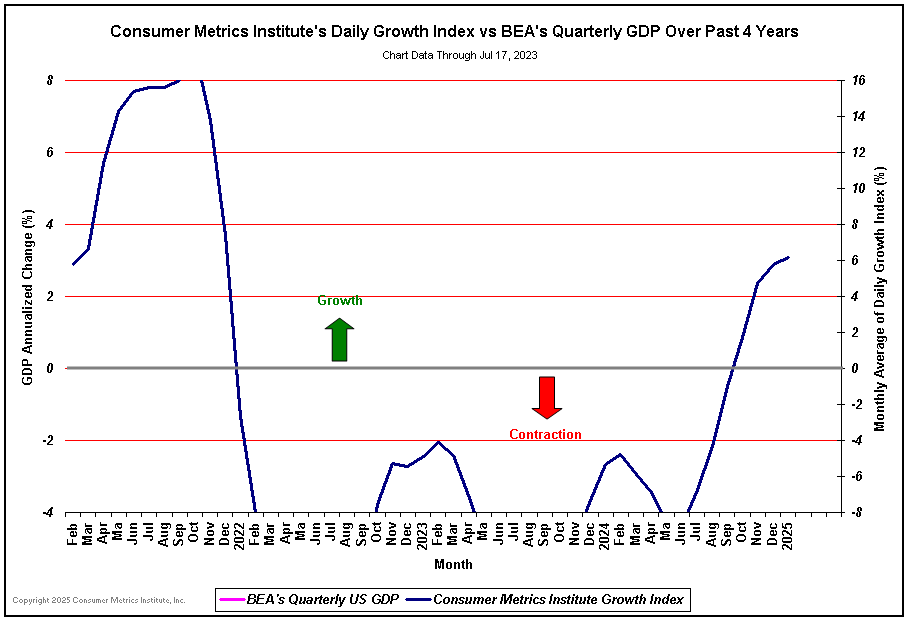

The Commerce Department’s first take on the Gross Domestic Product figures for the second quarter, which are likely to be revised downward in the future, are not good at all:
WASHINGTON — The United States economy has slowed considerably this year from a year ago, according to a report from the Commerce Department released on Friday.
The country’s gross domestic product, a broad measure of the goods and services produced across the economy, grew at an annual rate of 1.3 percent in the second quarter, after having grown at an annual rate of 0.4 percent in the first quarter — a number that itself was revised sharply down from earlier estimates of 1.7 percent. Data revisions going back to 2003 also showed that the 2007-2009 recession was deeper, and the recovery to date weaker, than originally estimated.
The news comes as Congress is debating how to put the nation on a more sustainable fiscal path, with measures that some economists worry could further slow the recovery and even throw the economy back into recession.
The latest numbers were especially disappointing precisely because the economy had shrunk so much during the recession. Usually a sharp recession is followed by a sharp recovery, meaning a recovery growth rate that is far faster than the long-term average growth rate; this time around, though, output is growing at only about a third the average rate seen in the 60 years preceding the Great Recession. As a result, the country’s output is far below its potential.
Particularly distressing is that consumer spending — which, alongside housing, usually leads the way in a recovery — has been extraordinarily weak in recent quarters. Inflation-adjusted consumer spending in the second quarter barely budged, increasing just 0.1 percent.
The economy’s slow growth rate is partly responsible for stubbornly high joblessness across the country. As of June, 14 million Americans were actively looking for work, and the average duration of unemployment has been reaching record highs month after month. Businesses are sitting on a lot of cash, but are still reluctant to hire because there is so much uncertainty about the future of the economy.
Slow economic growth takes not only a human toll, but a fiscal one as well. Tepid output increases mean slow growth in the tax revenue needed to pay down the nation’s debt.
Washington, therefore, has a delicate balancing act in its current debt ceiling debates. Given the unsustainable debt trajectory that the economy is on, Congress needs to impose greater fiscal discipline. But imposing too much too soon could be self-defeating by weakening growth so greatly that tax revenue falls and requires the country to borrow even more.
As I type this, trading on Wall Street has just started and stock indexes are down across the board, both in reaction to this number and the failure of the debt ceiling negotiations on Capitol Hill. They can’t really be surprised about this, though. After three months of bad employment numbers and yesterday’s Durable Goods numbers, it was pretty clear that we were headed for a bad report this morning, but perhaps not this bad. At the moment, there doesn’t seem to be any real prospect that the third quarter is going to be any better than the first or second, which means we’re likely to still see slow job growth and continued economic pessimism.
Politically, this all spells trouble for the President, I think. Without strong and sustained economic growth, the economic picture a year from now as we head into the 2012 elections and, as Philip Klein notes, history is not on the President’s side on this:
In a typically economic recovery, GDP growth is supposed to be a lot higher, because comparisons to the prior period are easier. For instance, during the comparable quarters of the Reagan presidency in 1983, the recovering economy grew at 5.1 percent and 9.3 percent, respectively.
Needless to say, this is more bad news for President Obama’s reelection chances. Also, with the economy this weak, one wonders if this will put the payroll tax cut extension back in play as part of the debt limit negotiations end game.
More importantly, with the economy this weak one wonders how the debt kamikazes and those playing games with the debt ceiling extension on Capitol Hill can look at themselves in the mirror this morning.