
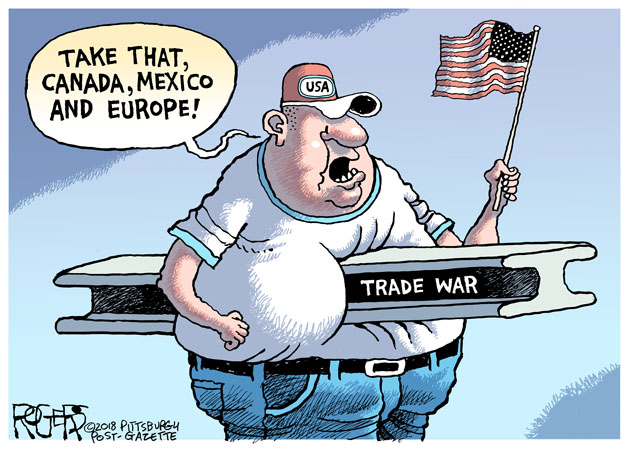

Fun note: This graphic is from 2018 and the first Trump Trade war. It’s almost like this could have been predicted.
Look, I know I’m not a business genius or investment banker, so naturally I was shocked to learn that businesses have a hard time doing long-term capital planning when they are unsure of what the policy landscape will be months from now, let alone years from now. This is a massive problem with the Trump Tariffs. Business Writer Derek Thomson points to the underlying conflicting strategies and goals that the President and other administration surrogates and whispers have expressed:
So, are these short-term tariffs intended to get other countries to remove tariffs on our goods, or are these long-term strategies to generate revenue and force companies to reshore manufacturing? I realize some galaxy brains will respond, “If the Trump administration clearly telegraphs what they want, then foreign governments can figure out ways to sabotage that strategy.” See for example:
Beyond demonstrating the type of zero-sum thinking that has led us to this mess, this perspective also misses out on the fact that many domestic organizations need to know the short and long-term goals to do their own planning.
Setting the issue of tariffs on raw manufacturing materials (or the average American consumer’s willingness to pay more for American-made products that cost more than their low-cost import competitors), reshoring manufacturing is not a quick or cheap investment for companies (especially in industries with narrow profit margins).
Victoria Guida’s Politico column “This Could Get Much Uglier’: The Fatal Flaw in Trump’s Trade War” dives into the details:
President Donald Trump’s sweeping tariff regime will completely transform America’s economic relationship with the rest of the world, all in the name of revitalizing domestic manufacturing.
And yet, many businesses won’t be rushing to shift their supply chains to U.S. shores.
For all the detail in Trump’s Wednesday announcement, his endgame is still shrouded in confusion. That’s lethal for long-term investment, making confident planning all but impossible.
“If you want stuff being put in the ground, you have to tell people the price, and the price needs to be fully inclusive of the tariff risk,” one former administration official in Trump’s first term, granted anonymity to speak freely, told me.
[…]
I’ve asked multiple corporate executives in recent weeks whether companies are likely to start investing in manufacturing in the United States in response to Trump’s policies, and the message has basically been: That’s an unanswerable question right now. Because making those decisions requires understanding the relative costs of doing it versus not doing it, and Trump is far too unpredictable to allow for that kind of calculation.
If the markets bloodbath gets much worse, will Trump back off? How much will tariffs change over the next three-plus years? And tariff policy could change drastically under a new president in 2028. Might companies just wait it out rather than making a long-term commitment of resources and hoping for the best?
[…]
The administration argues that it is “setting the stage for long-term economic growth,” as Treasury Secretary Scott Bessent put it to Fox News on Wednesday. “We are putting ourselves back onto a sound trajectory.”
In the meantime, the domestic manufacturing sector is shrinking amid corporate paralysis.
“Manufacturers are putting these decisions on hold,” said Jay Timmons, head of the National Association of Manufacturers, in a CNBC interview ahead of the tariff announcement. “They’re waiting to see whether they should invest and hire. And that’s not good for the economy.”
Anyone with manufacturing experience (I have from my first gig within Kodak’s Digital) or bare imagination can understand precisely why an unstable market is not a great time to make significant changes to where materials are sourced and where manufacturing happens. That said, in the interests of evenhandedness, if someone has links to content from reputable business or economics sites (no Zero Hedge does note count, and further it looks like even they may be buying into the woke mind virus TDS that these tariffs are a bad idea) please add them in the comments.









