

Via the NYT: U.S. Downgraded by Moody’s as Trump Pushes Costly Tax Cuts.
The credit rating of the United States received a potentially costly downgrade on Friday, as the ratings firm Moody’s determined that the government’s rising debt levels stood to grow further if Republicans enact a package of new tax cuts.
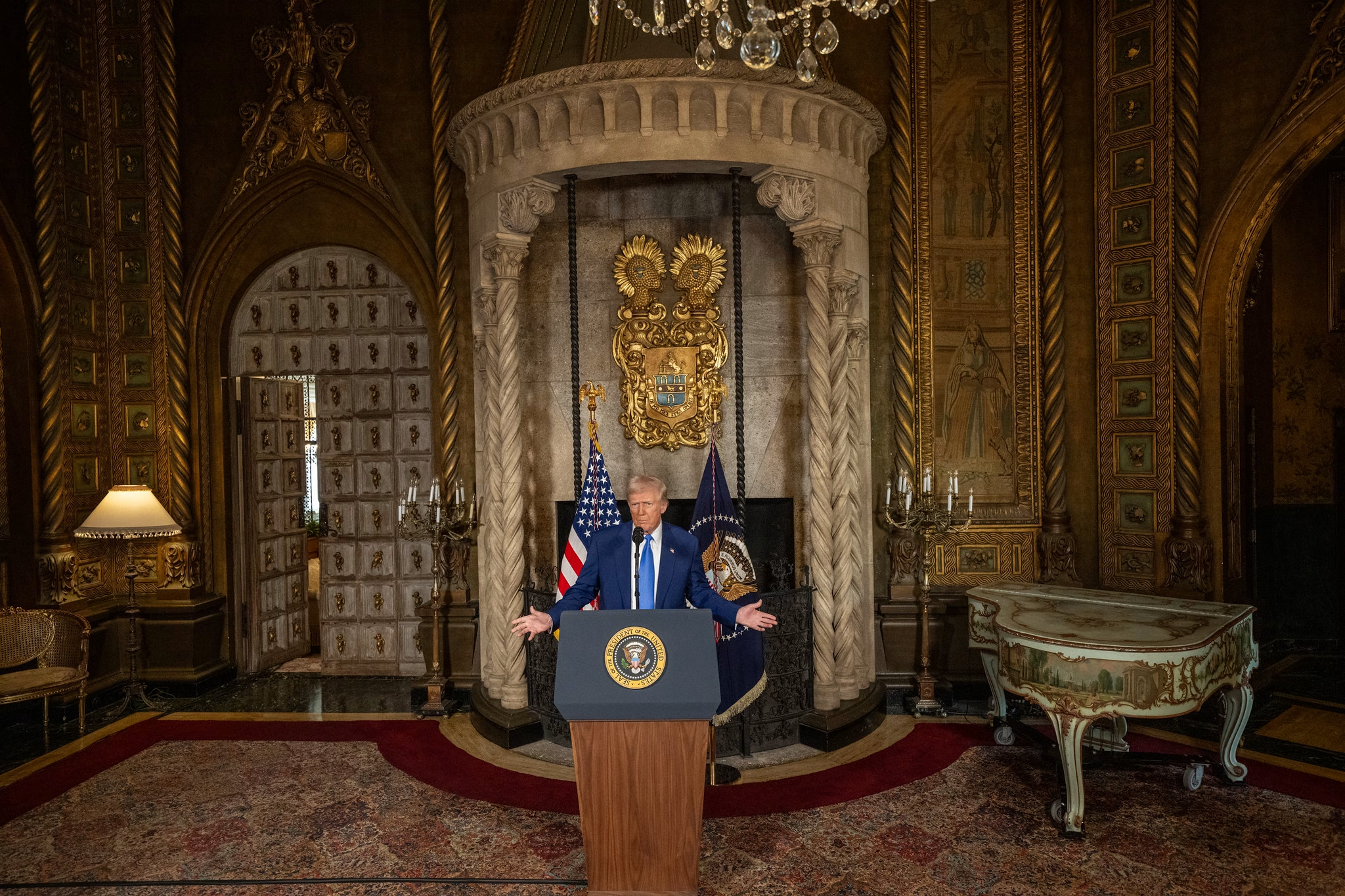
The downgrade, to one notch below the highest triple-A rating, amounted to a repudiation of Washington, where President Trump only hours earlier had pushed his party to adopt a legislative package that might add trillions of dollars to the nation’s fiscal imbalance.
The downgrade from Moody’s means that each of the three major credit rating agencies no longer gives the United States its best rating. Fitch downgraded the United States in 2023, citing fiscal concerns, and Standard & Poor’s downgraded the country in 2011
And it is not just some business abstraction:
The new rating decrease could send ripple effects throughout the economy if it prompts investors to demand higher payments on bonds, which in turn could raise consumers’ borrowing costs. So far, though, past downgrades have proved largely symbolic, as the American government’s debt remains the bedrock of the global financial system.
[…]
The prospect of much more government borrowing — when interest rates are already elevated — has made some bond investors nervous. So-called vigilantes in the bond market have been selling the government’s debt as the Republican tax package has wound its way through Congress, contributing to higher yields, which in turn translate to higher interest rates on consumer borrowing.
The 10-year Treasury bond yield has risen roughly 0.3 percentage points this month to around 4.5 percent. The 30-year Treasury yield briefly crossed 5 percent this week; the last time it did that, during some of the worst tariff fears, Mr. Trump cited the bond market among reasons he pared back his tariff proposals.
It’s a sign that the government could end up paying a higher interest rate on its debt if it can’t soothe investors’ concerns over its mounting debt, a development that could snowball into a full-blown debt crisis for the world’s largest economy.
In fairness, this is a long-term issue being exacerbated by the current administration.
Moody’s pointed to decades of gridlock and dysfunction in the nation’s capital. It found that Democrats and Republicans alike had failed to meaningfully curtail U.S. debt, which now towers above $36 trillion.
Nor had the U.S. government addressed myriad well-known, and long-term, financial challenges, Moody’s said, especially the rising costs and persistent underfunding of programs like Social Security and Medicare.
While Moody’s described the U.S. financial system as stable, and found the dollar to be strong and reliable, it also acknowledged the vast policy uncertainty — and it obliquely referred to the ways in which political stability and constitutional order can be “tested at times.”
And we are in one of those times.
I will readily agree that the Congress has been largely unwilling, if not simply unable, to address these issues. But it is also true that we are currently watching a party in power that wants to gut social programs by cutting taxes for the wealthy, all the while adding to the debt.
Moody’s specifically referred to the push to renew the expensive tax cuts adopted under Mr. Trump in 2017, a task that Republicans are now struggling with on Capitol Hill.
I would gladly take the GOP more seriously on the debt if their main agenda wasn’t reckless tax cut proposals.
While one can certainly call out Democrats as well, they aren’t in power at the moment, so what they want is kind of irrelevant at the moment. So I would advise against too much both-sidings in the now.
I will conclude with this: my personal preference is for a set of responsible fiscal policies that would require both cuts and tax increases. I would actually prefer some massive restructuring of certain aspects of the social safety net. For example, there is simply no way the current health care system is anywhere near as efficient in terms of cost as it should be and could be. I agree as a matter of simple fact that current approach is mess that could end in disaster (although my guess is that it just limps along, while hastening to add that the failures of Congress to better govern is part of why we have a Trump presidency in the first place, so maybe the disaster has arrived).
However, if the choice before me is the debt mess we have had and Party A, which wants to add to the debt to fuel tax cuts for very wealth people or Party B which wants to add to the debt to provide services for the not wealthy, I am going with the Party B option.
I realize that this is a simplification, but it is not inaccurate. I wish the choices were a bit more complex than they are, but such is American politics.








