

A new study by Martin Z. Bazant and John W. M. Bush of MIT, “A guideline to limit indoor airborne transmission of COVID-19,” is getting quite a bit of attention. Rather than regurgitate breathless press accounts, I’m going to reproduce the abstract:
Significance
Airborne transmission arises through the inhalation of aerosol droplets exhaled by an infected person and is now thought to be the primary transmission route of COVID-19. By assuming that the respiratory droplets are mixed uniformly through an indoor space, we derive a simple safety guideline for mitigating airborne transmission that would impose an upper bound on the product of the number of occupants and their time spent in a room. Our theoretical model quantifies the extent to which transmission risk is reduced in large rooms with high air exchange rates, increased for more vigorous respiratory activities, and dramatically reduced by the use of face masks. Consideration of a number of outbreaks yields self-consistent estimates for the infectiousness of the new coronavirus.
Abstract
The current revival of the American economy is being predicated on social distancing, specifically the Six-Foot Rule, a guideline that offers little protection from pathogen-bearing aerosol droplets sufficiently small to be continuously mixed through an indoor space. The importance of airborne transmission of COVID-19 is now widely recognized. While tools for risk assessment have recently been developed, no safety guideline has been proposed to protect against it. We here build on models of airborne disease transmission in order to derive an indoor safety guideline that would impose an upper bound on the “cumulative exposure time,” the product of the number of occupants and their time in an enclosed space. We demonstrate how this bound depends on the rates of ventilation and air filtration, dimensions of the room, breathing rate, respiratory activity and face mask use of its occupants, and infectiousness of the respiratory aerosols. By synthesizing available data from the best-characterized indoor spreading events with respiratory drop size distributions, we estimate an infectious dose on the order of 10 aerosol-borne virions. The new virus (severe acute respiratory syndrome coronavirus 2 [SARS-CoV-2]) is thus inferred to be an order of magnitude more infectious than its forerunner (SARS-CoV), consistent with the pandemic status achieved by COVID-19. Case studies are presented for classrooms and nursing homes, and a spreadsheet and online app are provided to facilitate use of our guideline. Implications for contact tracing and quarantining are considered, and appropriate caveats enumerated. Particular consideration is given to respiratory jets, which may substantially elevate risk when face masks are not worn.
COVID-19 is an infectious pneumonia that appeared in Wuhan, Hubei Province, China, in December 2019 and has since caused a global pandemic (1, 2). The pathogen responsible for COVID-19, severe acute respiratory syndrome coronavirus 2 (SARS-CoV-2), is known to be transported by respiratory droplets exhaled by an infected person (3⇓⇓⇓-7). There are thought to be three possible routes of human-to-human transmission of COVID-19: large drop transmission from the mouth of an infected person to the mouth, nose or eyes of the recipient; physical contact with droplets deposited on surfaces (fomites) and subsequent transfer to the recipient’s respiratory mucosae; and inhalation of the microdroplets ejected by an infected person and held aloft by ambient air currents (6, 8). We subsequently refer to these three modes of transmission as, respectively, “large-drop,” “contact,” and “airborne” transmission, while noting that the distinction between large-drop and airborne transmission is somewhat nebulous given the continuum of sizes of emitted droplets (11).* We here build upon the existing theoretical framework for describing airborne disease transmission (12⇓⇓⇓⇓⇓-18) in order to characterize the evolution of the concentration of pathogen-laden droplets in a well-mixed room, and the associated risk of infection to its occupants.
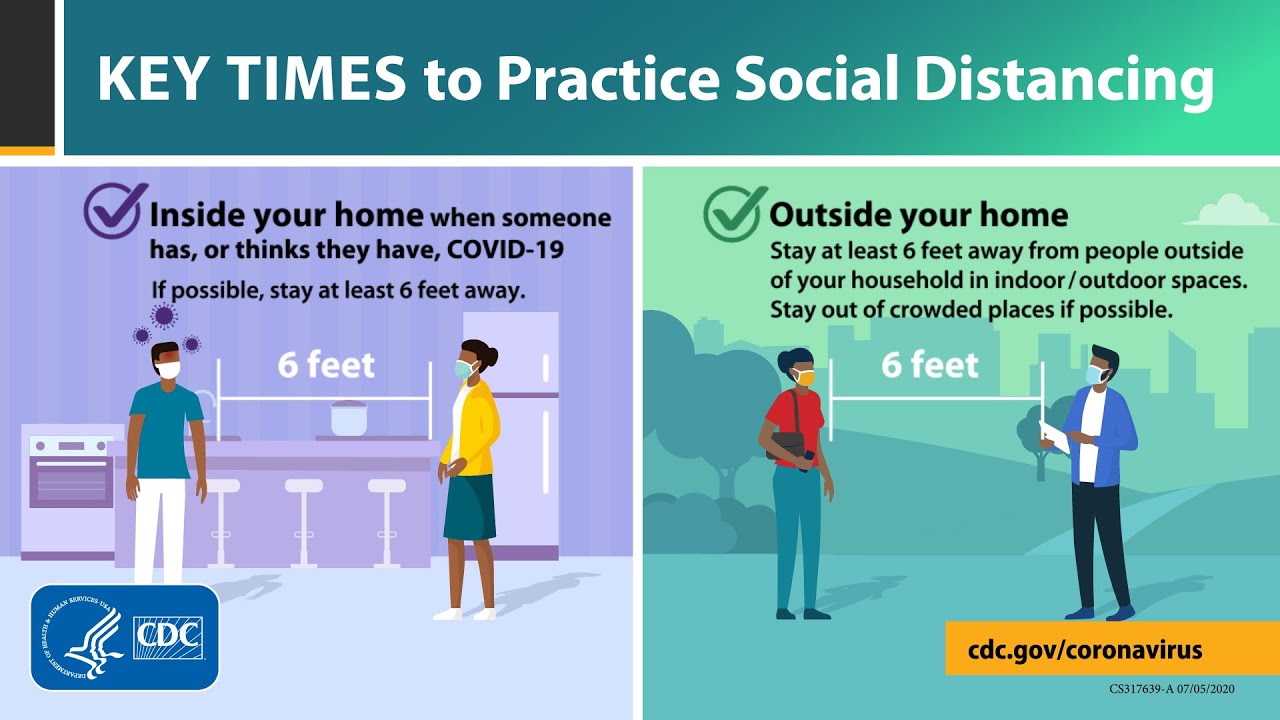
The Six-Foot Rule is a social distancing recommendation by the US Centers for Disease Control and Prevention, based on the assumption that the primary vector of pathogen transmission is the large drops ejected from the most vigorous exhalation events, coughing and sneezing (5, 19). Indeed, high-speed visualization of such events reveals that 6 ft corresponds roughly to the maximum range of the largest, millimeter-scale drops (20). Compliance to the Six-Foot Rule will thus substantially reduce the risk of such large-drop transmission. However, the liquid drops expelled by respiratory events are known to span a considerable range of scales, with radii varying from fractions of a micron to millimeters (11, 21).
There is now overwhelming evidence that indoor airborne transmission associated with relatively small, micron-scale aerosol droplets plays a dominant role in the spread of COVID-19 (4, 5, 7, 17⇓-19, 22), especially for so-called “superspreading events” (25⇓⇓-28), which invariably occur indoors (29). For example, at the 2.5-h-long Skagit Valley Chorale choir practice that took place in Washington State on March 10, some 53 of 61 attendees were infected, presumably not all of them within 6 ft of the initially infected individual (25). Similarly, when 23 of 68 passengers were infected on a 2-h bus journey in Ningbo, China, their seated locations were uncorrelated with distance to the index case (28). Airborne transmission was also implicated in the COVID-19 outbreak between residents of a Korean high-rise building whose apartments were linked via air ducts (30). Studies have also confirmed the presence of infectious SARS-CoV-2 virions in respiratory aerosols (31) suspended in air samples collected at distances as large as 16 ft from infected patients in a hospital room (3). Further evidence for the dominance of indoor airborne transmission has come from an analysis of 7,324 early cases outside the Hubei Province, in 320 cities across mainland China (32). The authors found that all clusters of three or more cases occurred indoors, 80% arising inside apartment homes and 34% potentially involving public transportation; only a single transmission was recorded outdoors. Finally, the fact that face mask directives have been more effective than either lockdowns or social distancing in controlling the spread of COVID-19 (22, 33) is consistent with indoor airborne transmission as the primary driver of the global pandemic.
The theoretical model developed herein informs the risk of airborne transmission resulting from the inhalation of small, aerosol droplets that remain suspended for extended periods within closed, well-mixed indoor spaces. When people cough, sneeze, sing, speak, or breathe, they expel an array of liquid droplets formed by the shear-induced or capillary destabilization of the mucosal linings of the lungs and respiratory tract (8, 34, 35) and saliva in the mouth (36, 37). When the person is infectious, these droplets of sputum are potentially pathogen bearing, and represent the principle vector of disease transmission. The range of the exhaled pathogens is determined by the radii of the carrier droplets, which typically lie in the range of 0.1 μm to 1 mm. While the majority are submicron in scale, the drop size distribution depends on the form of exhalation event (11). For normal breathing, the drop radii vary between 0.1 and 5.0 μm, with a peak around 0.5 μm (11, 38, 39). Relatively large drops are more prevalent in the case of more violent expiratory events such as coughing and sneezing (20, 40). The ultimate fate of the droplets is determined by their size and the airflows they encounter (41, 42). Exhalation events are accompanied by a time-dependent gas-phase flow emitted from the mouth that may be roughly characterized in terms of either continuous turbulent jets or discrete puffs (20, 38, 43). The precise form of the gas flow depends on the nature of the exhalation event, specifically the time dependence of the flux of air expelled. Coughs and sneezes result in violent, episodic puff releases (20), while speaking and singing result in a puff train that may be well approximated as a continuous turbulent jet (38, 43). Eventually, the small droplets settle out of such turbulent gas flows. In the presence of a quiescent ambient, they then settle to the floor; however, in the well-mixed ambient more typical of a ventilated space, sufficiently small drops may be suspended by the ambient airflow and mixed throughout the room until being removed by the ventilation outflow or inhaled (SI Appendix, section 1).
Theoretical models of airborne disease transmission in closed, well-mixed spaces are based on the seminal work of Wells (44) and Riley et al. (45), and have been applied to describe the spread of airborne pathogens including tuberculosis, measles, influenza, H1N1, coronavirus (SARS-CoV) (12⇓⇓⇓-16, 46, 47), and, most recently, the novel coronavirus (SARS-CoV-2) (17, 25). These models are all based on the premise that the space of interest is well mixed; thus, the pathogen is distributed uniformly throughout. In such well-mixed spaces, one is no safer from airborne pathogens at 60 ft than 6 ft. The Wells-Riley model (13, 15) highlights the role of the room’s ventilation outflow rate Q in the rate of infection, showing that the transmission rate is inversely proportional to Q, a trend supported by data on the spreading of airborne respiratory diseases on college campuses (48). The additional effects of viral deactivation, sedimentation dynamics, and the polydispersity of the suspended droplets were considered by Nicas et al. (14) and Stilianakis and Drossinos (16). The equations describing pathogen transport in well-mixed, closed spaces are thus well established and have recently been applied to provide risk assessments for indoor airborne COVID-19 transmission (17, 18). We use a similar mathematical framework here in order to derive a simple safety guideline.
We begin by describing the dynamics of airborne pathogen in a well-mixed room, on the basis of which we deduce an estimate for the rate of inhalation of pathogen by its occupants. We proceed by deducing the associated infection rate from a single infected individual to a susceptible person. We illustrate how the model’s epidemiological parameter, a measure of the infectiousness of COVID-19, may be estimated from available epidemiological data, including transmission rates in a number of spreading events, and expiratory drop size distributions (11). Our estimates for this parameter are consistent with the pandemic status of COVID-19 in that they exceed those of SARS-CoV (17); however, our study calls for refined estimates through consideration of more such field data. Most importantly, our study yields a safety guideline for mitigating airborne transmission via limitation of indoor occupancy and exposure time, a guideline that allows for a simple quantitative assessment of risk in various settings. Finally, we consider the additional risk associated with respiratory jets, which may be considerable when face masks are not being worn.
I haven’t had time, and will likely not take time, to read the entire paper, which is available both inline and in PDF format, at the link. Frankly, my mathematical literacy is likely insufficient to glean more from the full paper than the abstract.
But, based on my lay understanding of the findings, it seems that:
- “Six feet” is a meaningless number with respect to this disease. Short contact at three feet is likely no more dangerous and prolonged exposure at sixty feet is almost certainly more dangerous than limited exposure at six feet.
- But it’s not true to say that distancing doesn’t matter. It’s just far less important than duration, ventilation, and exposure time.
- Clearly, what people are doing in the space matters as well. Ordinary breathing is less of a spreading event than heavy breathing or singing. Duh.
- Further, wearing a decent faskmask (and, obviously, getting vaccinated, not considered in the study given the timelines involved) matters a hell of a lot more than distance, at least in the context of a relatively confined space like a restaurant or a church.
- Frustratingly, though, public health officials, responding to guidelines from CDC, WHO, and others who have access to the modeling, are still regulating based on the state of our knowledge about the disease—which was quite reasonably extrapolated from what we knew about SARS, H1N1, and previous pandemics—a year ago.
Some things to keep in mind:
- Neither of the co-authors are physicians or epidemiologists.
- Still, they have impressive credentials. Bazant has his PhD in physics from Harvard but has dual appointments in the chemical engineering and mathematics departments at MIT. Bush has his PhD in geophysics from Harvard, has an appointment in the mathematics department at MIT, and his recent work deals with “surface tension-driven phenomena and their applications in biology.” The reviewer was Cal Tech’s John H. Seinfeld, a very senior scholar whose work focuses on “Atmospheric chemistry and physics, Aerosols.”
- This work is mostly theoretical—based on modeling and computer simulations—but informed by how the disease has performed in the wild, particularly in “superspreader” events.
That said, the findings comport with what we already know from the observational evidence. Most obviously, restaurants, where most states that have allowed indoor dining to resume have done so with physical distancing requirements, have been far and away the biggest contributor to outbreaks. And this is because, while the guidelines typically require tables be arranged such that diners not of the same party are at least 6 feet apart, most patrons take off their masks while seated and leave them off for the duration of their stay. Meanwhile, truly outdoor dining (as contrasted with mostly enclosed tents that have poor circulation) has not at all been linked to disease spread.
UPDATE: Bruce Y. Lee, who among other things is a Professor of Health Policy and Management at the City University of New York (CUNY), offers some further cautions about reading too much into the study. Most directly, he’s confronting those in right-wing media who are claiming that the study says that we should stop social distancing and masking, which clearly isn’t what it says. But, also, he objects to the study’s focus on microparticulates in a “well-mixed room,” noting there are other possible vectors.
Remember the study did miss a big thing. Or at least a bigger thing or a bunch of bigger things: the larger respiratory droplets that can come out of a person’s mouth. It also missed the even bigger things that may be spewing out the respiratory droplets and touching you, touching me: people. The six foot distance is to keep people from directly contacting each other and the larger respiratory droplets from their mouths from reaching other people.
As you probably have observed, people don’t usually talk to each other standing straight with their arms glued to their sides, looking like Lego people. Instead, they often gesticulate, waving their hands and arms as if they were throwing cabbage at others, getting Bruno Mars to sit at their table, or both at the same time. A six foot or one Denzel radius can help prevent accidental contact, you know, the “sorry, was that your face that my hand hit” type of contact.
Such a radius can also keep you clear of the rotating spit sprinklers that people tend to be.
While I think this overstates things (I believe, intentionally as an attention-getting device) it’s certainly reasonable. But, again, I think he’s reacting to people intentionally misreading the study, not the study itself.









