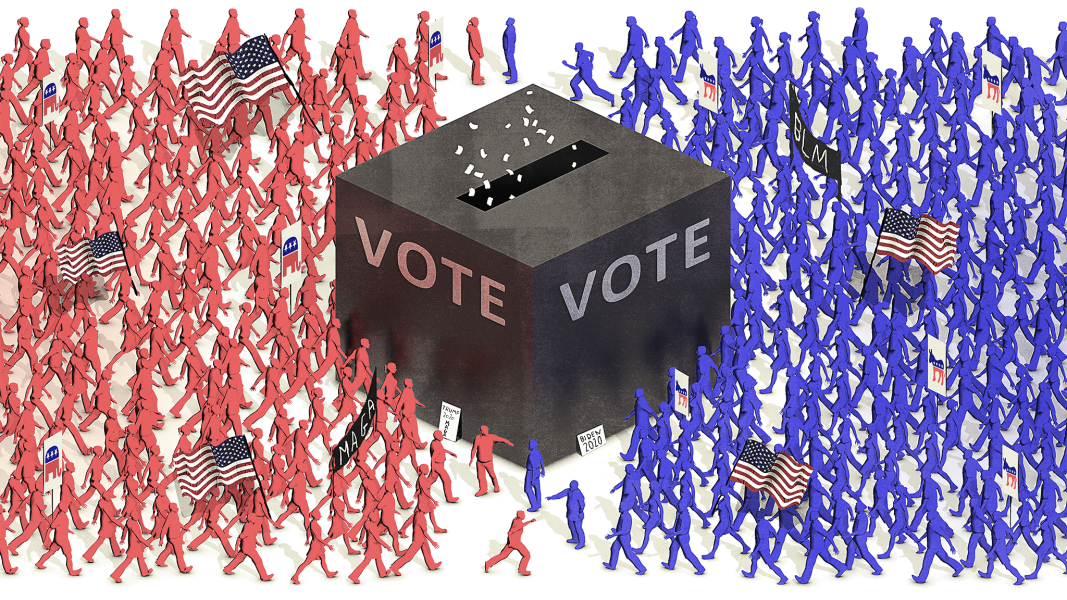
Christopher Hitchens lampoons the shallow discourse of our political campaigns.
It is cliché, not plagiarism, that is the problem with our stilted, room-temperature political discourse. It used to be that thinking people would say, with at least a shred of pride, that their own convictions would not shrink to fit on a label or on a bumper sticker. But now it seems that the more vapid and vacuous the logo, the more charm (or should that be “charisma”?) it exerts. Take “Yes We Can,” for example. It’s the sort of thing parents might chant encouragingly to a child slow on the potty-training uptake. As for “We Are the People We Have Been Waiting For” (in which case, one can only suppose that now that we have arrived, we can all go home), I didn’t think much of it when Rep. Dennis Kucinich used it at an anti-war rally in 2004 (“We Are the People We Are Waiting For” being his version) or when Thomas Friedman came across it at an MIT student event last December. He wrote, by the way, that just hearing it gave him—well, you guess what it gave him. Hope? That’s exactly right.
Pretty soon, we should be able to get electoral politics down to a basic newspeak that contains perhaps 10 keywords: Dream, Fear, Hope, New, People, We, Change, America, Future, Together. Fishing exclusively from this tiny and stagnant pool of stock expressions, it ought to be possible to drive all thinking people away from the arena and leave matters in the gnarled but capable hands of the professional wordsmiths and manipulators. In the new jargon, certain intelligible ideas would become inexpressible. (How could one state, for example, the famous Burkean principle that many sorts of change ought to be regarded with skepticism?) In a rather poor trade-off for this veto on complexity, many views that are expressible (and “We the People Together Dream of and Hope for New Change in America” would be really quite a long sentence in the latest junk language) will, in turn, be entirely and indeed almost beautifully unintelligible.
And it’s not as if anybody is looking for coded language in which to say: “Health care—who needs it?” or “Special interests and lobbyists—give them a break,” let alone “Dr. King’s dream—what a snooze.” It’s more that the prevailing drivel assumes that every adult in the country is a completely illiterate jerk who would rather feel than think and who must furthermore be assumed, for a special season every four years, to imagine that everyone else “in America” or in “this country” is unemployed or starving or sleeping under a bridge.
While Barack Obama is the obvious target of this lament, it’s only because he’s its most adept practitioner in quite some time. Newt Gingrich is his most recent Republican analogue and he didn’t have Obama’s charm and charisma. Gingrich’s “Contract with America” was focus-tested and he was a master of using buzz words; he did, at least, put this all to use in the service of some genuine policy wonkery. His most recent book, Real Change: From the World That Fails to the World That Works, manages to work in several of the keywords into the title.
The bottom line, though, is that it works. Campaigns are about broad visions and politicians who get into the policy muck almost always lose.
via Ericka Anderson