


Here’ the latest from the NYT: South Korean Leader Will Face Impeachment Vote Over Martial Law Declaration.
The National Assembly can impeach the president if more than two-thirds of lawmakers vote for it. Mr. Yoon’s party controls 108 seats in the 300-member legislature, so some members of his party would have to vote for the impeachment motion for it to pass.
If the lawmakers vote to impeach Mr. Yoon, he would be suspended from office. For the president to be removed from office, the Constitutional Court must approve the impeachment in a trial.
So we will wait and see if enough members of the People Power Party have more respect for the Korean constitutional order than Republicans did for the American version.
Matthew Shugart has a great post with a rundown of the constitutional issues: The South Korean autogolpe attempt.
His update includes this from BlueSky from Joel Atkinson, a professor at Hankuk University in Seoul.
Impeachment would require at least 8 members from Pres. Yoon’s own party to vote with the opposition. Then it has to go to the Constitutional Court. But 3 of 9 justices retired, and replacements haven’t been confirmed. The current 6 justices are not enough. A min of 7 are required
[image or embed]— Joel Atkinson (@joelatkinson.bsky.social) December 3, 2024 at 8:39 PM
The BBC has a handy infographic:
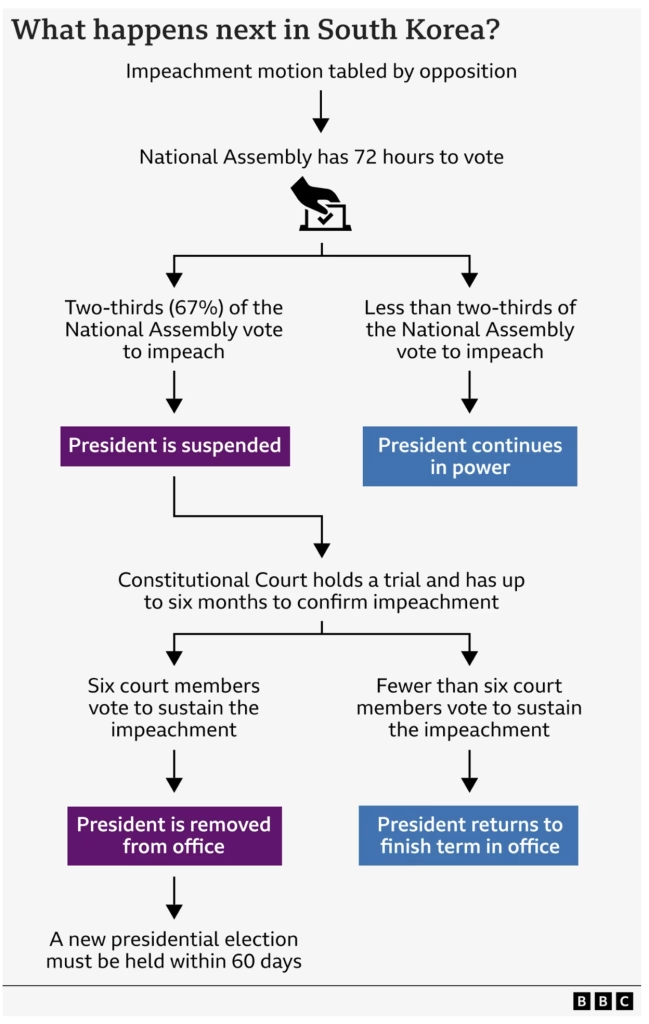
Atkinson’s BlueSky feed is worth reviewing for quite a lot of useful news and information about the autogolpe attempt by Yoon and its fallout.
One interesting observation is that the plan/hope from Yoon and his cabinet was that the military would block the parliament from assembling, thus blocking a vote. The military did not do so, and here we are.
Along those lines (via The Telegraph via Yahoo News), Two hours and 48 minutes of chaos: How martial law rose and fell in South Korea.
Jung Su-yeon crawled on her hands and knees through the frantic legs of South Korea’s security forces to save democracy.
She had rushed through her city of Seoul shortly after the president shocked the world by announcing martial law and sending the army to the gates of parliament to seize power.
Helicopters circled overhead as crowds of police and military stood between Ms Jung and her colleagues making a last stand.
“The MPs and their secretaries all jumped the walls to get inside, but there were still police [there] and a fight broke out,” she told The Telegraph in the early hours of Wednesday morning. “I managed to crawl between the legs of a policeman.”
Once inside, Ms Jung – who works for the opposition Democratic Party’s secretary general Kim Yoon-deok – found herself in a face-off, and she was unsure where the situation would end.
[…]
Other MPs meanwhile scrambled to get to the stone National Assembly building to call a vote to bring the entire debacle to a rapid close.
[…]
Even Mr Yoon’s party were dismayed; his lawmakers said the presidential office had never warned them about a martial law announcement.
Still – as Ms Jung found out – getting inside the National Assembly itself would prove easier said than done, with South Korea’s special forces storming the parliament building and attempting to block the entrance.
Fundamentally, the account in the piece (and others) suggests that, on the one hand, the military tried to follow the orders of the president and the defense minister, but also that they were not willing to use the violence that would have been necessary for the coup to have been successful. This is always a key gamble by those who would attempt to use the military for such ends: will they shoot?
There is also the question of whether the military, once deployed in such a fashion, will listen to other centers of power within the state, such as parliament. It would seem that Korean institutions were strong enough to withstand this anti-democratic onslaught.
The miscalculation by Yoon and his cabinet was enormous and it is a major affirmation of the resiliency of South Korea’s democratic institutions that this attempt was quelled so quickly. It is also a sad reminder of how poorly our system responded to the January 6th insurrection. As a lifelong observer of American and international politics it is an amazing and depressing contrast to see.
To be clear, I am not saying that I think Trump would try something like Yoon’s autogolpe attempt in the same manner. There are numerous reasons that would be unlikely, but this is a reminder that Trump did try to overturn an election and his party lacked the courage to make sure he was banned from national politics.
Also worth a read: South Korea’s Warning for Washington in The Atlantic.










